

Integrals Power’s LMFP cathode material has passed 1,500 charge-discharge cycles in QinetiQ testing, retaining nearly 80% capacity. Cranfield University cold trials showed 85% capacity at -25°C, outperforming current LFP and LMFP benchmarks for automotive and defense applications.
Lithium manganese iron phosphate (LMFP) cathode active materials developed by Milton Keynes-based Integrals Power have surpassed 1,500 charge-discharge cycles in independent testing by QinetiQ, while separate cold-temperature trials at Cranfield University show the chemistry retaining 85% capacity at -25°C.
The cycle life testing, conducted at a 1C rate, found the pouch cell retaining nearly 80% of its original capacity after 1,500 cycles. At the 1,000-cycle mark passed last year, retained capacity was above 80%. QinetiQ’s testing program is ongoing.
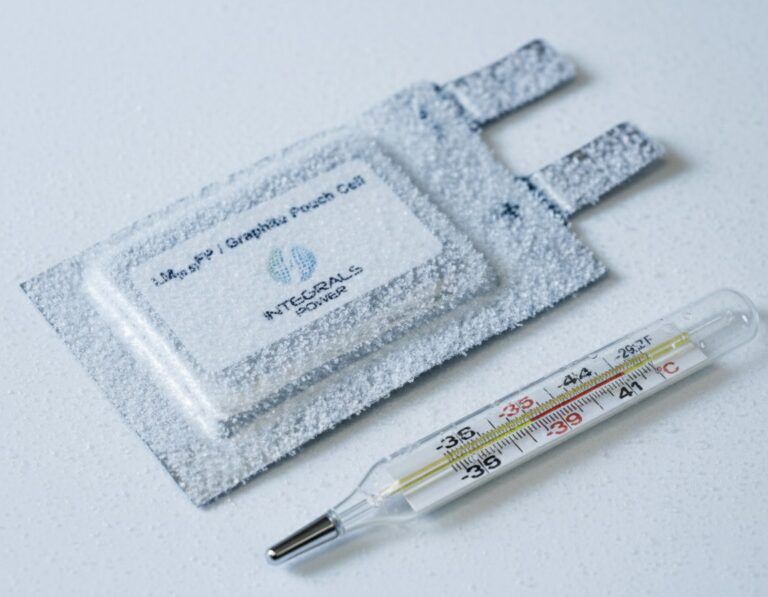
Cold-temperature results from Cranfield University, using pouch cells from the same production batch, showed 85% retained capacity at -25°C and 68% at -30°C. According to Integrals Power, current benchmark lithium iron phosphate (LFP) and LMFP cell chemistries typically deliver only around 50% and 40% respectively at those temperatures.
“Independent, third-party testing by industry experts is a cornerstone of our business, and these latest results from QinetiQ and the University of Cranfield are invaluable in providing trusted and credible data to our customers around the world,” says Behnam Hormozi, founder and chief executive at Integrals Power. “The results prove that batteries made from our LMFP material can last longer, and perform better in sub-zero conditions.”
The LMFP material features an 80% manganese content and was produced at Integrals Power’s UK multi-tonne pilot line facility using raw materials sourced from Europe and North America. The company says this demonstrates the chemistry can help reduce the automotive industry’s reliance on Chinese supply chains, while also supporting sovereign supply requirements for the defense sector.
Integrals Power says its LMFP offers lower cost, higher safety, reduced toxicity, less reliance on critical minerals, and a lower carbon footprint than the nickel manganese cobalt (NMC) chemistries currently favored by global vehicle manufacturers. It also claims higher energy density than LFP, which is taking a growing share of the battery market.
The company holds international patents on LMFP and has patented innovations across more than 20 cathode materials, including LFP.