

Can self-healing batteries really mimic biological repair processes, extend EV lifespan, reduce costs, and transform energy storage from disposable components to regenerative assets?
We have come a long way since the Voltaic pile in 1800, irrespective of the validity or otherwise of the 2,000-year-old Baghdad battery. However, all the innovations and advances since then were refinements of the basic principle. The EV battery has improved with time, but it was far from perpetual or indestructible. The solution lay not in linear thinking or standard physics, but the inspiration of biology. With the benefit of technology and material science the battery can now mimic the body in autonomous self-repair.
Self-healing of batteries resembles the responsive bodily wound healing process whereby repair is affected by organic, even systemic, reaction to external stimuli.
The two forms of self-healing involved are described as intrinsic and extrinsic. Extrinsic typically involves a healing agent released from an embedded reservoir within the material triggered in response to some kind of rupture and then flowing by capillary action to target where needed. The healing agent can be contained in microcapsules or a vascular network, delivered efficiently and effectively to seal and repair by chemical reaction such as polymerization. This can be applied to the restoration of conductivity and repair of damaged electrodes and separators.
Intrinsic self-healing, on the other hand, is particularly suitable for microscopic repair involves materials designed with smart properties like reversable bonds that enable them to fracture and reform structurally with a memory function. These bonds include hydrogen bonds, metal-ligand coordination, and dynamic covalent bonds including the Diels-Ader chemical reaction. Another process is T-T stacking interaction between electron rich and deficient aromatic rings to effect autonomous repair of polymer electrolytes and electrode surrounds.
Evolution
The first self-healing materials included reactive concrete in the nineteenth century, self-repairing ceramics in the 1960s and microcapsule embedded polymers from 2001 as developed in the University of Illinois and then vascular networks of embedded microchannels. The next development was to affect the healing and restore the integrity of a polymer without a catalyst, which was achieved from 2013 (‘Terminator’) at the IK4-Cidetek Research Center in Paseo, Spain. Battery self-healing began in the same year at Stanford University with the development of a commercially viable self-healing electrode by a team under Professor Yi Cui. The team used a stretchy polymer to coat the electrode to bind it together, and spontaneously heal microscopic cracks that develop during battery operation. The team found that silicon electrodes lasted 10 times longer when coated with the self-healing polymer.
“Their capacity for storing energy is in the practical range now,” says Professor Yi Cui, “But we would certainly like to push that.” Some of the chemical bonds within the polymers were deliberately weakened, so their resulting broken ends could be chemically drawn to each other and link up again, in the way that DNA can break down, assemble and rearrange.
Professor Eric Detsi from Penn State University has been studying the self-healing potential of liquid metal batteries and the advantages of electrode transformation between liquid and solid in the recovery from volume change-induced degradation. Although the research was proof of concept rather than anything concrete, it has progressed.
“We have developed two transformative self-healing liquid metal batteries (one is sodium-Iron, and the other is magnesium-sulphur) that cannot yet be disclosed at this stage because we are trying to commercialize them,” says Detsi.
Professor Oren A. Scherman at the University of Cambridge and his team have developed self-healing ‘jelly’ batteries made from hydrogels, which can stretch to over ten times their original length without affecting their conductivity.
“Our research concentrates on non-covalent, reversible self-assembly that allows for the assembly of multiple layers of ionically conductive hydrogels giving rise to output voltages,” says Scherman. “The layers can be readily stretched and deformed without compromising performance.”
Scherman believes there is a lot left to be done in the energy storage and power source space: “Creative and exciting research is clearly important to fund to push next generation batteries forward.”
Approaches
Healing Bat consortium brings together 10 European research centres, universities and companies from six different countries to explore the development of smart and sustainable batteries of the future. The project is pioneering a new generation of lithium-sulphur (Li-S) batteries with integrated self-healing capabilities: “The batteries incorporate healing agents into the electrolyte, cathodes and separator layers,” says Stefan Palzar (TU Dortmund) coordinator and Liqiang LU (HZB) partner. “These agents can repair damage caused by degradation, dendrite formation, and electrolyte breakdown. For instance, an iodine-based additive in electrolyte is employed to suppress lithium dendrite growth, and activate the inactive lithium (e.g. from solid-electrolyte interphase) on the anode side, therefore prolonging the battery life. Healing is triggered either passively or actively, for example by adjusting charging voltages or using temperature-sensitive polymer capsules.”
This approach also includes structural batteries, where the battery itself serves as a load-bearing component. “These use healable polymer networks based on dynamic hydrogen bonding and metalorganic interactions to restore mechanical integrity and electrochemical performance after damage,” says Palzar.
The project includes demonstrators with extended cycling life and embedded sensors for monitoring the state of health. Also, whereas previous efforts focused on qualitative, ex-situ healing, this work introduces quantifiable, in-situ healing protocols. “It integrates sensing, healing, and performance validation into a unified system. The use of smart separators, functional interlayers, and embedded sensors enables real-time monitoring and healing actuation, making it one of the first truly integrated sense-heal battery systems,” says Palza.
Smart sensors
Research continues to enhance polymers and other self-healing battery materials to improve longevity and performance. Other research institutions active in the technology include UC Berkeley, which has developed a stretchable self-healing battery capable of withstanding damage; Clemson; Giorgia Institute; Zhengzhou University, which has investigated self-healing electrodes and liquid metals; plus, Healing Bat; and the EU-funded Phoenix and Salamander Projects.
Battery raw materials are a resource limited by geography, amount and supply. Geopolitics plays no small part either and gigafactories compete for a constant supply from a diminishing mineral storehouse restricted by political and economic self-interest. In addition, the extraction of raw materials produces its own pollution as well as human rights issues. Thus, reducing reliance, whether through recycling or extending the lifetimes of batteries, is desirable and reduces overall costs that would otherwise be passed on to the consumer.
Continued charging and discharging of a battery damages its electrodes and consequently reduces its working life. Anything that can reduce that burden is an advantage to industry and consumer. Whatever damage within a battery can be repaired autonomously equates to longevity, reliability, prolonged energy storage and performance.
This, in turn, means the likelihood of extended warranties for OEMs and consumers who enjoy the additional benefit of lighter and safer batteries and a reduced total cost of ownership over what promises to be an extended lifetime of the whole vehicle.
Integrated electrochemical, mechanical or resistance sensors continuously monitor battery temperature, voltage resistance, stress and chemical reaction. Upon detection of damage to an anode or cathode dissolution the information is communicated to the battery management system, which activates the healing.
Shape memory materials including polymers and alloys can restore structural integrity, close fissures and remove weaknesses with through application of heat or an electrical current. Damage control through this method can address problems such as dendrite growth, electrode cracks, and electrolyte damage.
Market transformation
Various battery manufacturers have been embracing these new materials. For example, StoreDot’s self-healing technology is an advanced system designed to enhance the longevity, safety, and performance of its Extreme Fast Charging (XFC) batteries. It’s a multi-layered approach (a fusion of software, hardware, and unique material science) that goes beyond simply managing the battery to actively reconditioning it.
“At its core, the system’s objective is to proactively identify and repair underperforming or overheating battery cells within a pack, often without the driver even noticing,” explains StoreDot CEO, Doron Myersdorf. This is a significant breakthrough because it addresses the primary cause of battery degradation: the varied performance of individual cells over thousands of charge-discharge cycles.
A crucial part of the self-healing system is the use of proprietary additives within the electrolyte and anode composition. StoreDot has been granted a patent for a self-healing lithium-ion battery that includes a solid electrolyte interphase (SEI) self-healing combination. “The SEI is a protective layer that forms on the anode during the battery’s first charge. Over time and especially with fast charging, this layer can degrade, leading to cell failure. StoreDot’s technology includes an additive that can repair and regenerate this critical layer, thereby preserving the cell’s long-term health and performance.”
The self-healing system is an integral part of the company’s goal to have production-ready, silicon-dominant XFC batteries by 2026.
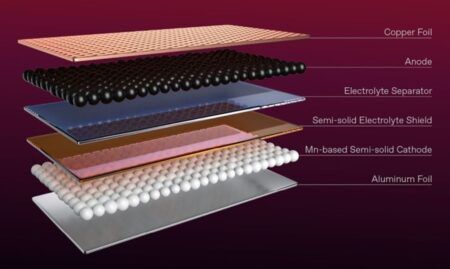
Its long-term roadmap that includes moving toward semi-solid batteries, where self-healing capabilities will be even more critical for managing new chemistries and ensuring long-term reliability.
The self-healing technology is designed to prevent overheating and maintain uniform temperatures, which are critical for safety and prolonging battery life. The technology has been proven to handle frequent XFC without compromising battery health, providing a long lifespan and minimizing degradation. This commitment to longevity is a key selling point for OEMs, who are increasingly focused on battery warranties.
By enabling smaller battery packs, cost reductions for EV manufacturers can be achieved. “A smaller pack, for example, can save a carmaker an estimated $4,500 and reduce the vehicle’s weight,” says Myersdorf. “A 30-kWh reduction in battery size can save approximately 200kg, equivalent to the weight of several passengers.”
Myersdorf believes that the future of self-healing batteries reaches far beyond simply extending the life of a single electric vehicle: “I see it as a fundamental shift in our relationship with energy storage – from a disposable, consumable product to a durable, regenerative asset.” His vision is built on three key pillars: the ‘living’ battery, the interconnected energy ecosystem, and the democratization of sustainable technology.
He sees the self-healing battery evolving into a ‘living’ entity with its own health management system rather than remaining a passive component.
Scaling up
‘Forever batteries’ may not actually be immortal, he says, but he expects them to have a functional lifespan that matches or even exceeds that of the vehicle itself.”
He points out that reducing the cost of the single most expensive component of an EV, self-healing batteries will help manufacturers bring down the overall price of electric cars, making them a viable option for a broader consumer base.
The building of an organic and integrated energy storage system that monitors and maintains itself is ongoing.
The integration of self-healing nanomaterials and processes, such as embedded sensors, microcapsules and channels, into conventional manufacturing techniques and materials may present challenges. Consequently, the advantages must outweigh them sufficiently and influence the practices of competitors enough to potentially give them an advantage, to make adaption worthwhile and even necessary.
There is also a tipping point related to price and advantage. This may just come down to the relationship between the amount of savings by which the lifetime and incident-free running of the battery will be extended against difference in initial price.
Self-healing batteries are currently covered by existing regulations, such as IEC 62133 and IEC 62619. However, specific regulations may come. Specific safety standards as a basis of certification covering failure modes, chemical stability, trigger mechanisms and healing validation, are being explored by BMS projects and initiatives like Battery 2030.
Self-healing batteries can only have a positive effect on charging infrastructure. Charging has far less of a detrimental effect on the battery and so that may open all sorts of opportunities relating to fast charging, V2G and back-up systems in charging stations.
The energy storage market disruption potential is huge, but has its caveats. Distinct advantages relating to performance, safety, sustainability, and lifespan are compelling, but challenges such as manufacturing costs, scalability, regulation, efficiency and holistic balancing will take some work before ubiquity is achieved in the industry.
“Challenges such as scaling up manufacturing, validating healing protocols under real-world conditions, and navigating regulatory pathways can be addressed through iterative testing, industry collaboration, and alignment with broader sustainability goals,” says Palzar. “More generally, the vision is to enable a new class of intelligent, long-lasting, and resource-efficient batteries that support Europe’s leadership in advanced energy technologies and contribute meaningfully to the global transition toward clean mobility and energy systems.”
Salamander Project
Inspired by the regenerative abilities of the titular amphibian, the EU-funded project of that name is intended to develop and integrate embedded sensors and self-healing functionality in Li-ion batteries.
Dr Samson Y. Lai, project coordinator explains, “Salamander project uses a resistance sensor array to measure cracking and damage on the anode. This is planned to indicate when the anode needs self-healing to be triggered. Another sensor will be on the cathode, which detects Mn ion concentration in the electrolyte, representing dissolved Mn from the cathode. Once it reaches a certain threshold concentration, Mn scavengers will be activated to capture the Mn and prevent further damage.
“Salamander sensors are different in that they are designed to be inside the cell when most sensors currently in practice are external to the cell. This means they can more directly measure and observe key parameters that relate to the health condition of the battery, particularly when it needs to be self-healed.
“Salamander is one of a group of EU projects focused on the broader effort of developing smart batteries which can sense and self-heal. There are many routes to smart batteries and many self-healing functionalities which address different degradation mechanisms. The goal of Salamander is to explore these options and develop them so that the field has a variety of tools and strategies to tackle degradation and improve quality, reliability, lifetime, and safety. With a variety of approaches, different self-healing technologies can be implemented according to constraints related to performance, cost, safety, etc.
“The ultimate vision is a smart battery which can sense its own health condition and ideally intelligently apply corrective action to activate or induce self-healing. This is a cutting-edge technology concept and the future in this field still has much to be defined, with provides both challenges and opportunities for research and development.
“The focus of smart battery functionalities is an outcome where batteries can last longer and be more reliable. When this is achieved, it means batteries will be replaced less often and the environmental impact from production and disposal or recycling will be lessened. The development of sensor and self-healing technology can add new features and information to batteries, allowing us to better understand how and when they may need replacing or re-conditioning.”