

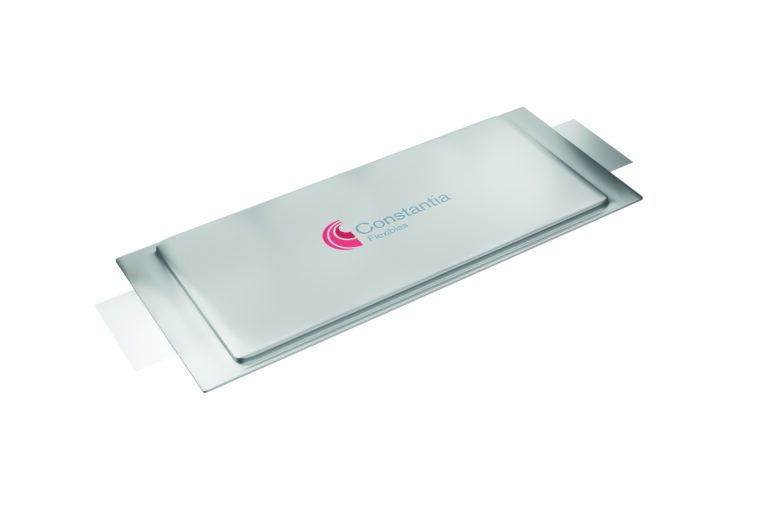
Austrian packaging company Constantia Flexibles has launched energon, a European-made battery foil portfolio. It includes energon P pouch cell laminate, produced at Constantia Patz, and energon C cathode foil up to 1,800mm wide, produced at Constantia Teich. Several European e-mobility manufacturers are early customers following five years of development.
Flexible packaging producer Constantia Flexibles, which is headquartered in Vienna, Austria, has entered the rechargeable battery market with a range of pouch cell laminates and cathode foils for lithium-ion cells. In Europe the products will be sold under the brand energon.
The launch follows five years of development and qualification work. The company started its battery materials program in 2021, reached prototype quality in 2024 and began industrial-scale production in 2025. Constantia Flexibles says it is currently the only supplier outside Asia offering commercially available, qualified and tested pouch cell laminates. The company reports that the laminate’s long-term electrolyte resistance and stability through aging cycles were validated in testing with European research institutions.
The pouch cell laminate, energon P, combines aluminum and polymer layers to protect the cell’s internal chemistry. It is designed to provide the mechanical strength needed for deep drawing while maintaining sealing performance, and it resists moisture and electrolytes. The laminate is intended for automated, high-volume production lines and is made at Constantia Patz in Austria.
The cathode foil, energon C, is designed for coating with cathode active material in series production and is available in widths of up to 1,800mm (71in). It uses aluminum sourced and processed in Europe and is produced at Constantia Teich using electricity from renewable sources. Low Carbon Aluminum sourced in Europe is available as an option. Customers can also specify aluminum certified by the Aluminium Stewardship Initiative (ASI). The portfolio meets the ISO 9001 and IATF 16949 quality management standards.
“Over the years, we have built extensive expertise in battery materials and completed demanding qualification processes with leading automotive customers. This know-how now forms the foundation of a portfolio that meets the highest quality expectations while strengthening Europe’s manufacturing base for battery materials,” says Wolfgang Kitzler, executive vice president of the aluminum division at Constantia Flexibles and managing director of Constantia Teich.
Constantia Flexibles entered the market through automotive applications. Several European e-mobility manufacturers are among its first customers, and the company works with their research and development teams to tailor material performance to specific applications. It also plans to target consumer electronics, aviation, stationary energy storage and renewable energy infrastructure.
According to Pierre-Henri Bruchon, executive vice president of pharma at Constantia Flexibles, the move builds on capabilities the company already has. “The battery market is a natural extension of our expertise in advanced aluminum-based materials. By entering this field, we are expanding into a sector with long-term potential while leveraging capabilities that already exist within Constantia Flexibles. energon represents an important step in broadening our business beyond traditional packaging applications,” he says.
The company’s existing manufacturing infrastructure can produce both battery and packaging materials without additional investment, which allows it to shift capacity as demand changes. Constantia Flexibles also takes part in several European research and funding programs aimed at enabling local battery cell production.