

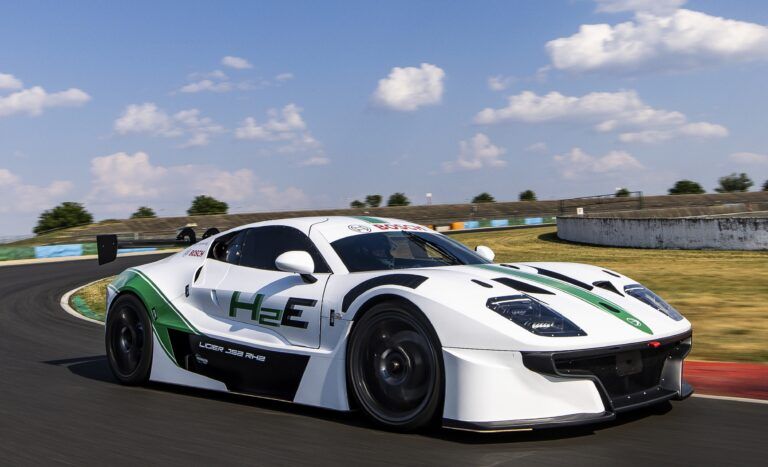
Bosch Engineering and Maserati have presented an optimized hydrogen combustion engine based on the Maserati Nettuno 3.0-liter twin-turbo six-cylinder, producing 480kW and 880Nm using Bosch HIDI LCV direct injectors. The engine powers the Ligier JS2 RH2 demonstrator, which will complete a demo lap at Le Mans on June 13, 2026.
Bosch Engineering GmbH, headquartered in Abstatt, Germany, has presented an updated hydrogen combustion engine based on the Maserati Nettuno gasoline unit ahead of the 24 Hours of Le Mans. The engine produces approximately 480kW and 880Nm of torque in motorsport specification, and will power the Ligier JS2 RH2 demonstrator vehicle during a demo lap on the Le Mans circuit on June 13, 2026.
The hydrogen unit retains the core architecture of the Maserati Nettuno – a 3.0-liter twin-turbocharged six-cylinder with dry sump lubrication – including the cylinder head and turbocharger. Piston geometry has been modified and compression ratio reduced to optimize performance at high engine speeds. The injection system, ignition system, and engine control unit have all been replaced, with the updated specification switching from the original combined direct and port fuel injection arrangement to hydrogen direct injection using Bosch’s high-injection direct injection low calorific value (HIDI LCV) injectors. Bosch says this change improves combustion stability, torque, and power output while reducing emissions.
“Nettuno is a state-of-the-art engine that continues to demonstrate robustness, efficiency, and versatility,” says Davide Danesin, head of Maserati Engineering. “For this reason, it has proven to be particularly well-suited for conversion to hydrogen, thanks to its inherent strength, which allows it to withstand very high cylinder pressures.”
Bosch Engineering entered into a strategic partnership with Ligier Automotive in 2021 to develop the Ligier JS2 RH2 prototype. The vehicle was first shown at Le Mans in June 2023 and has since accumulated nearly 8,000 kilometers of track testing across varying weather conditions without reported technical failures. Successive development phases have increased torque and power outputs while further reducing emissions.
“To make a vision like the hydrogen race car a reality, you need a strong team,” says Ingo Mauel, head of Bosch Motorsport. “Our strategic partnership with Ligier Automotive is the foundation on which we are developing and testing the vehicle. At the same time, our collaboration with Maserati provided a first-class basis for the engine. This pooling of expertise is our key to bringing sustainable performance to the road faster.”
Jacques Nicolet, president of Ligier Automotive, draws a historical parallel with the project. “The original Ligier JS2, powered by a V6 3.0-liter Maserati engine, claimed victory at the Tour Auto in 1974. Today, this legacy inspires us to look ahead,” he says. “Together, we are not only developing a race car demonstrator, but also opening the door to future applications, such as a decarbonized track-day car integrating Maserati engine technology and Bosch hydrogen systems.”
The Ligier JS2 RH2 will be on display in the H2 Village at Le Mans throughout race week and will complete its demonstration lap on Saturday, June 13.