


Despite the dip, the EV rollout is still accelerating, but the skilled workforce needed to support it is falling behind. With technician shortages deepening and training investment stalling, industry-education partnerships are emerging as a critical route to closing the gap before targets slip out of reach.
The UK’s EV sector continues to expand at pace, but the workforce it needs to sustain that expansion is struggling to keep up. As infrastructure targets loom and the 2030 ICE ban deadline approaches, the industry is confronting a skills crisis that no amount of ambition alone can solve.
The numbers are striking, and not in a reassuring way. By the end of 2025, there were over 1.8m fully electric cars on UK roads, with battery electric vehicles (BEVs) accounting for almost one in four new cars sold. The government has set a target of 300,000 public charge points by 2030. And yet, according to the Institute of the Motor Industry (IMI), only 24% of the UK’s automotive technician workforce is certified to work on EVs. The pace of EV adoption and the pace of skills development are not moving in the same direction.
This is not a problem unique to the EV sector. The UK’s 2024 Employer Skills Survey, published by the Department for Education and Skills England, found that 210,000 vacancies across the economy were classified as skill-shortage vacancies: 27% of all open roles. That figure is 5% higher than in 2017, meaning the structural problem has deepened even as the acute distortions of the pandemic period have faded. Skills shortages are estimated to cost the UK economy around £39bn annually, with projections suggesting that figure could reach £120bn by 2030 if left unaddressed.
Against that backdrop, the EV sector’s own shortfall stands out for its acuity. The IMI projects a shortfall of 3,000 EV technicians by 2031, rising to 16,000 by 2035. More troublingly, the number of technicians gaining EV qualifications fell by 13% between the first and third quarters of 2025 alone. Training investment is moving in the wrong direction at exactly the moment it needs to accelerate.

Plugging the hole
Nowhere is the mismatch more pressing than in the deployment of charging infrastructure. Installing and maintaining EV charge points requires qualified electricians with specialist knowledge, and those electricians are in critically short supply. According to Adam Hall, Director of Energy Services at Drax Electric Vehicles, two thirds of employers report difficulties finding qualified electricians who can install EV charge points. “Skills development is not keeping pace with infrastructure growth,” he says, “which makes partnerships like ours essential.”
The partnerships he’s referring to are part of Drax EV’s link to Kirklees College in Huddersfield, under which students gain hands-on access to live EV charging equipment. The partnership grew from what Hall describes as a shared ambition, both to develop the next generation of engineering talent and to accelerate the UK’s transition to low-carbon transport. “By working with progressive education providers, we can bridge the gap between classroom learning and the real-world technology driving the energy transition,” he says.
The value of that hands-on exposure is hard to replicate in a traditional classroom. “Working directly with real systems helps students understand how technology behaves in real-world conditions,” Hall explains, “strengthens their readiness for employers and encourages the curiosity and innovation that sit at the heart of clean technology.”
Steve Plumstead, Curriculum Director at Kirklees College, is very clear about what the arrangement means in practice: students learning through hands-on experience with real, live EV systems. “Skills development is not keeping pace with infrastructure growth, which makes partnerships like this essential.”
Reskilling the workforce
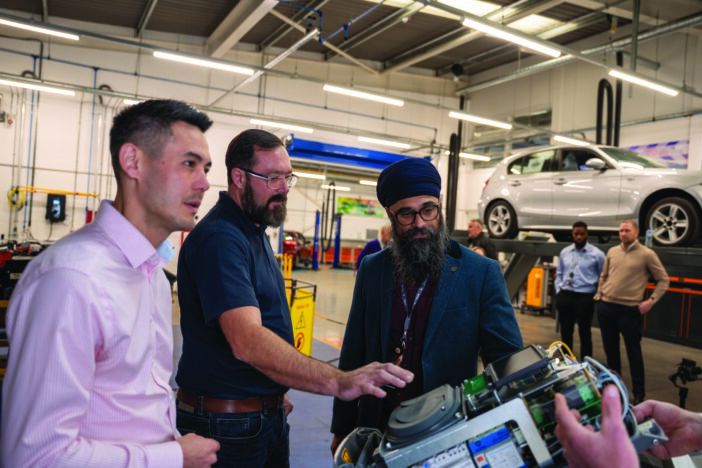
The challenge extends well beyond electricians. The MIRA Technology Institute (MTI), based in Nuneaton and embedded within the HORIBA MIRA automotive R&D campus, trains across the full spectrum of EV-related disciplines: battery systems, power electronics, EV-specific manufacturing processes, charging infrastructure, high-voltage safety, and increasingly, autonomy, cyber security, and hydrogen technologies. Lisa Bingley, MTI’s Operations Director, describes the institute’s purpose as bridging the gap “between where the workforce is today and where the industry needs to be as the transition to electrification accelerates.”
MTI’s learner base reflects the multi-dimensional nature of the skills challenge. A significant proportion are reskillers: experienced automotive technicians trained on internal combustion engines who need to update their knowledge for an electrified world. Alongside them are new entrants – school leavers, apprentices and career-changers – ranging in age from 16 to mature adults. “This diversity is one of MTI’s strengths,” says Bingley. “It creates a workplace-style learning environment where people with different experiences learn from each other.”
The institute works closely with major OEMs including Jaguar Land Rover and Bentley, whose involvement shapes the curriculum and keeps it aligned with evolving industry expectations. Bingley is clear about why this matters: “Industry knows it can’t secure its future workforce unless it actively shapes training.” The model has been recognised with a Queen Elizabeth Prize for Education, awarded to MTI’s college partner, North Warwickshire and South Leicestershire College, for the work delivered at the institute.
Both Drax EV and MTI are operating in a talent market under pressure from multiple directions simultaneously. The EV sector is not simply competing with traditional automotive for recruits; it is competing with aerospace, energy, advanced manufacturing and digital technology. All of which are drawing on the same pool of technically skilled graduates and mid-career professionals.
Green jobs more broadly are now commanding a significant wage premium. ONS data shows that green job listings averaged £45,980 in 2024 — around £8,000 above the UK’s median salary. In the renewable energy sector specifically, UK professionals saw an average 13.2% salary increase in 2025, with mean compensation reaching £82,808. These are the salaries that EV-focused employers and training institutions must compete with when attracting both learners and the specialist instructors needed to teach them.
Recruiting qualified technicians to teach is, in any technical discipline, difficult. In EV, it is harder still. “People with advanced EV expertise are in high demand, and industry salaries can be very competitive,” acknowledges Bingley. MTI’s response is to prioritise candidates with both technical ability and a passion for teaching, and to support them with continuing professional development. It also draws on the Taking Teaching Further Fund, which covers training costs and provides top-up incentive payments for new instructors.
Employers’ complaints about graduate readiness are well-documented in the broader skills debate, and the EV sector is no exception. Traditional electrical engineering courses, says Hall, “don’t always cover these emerging technologies in enough depth.” As the sector shifts from early adoption to large-scale rollout, the skills required are shifting with it: professionals who understand the integration of renewable energy and EV charging, who can work safely at high voltage, and who are comfortable with the software and diagnostics now integral to modern EV systems.
MTI’s approach to this extends beyond purely technical training. “Alongside technical ability, employers are increasingly looking for strong soft skills: problem-solving, communication, teamwork and the ability to adapt quickly as technology evolves,” says Bingley. Leadership and project-management capabilities are growing in value as EV roles become more multidisciplinary. The era of the lone technician with a single specialism is, in this sector at least, already passing.
Policy must follow
Individual partnerships, however effective, are not sufficient on their own. The scale of the challenge requires a systemic response from top to bottom. The government has made moves in this direction. Skills England, launched in 2024, has identified green transition skills as a national priority. The Clean Energy Jobs Plan forecasts over 400,000 additional clean energy jobs by 2030. But ambition needs to be matched with sustained investment. “With 65% of employers struggling to find qualified EV electricians. And with a national target of 300,000 public charge points by 2030, there is a clear need for further investment in skills and training,” says Hall.
Bingley echoes the need for policy stability. “Government funding has helped support skills bootcamps and infrastructure investments, but the industry needs longer-term stability and clearer policy direction to plan effectively.” The stops and starts that have characterised EV policy – the reversal and reinstatement of the 2030 ICE ban deadline, extended periods of regulatory uncertainty – have dampened training investment at precisely the moment when momentum was most needed.
What both voices share is a conviction that the solution lies in closer, more systematic collaboration between industry and education. “Partnerships like this are one of the most meaningful ways to support the long-term development of the EV sector,” says Hall. “By helping students build relevant skills, you are contributing directly to the future of the industry.” Bingley frames it institutionally: MTI’s strength is its capacity to adapt quickly, by refreshing modules and updating equipment as technology changes in ways that traditional educational models struggle to match.
The UK’s EV transition will not be determined solely by battery chemistry, charging speeds, or government targets. It will be determined, in no small part, by whether the country can produce – in time and in sufficient numbers – the people qualified to build it, maintain it and keep it running. That is a training problem as much as a technology problem. And on current trajectories, it remains unsolved.

Industry training initiatives in action
The response to the EV skills shortage is taking shape across multiple fronts, from manufacturer-led bootcamps to reformed apprenticeships and targeted government funding. The question is whether the scale of these initiatives matches the scale of the problem. Four areas are key here:
1) Manufacturer-led training
Several major OEMs have moved beyond curriculum consultation to direct training provision. Nissan, for example, offers a free two-week Skills Bootcamp in Electric Vehicle Component Manufacturing, a short, intensive pathway designed to give existing technicians the foundational EV knowledge needed to retrain quickly. Across the industry, companies including Jaguar Land Rover and Bentley are actively shaping college and institute curricula to ensure graduates arrive work-ready, rather than requiring extensive on-the-job remediation.
2) Logistics and commercial vehicles
The skills gap extends into the commercial vehicle sector, where the transition to electric HGVs is accelerating. Logistics UK has partnered with Stephenson, Brooksby and Melton College and Bristol College to deliver electric truck maintenance training programmes, helping fleet mechanics qualify to work on battery-electric lorries. The organisation has called on the government to prioritise apprenticeships over university degrees as the primary route into technical transport roles.
3) Apprenticeship reform
The Autumn 2024 Budget committed £40m to support shorter-duration and foundation apprenticeships: eight-month programmes aimed at young people and those who have previously been unable to complete a full apprenticeship. From August 2025, the minimum apprenticeship duration was reduced from twelve to eight months, creating faster pathways into technical roles. The government has also signalled plans to replace the Apprenticeship Levy with a broader Growth and Skills Levy, intended to give employers more flexibility in how they fund workforce development.
4) Untapped workforce
Government analysis suggests that around 13,700 people currently out of work already meet all the skills requirements for at least one priority clean energy occupation, with over 100,000 meeting most requirements. Bringing inactive workers back into technical roles – through targeted support, retraining grants and employer incentives – represents one of the fastest available routes to closing the gap, without waiting for the education system to expand its output.