

Johnson Matthey has opened its first hydrogen internal combustion engine testing facility in Gothenburg, Sweden, representing a £2.5 million investment. The center tests emission control systems for engines up to 600 kilowatts, supporting decarbonization efforts in medium and heavy-duty transport.
Johnson Matthey has opened its first dedicated hydrogen internal combustion engine testing facility in Gothenburg, Sweden, marking a £2.5 million investment in emission control technology development.
The new center of excellence expands the company’s heavy-duty vehicle testing capabilities, focusing on hydrogen internal combustion engine technology that uses zero-carbon hydrogen fuel in established engine designs. This approach offers a potential decarbonization pathway for medium and heavy-duty transport sectors, including trucks and buses.
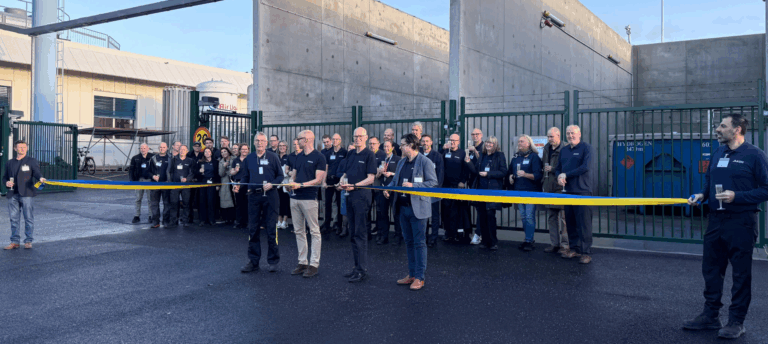
The facility, which was completed on time and on budget over a three-year period, was officially opened by Damien Sotty, research and development director at Johnson Matthey, alongside Daniel Sandqvist, Gothenburg test center manager, and Jonas Edvardsson, managing director of Johnson Matthey Gothenburg.
“This investment shows JM is backing H₂ICE as a ready-to-go technology that will enable mobility partners to meet their decarbonization and climate goals,” said Tauseef Salma, chief technology officer in clean air at Johnson Matthey. “Our state-of-the-art Gothenburg facility positions JM as a world leader in sustainable technology solutions, transforming energy and reducing carbon emissions.”
The installation supports engines up to 600 kilowatts and enables full-engine testing for the first time at Johnson Matthey. The facility tests catalyst performance within engine after-treatment and control systems, providing data for hydrogen mobility solution development. Infrastructure includes on-site hydrogen supply and storage with compression capabilities up to 413 bar, along with flow meters, analyzers, exhaust measuring instruments, and comprehensive safety systems.
The investment follows Johnson Matthey’s participation in Project Brunel, a collaboration with Cummins, PHINIA, and Zircotec that ran from November 2021 to March 2025. The partnership developed a 6.7-liter hydrogen engine for medium-duty vehicles, delivering improvements in performance and durability.
Salma emphasized the company’s ongoing commitment: “For more than two centuries, JM has helped tackle some of the world’s biggest challenges. The opening of this new testing facility shows our commitment to strategic partnerships to drive innovation, strengthening the potential of H₂ICE as a net zero pathway for commercial vehicles.”
Johnson Matthey serves as a founding member of the Global Hydrogen Mobility Alliance, a coalition of over 30 companies advocating for hydrogen mobility integration in European transport decarbonization strategies.