

Renault has announced its futuREady strategy, including a new 800V RGEV medium 2.0 electric platform offering up to 750km range or 1,400km with a range extender. The automaker plans 26 new models by 2030, targeting 100% electrified sales in Europe and over two million vehicles sold worldwide.
Renault has unveiled a new electric vehicle platform capable of up to 750km of WLTP range in pure-electric form and 1,400km with a range extender, as part of a plan to launch 26 new products by 2030.
The Paris-based automaker revealed its futuREady strategy on March 10, confirming it will target 100% electrified sales in Europe and 50% electrified sales internationally by the end of the decade. The brand is aiming to sell more than two million vehicles worldwide by 2030, with half of those sales generated outside Europe.
“We are now accelerating the next cycle of growth for the Renault brand thanks to three powerful drivers,” says Fabrice Cambolive, chief executive officer of the Renault brand and chief growth officer at Renault Group. “Our ambition is clear: strengthen our European leadership, accelerate electrification, and go faster internationally to confirm Renault as the number one French automotive brand worldwide.”
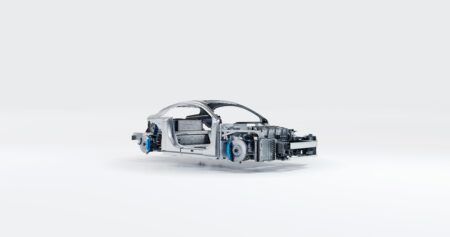
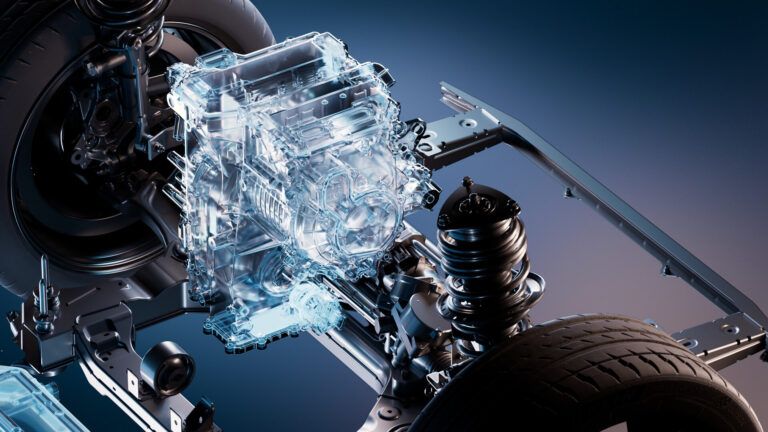
At the heart of the electrification push is the new RGEV medium 2.0 platform, designed for vehicles spanning the B+ to D segments. The architecture features 800V capability for ultra-fast charging and will be offered in three configurations: a pure-electric version with up to 750km WLTP range, a 4×4 electric variant with a towing capacity of up to two tonnes, and an electric version with a range extender delivering a combined 1,400km.
Renault has also confirmed that its full hybrid E-Tech powertrain will continue in Europe and international markets beyond 2030, positioning the technology as an ongoing bridge to full electrification.
In commercial vehicles, the Trafic van E-Tech electric will become Renault’s first software-defined vehicle (SDV), featuring 800V technology and a range of up to 450km.
The automaker also presented the R-Space Lab concept, a 4.5m-long, 1.5m-tall one-box vehicle exploring modular cabin design. Features include a full-width curved openR panorama screen, steer-by-wire, seat-integrated airbags on the passenger side, and rear doors that open to 90 degrees. The concept also incorporates a tactile alcohol detector and in-car artificial intelligence for driver coaching. Renault says the R-Space Lab is not a direct precursor to a production model but illustrates the brand’s direction for interior design.
Internationally, Renault sold 620,000 vehicles outside Europe in 2025, up 11% on the previous year. The brand plans to launch 14 new international models by 2030, built from hubs in Morocco, Turkiye, Latin America, South Korea and India.
“Renault now relies on robust hubs in Morocco, Türkiye, Latin America, South Korea and India, where we already have strong industrial and commercial presence,” says Cambolive. “With futuREady, our ambition is clear: to strengthen our positions in our key markets with products that are fully adapted to each region, electrified and true to Renault’s DNA.”
The company will use the Geely Electric Architecture (GEA) multi-energy platform to expand its zero- and low-emission range through plants in Brazil and South Korea.
India is central to the plan. Renault says four new models, including all-electric and full hybrid variants, will be designed and assembled in the country by 2030. The Bridger Concept show car, a sub-four-meter B-segment SUV with 200mm ground clearance and 400 liters of boot space, previews the first of these vehicles. Built on the Renault Group Modular Platform small (RGMP small), it will be available in combustion, hybrid or electric versions and is expected to launch in India before the end of 2027 before rolling out to other markets.
In Europe, Renault plans 12 new models by 2030, building on recent launches including the Clio, Renault 5 E-Tech electric, Renault 4 E-Tech electric and Twingo E-Tech electric, while preparing a wave of C- and D-segment electric and hybrid vehicles.