


UK-based Skyfly Technologies has raised $10 million in seed funding led by HICO Investment Group, with Archangel participating. The money will fund FAA certification of the two-seat Axe eVTOL under MOSAIC light-sport rules, UK and US production, and hybrid propulsion for the unmanned Longbow. First deliveries are planned for 2027.
Skyfly Technologies, a developer of electric and hybrid-electric aircraft based in Thorpe Mandeville, UK, has closed a US$10m seed funding round to take its two-seat Axe from flying prototype to production aircraft. HICO Investment Group led the round, and defense technology fund Archangel also took part.
The funding will be used to complete the Axe’s certification under the US Federal Aviation Administration’s (FAA) Modernization of Special Airworthiness Certification (MOSAIC) rules, which came into force in July 2026. It will also expand the team and production capacity in the UK and US, and speed up development of the hybrid propulsion system for Longbow, an unmanned, longer-range variant of the Axe aimed at defense and government customers. First customer deliveries are planned for 2027.
The MOSAIC reforms rewrote the FAA’s light-sport aircraft (LSA) rules to admit electric propulsion, multi-motor designs and vertical takeoff aircraft. Under the updated rules, the Axe qualifies as a two-seat, light-sport electric vertically capable aircraft (eVCA). This is a category of electric vertical takeoff and landing (eVTOL) aircraft intended for private ownership, with simplified pilot qualification requirements.
According to Michael Thompson, chief executive at Skyfly, the timing of the raise was linked to the rule change. “This investment gives us the resources to take the Axe from a flying prototype to a certified aircraft in customers’ hands. The FAA’s MOSAIC rules have opened a route to market that simply did not exist for electric aircraft before, and the Axe was designed for exactly this category,” he says.
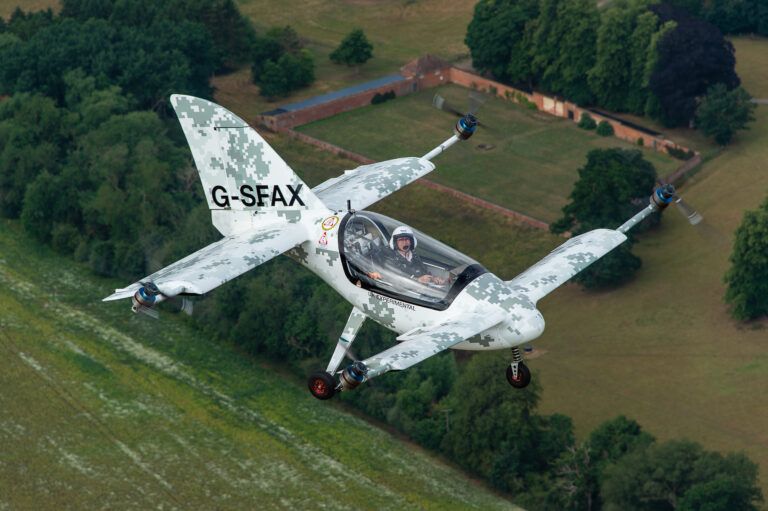
The Axe hovers on eight fixed-angle electric motors and uses its wings for lift in forward flight. It can also take off and land conventionally when a runway is available. It has no tilting motors or rotating wings, and it can glide if power is lost. Skyfly says rotor-only personal eVTOL designs can use up to four times more energy in cruise because they generate no aerodynamic lift.
The aircraft has a range of more than 100 miles (161km), a flight time of 60 to 90 minutes, a cruise speed of 100mph (161km/h) and a payload of 200kg (441 lb). Its airframe uses composite structures to reduce weight, and it is designed to accept new battery and motor technology as it becomes available. Skyfly projects running costs of around $90 (£70) per flight hour. It compares this with around $400 (£300) for the Robinson R22 and Cessna 152, two-seat trainers designed in the 1970s.
The prototype has made more than 100 piloted flights, including what the company says was Europe’s first airfield-to-airfield eVTOL flight. It holds experimental flight permits in the UK and the US, where a Skyfly flight test team has been operating since 2025. The order book stands at 61 private customers.
The Longbow is a hybrid-electric unmanned aircraft with a range of more than 400 miles (644km) and a 200kg payload. It is designed for cargo resupply; intelligence, surveillance, target acquisition and reconnaissance (ISTAR); medevac; and ship-to-shore logistics. Skyfly has been enrolled in the UK Ministry of Defence (MoD) heavy lift challenge. Both aircraft will be built at the company’s 10,000ft² manufacturing and assembly facility in the UK.
“It also accelerates development and demonstration of the hybrid propulsion technology underpinning our defence products, at a moment when uncrewed aircraft have become central to how nations think about security,” Thompson adds.
“Longbow addresses a clear requirement for unmanned systems that can move meaningful payloads over significant distances without relying on a runway. Archangel invests exclusively in defence-first companies, and our backing of Skyfly reflects the potential we see in its technology to deliver mission necessary capability for the modern battlespace,” says Nicholas Nelson, general partner at Archangel Ventures.
Chris Hartnoll, managing director at HICO Investment Group, points to the drivetrain. “Electrification is revolutionising every industry that moves things, and aviation is next. A simpler electric drivetrain, with fewer moving parts and requiring a fraction of the maintenance, makes aircraft like the Axe practical for private owners for the first time and will enable the Longbow to transform logistics across domains,” he says.