

Belgian start-up SOLiTHOR reports its solid-state lithium battery has reached 465 Wh/kg and 1,400 Wh/L without liquid electrolyte. Its sol-gel chemistry skips electrolyte filling, cuts formation and aging by two-thirds, and passed nail-penetration and overcharge safety tests. The update was presented at Battery Show Europe in Stuttgart.
SOLiTHOR has reported that its solid-state lithium battery technology has reached an energy density of up to 465 Wh/kg and 1,400 Wh/L at stack level in a pouch design, without requiring any liquid electrolyte.
The Sint-Truiden, Belgium-based deep-tech chemistry start-up is presenting the technical update at Battery Show Europe in Stuttgart, where co-founder and chief technology officer Dr. Fanny Bardé has been detailing the results. The figures follow the first-time impregnation of the company’s proprietary Solid Composite Electrolyte with a high-loading cathode that has an areal capacity of 8 mAh/cm².
SOLiTHOR’s sol-gel chemistry is offered as an alternative manufacturing pathway to competing polymer, inorganic, and semi-solid technologies. Because the process does not require a liquid electrolyte-filling step, the company says it is roll-to-roll compatible and shortens formation and aging by two-thirds. Together, these steps can account for up to 25% of current processing costs. SOLiTHOR says existing lithium-ion facilities can be upgraded for solid-state production with no new equipment and limited switching costs.
In multilayer pouch cells at 25°C, the technology has demonstrated continuous discharge rates of up to 5C with minimal capacity loss, and pulse discharge rates of up to 10C for 30 seconds at 50% state of charge. The company says this high-power capability suits applications requiring sudden bursts of power, such as drones during takeoff and landing.
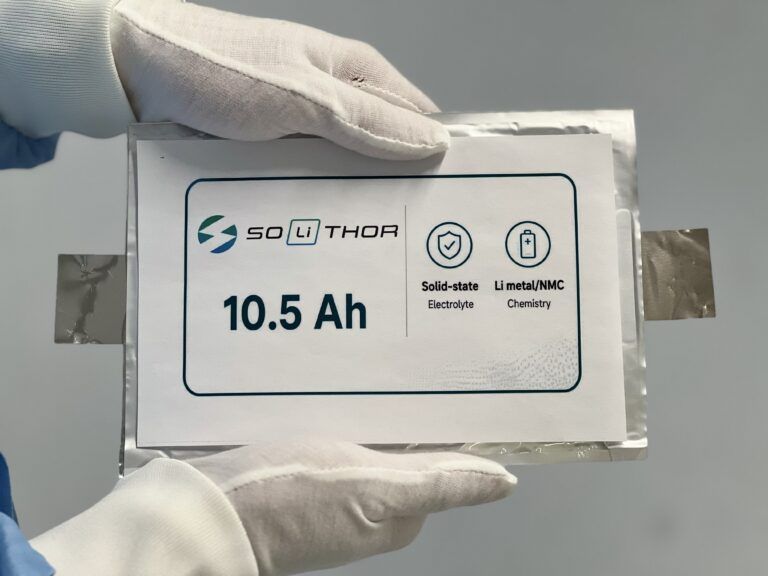
On durability, the technology has demonstrated more than 500 discharge cycles on a 1 Ah multilayer pouch cell while retaining more than 80% of initial capacity. SOLiTHOR has also manufactured its first 10 Ah demonstration cell, which it says shows the technology’s scalability for a broader range of applications.
In safety testing, the technology passed overcharge and nail penetration tests on a fully charged multilayer pouch cell with no smoke, leakage, thermal runaway, or fire.
“SOLiTHOR has developed a chemistry that allows the industry to rethink the manufacturing of solid-state battery cells,” says Bardé. “These technical achievements not only prove that the chemistry works, but that it delivers the combination of energy density, power performance, and cycle life required for practical applications. The achievements also highlight our ability to accelerate development, with faster iterations and more effective impact on performance.”
The company says its Solid Composite Electrolyte can be produced entirely with materials widely available at scale in Europe and is compatible with the European industrial base. SOLiTHOR expects to benefit from emerging European legislation such as the European Industrial Accelerator Act.
“With this major technical update, we are demonstrating that our technology can be realistically produced, satisfying the demands of high-performance and high-value applications within aerospace, dual-use, and mobility,” says Rodrigo P. Navarro, chief executive at SOLiTHOR. “We believe our technology will offer a compelling opportunity for the industry that addresses both technical performance and manufacturing economics, while contributing to the strategic autonomy of Europe.”
SOLiTHOR is expanding its partnerships to validate the technology and was recently granted its first defense funding as part of the DEEP-TECH project, supported by the European Defence Fund to advance Europe’s deep-sea autonomy.