

YASA has secured UK government funding through the DRIVE35 competition for Project Resilience, developing rare-earth-free and heavy-rare-earth-free axial flux motor technologies for future electric and hybrid vehicles. The Oxford-based motor manufacturer will pursue two technology pathways to reduce automotive industry reliance on volatile rare-earth magnet supply chains.
YASA, an axial flux electric motor manufacturer based in Oxford, UK, has secured UK government grant funding to develop rare-earth-free and heavy-rare-earth-free axial flux motor technologies for future electric and hybrid vehicles.
The programme, named Project Resilience, aims to reduce the automotive industry’s exposure to rare-earth magnet supply chains, which the company says are geographically concentrated and vulnerable to geopolitical uncertainty, export restrictions and price volatility. Heavy rare earths, commonly used to help permanent magnets withstand high temperatures in powerful motors, are described by YASA as difficult and carbon-intensive to extract and process.
The funding was awarded through the DRIVE35 Demonstrate competition, delivered by the Department for Business, Innovation, Science and Trade in partnership with the Advanced Propulsion Centre (APC) UK and Innovate UK. DRIVE35 forms part of the UK government’s Advanced Manufacturing Sector Plan, which includes £4 billion ($5.1 billion) in grant funding available to 2035 for automotive research and development, scale-up and transformation.
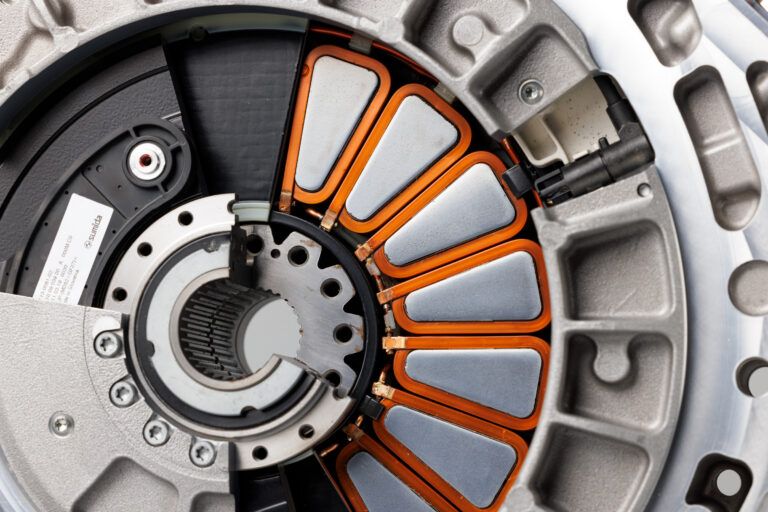
Project Resilience will pursue two technology pathways built around YASA’s existing stator technology. For high-performance battery-electric and hybrid vehicles, the company will investigate heavy-rare-earth-free permanent-magnet motor designs intended to maintain power density without increasing motor mass or package size. In parallel, YASA will develop fully rare-earth-free axial flux technology for applications with different performance, cost and manufacturing requirements. The approach is designed to create a modular motor architecture in which different rotor technologies can be selected according to a vehicle programme’s requirements, while sharing engineering and manufacturing knowledge across both routes.
The work will be carried out at YASA’s engineering and development facilities in the UK.
“Rare-earth materials have played an important role in the development of powerful and compact electric motors, but the automotive industry must now prepare for a future in which availability, environmental impact and security of supply are increasingly important considerations,” said Tom Hillman, head of motor simulation at YASA. “Project Resilience is about creating credible alternatives without losing sight of what vehicle manufacturers need from an electric motor.”
According to Ian Constance, chief executive at the Advanced Propulsion Centre UK, the projects funded through DRIVE35 reflect the breadth of engineering capability in the UK automotive sector. “Through DRIVE35, we are supporting businesses to move promising technologies to commercial deployment and manufacturing at scale,” he said.
YASA, a subsidiary of Mercedes-Benz Group since 2021, employs more than 300 people across sites in Oxford, Bicester and Welshpool, UK.