

Volvo Cars marked 50 years since unveiling its Elbil electric prototype in 1976. The Elbil used twelve 6-volt lead-acid batteries, offered 31 miles of range and took ten hours to charge. Volvo’s EX60 P12 AWD offers a 503-mile WLTP range and adds 211 miles in ten minutes at 400kW.
Volvo Cars has marked 50 years since it unveiled the Elbil, an EV prototype first shown in November 1976, by setting its specifications against those of its latest battery-electric model, the EX60.
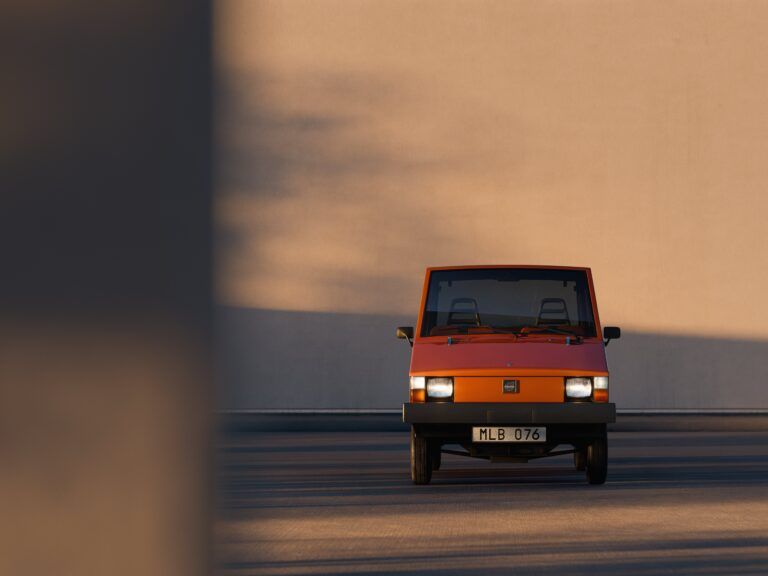
The orange four-seat Elbil was powered by twelve 6-volt lead-acid batteries, which needed ten hours to charge and gave a range of 31 miles. By comparison, the EX60 P12 all-wheel drive (AWD) has a range of 503 miles under the Worldwide Harmonized Light Vehicle Test Procedure (WLTP). Its lithium-ion battery can add up to 211 miles of range in ten minutes on a 400kW direct current (DC) charger.
According to Nicole Melillo Shaw, managing director at Volvo Car UK, “The Elbil was a bold example of Volvo’s forward-thinking approach to electrification, demonstrating our ambition to explore new technologies long before electric vehicles became mainstream. Fifty years on, the EX60 shows just how far we’ve come, combining exceptional electric range, rapid charging and pioneering safety innovations.”

To save space, the Elbil’s 9.5kW motor was integrated with the rear axle. It was paired with a specially developed step-less transmission, giving a top speed of 43mph. Weight was kept down by using glass-fiber-reinforced plastic for the hood and tailgate and aluminum for the doors and roof panels, for a curb weight of 1,200kg.
Only two Elbil prototypes were built. The second was a yellow two-seat delivery vehicle with a sliding door. Part-funded by the Swedish state, it was developed for employees of Televerket, Sweden’s former state-owned telecommunications authority, to make short, zero-emission deliveries around Gothenburg.
The EX60 is the first vehicle built on Volvo’s SPA3 modular EV architecture. It uses cell-to-body construction and mega-casting to reduce weight. Volvo’s in-house-developed e-motors power three powertrain options: the P6 with 374hp, the P10 with 510hp and the P12 with 680hp.
On safety, each Elbil seat had a three-point seatbelt, which Volvo first fitted as standard in 1959. The car’s orange paint was chosen to make it more visible. The EX60 has a multi-adaptive seatbelt for front occupants, which Volvo describes as a world first and which was named one of TIME’s Best Inventions of 2025. The belt works alongside the car’s restraint systems and a safety cage reinforced with boron steel. The EX60 also gets Volvo’s Connected Safety features through an over-the-air (OTA) update. These use shared vehicle data to give real-time alerts about road work, accidents and vulnerable road users.
“While the technology has evolved significantly, what we stand for remains unchanged – to develop cars that make life easier, safer and better for people. The EX60 is a testament to that commitment and an exciting example of what the future holds for Volvo Cars,” adds Melillo Shaw.