

AutoFlight has developed floating solar-powered vertiports that enable electric vertical take-off and landing aircraft to operate from rivers, lakes, and coastal waters, addressing infrastructure deployment challenges in urban air mobility.
AutoFlight Aviation Technology has introduced what it describes as the world’s first integrated water-based infrastructure system for electric vertical take-off and landing aircraft, addressing deployment bottlenecks that have slowed the expansion of urban air mobility networks.
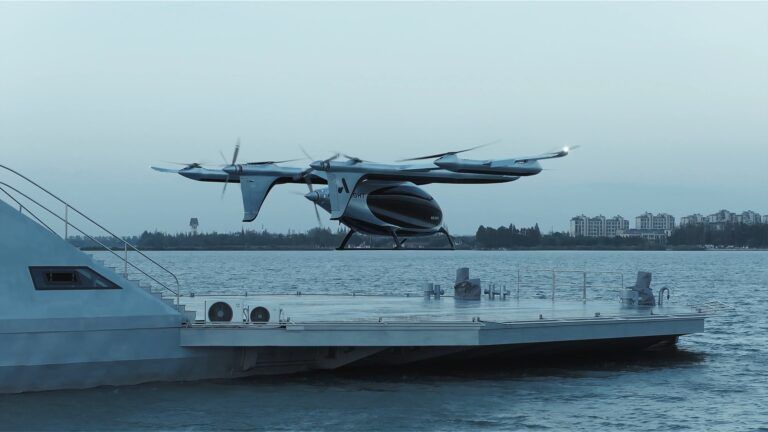
The company demonstrated the floating platform at Dianshan Lake in Kunshan, China. The system combines eVTOL landing pads with photovoltaic energy storage, charging capabilities, and intelligent dispatch systems, all designed for rapid deployment across rivers, lakes, and coastal areas.
The floating vertiport operates as a mobile aerial hub, featuring a solar panel-covered deck that serves as a landing platform and a cabin area functioning as both a departure lounge and technical operations room. The fully electric system enables zero-carbon operations, supporting take-off, landing, and charging functions while maintaining data connectivity with aircraft.
According to AutoFlight, the water-based infrastructure addresses critical challenges facing the low-altitude economy, particularly the limited availability of landing sites and lengthy construction timelines associated with traditional land-based vertiports. The system is compatible with multiple AutoFlight eVTOL models, including the industrial White Shark, the two-ton cargo aircraft CarryAll, and the six-seat passenger model Prosperity.
The company has identified five primary application areas for the technology. In offshore energy operations, AutoFlight claims the solution can improve personnel and equipment transport efficiency by more than tenfold. For emergency response, the system reportedly reduces reaction time by over 50 percent while expanding search coverage areas. Additional applications include high-frequency urban commuting, marine tourism, and coordinated multi-vertiport operations.
AutoFlight demonstrated the system’s capabilities through a public flight test featuring a two-ton eVTOL aircraft launching from the water vertiport. The company also conducted a three-aircraft formation flight that included live supply and life raft deployment exercises.
The vertiport was developed in partnership with CATL, which provided battery systems and clean energy integration for both the aircraft and floating platforms. The collaboration aims to advance emission-free air mobility infrastructure beyond traditional land-based deployment models.
By utilizing underused water surfaces, the technology offers coastal and waterside cities an alternative pathway for establishing urban air mobility networks without requiring extensive ground-based construction or competing for limited urban land resources.