


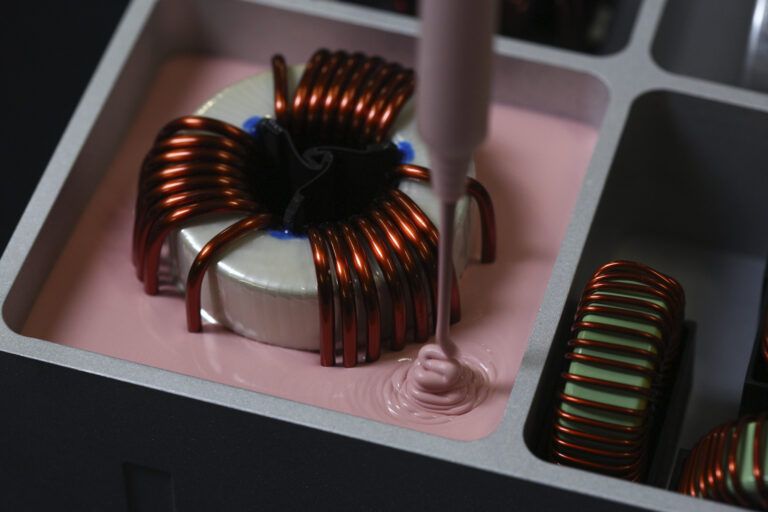
Unlocking Higher Power Density in EV Electronics
As EV power electronics shrink, heat becomes the limiting factor. On-board chargers, inverters, converters and electric machines are all expected to deliver more power from less space, and every degree of temperature rise costs efficiency and component life.
In this white paper, Parker Lord measures how much the right potting material can help. Researchers potted 15 high-power inductors in liquid-cooled aluminum fixtures using five silicone encapsulants ranging from 0.1 to 4.0 W/m·K. They then ran the inductors under load from a 9.3 kW charger at coolant temperatures of 25°C and 50°C.
The results are striking. Compared with an insulating gel, the most conductive compounds cut inductor temperature rise by around 50°C, from roughly 55°C to under 10°C. Time to reach a stable temperature dropped from nearly two hours to about 15 minutes, so components spend far less time at elevated temperatures. Even moderately conductive grades delivered significant gains.
Download the paper to discover:
- How temperature rise and equilibration time scale with thermal conductivity
- Why the results held consistent across both coolant temperatures
- How low-viscosity formulations flow into tight geometries and degas easily for void-free potting
- What these findings mean for designing smaller, lighter and lower-cost power electronics
The paper is written by Parker Lord Staff Scientist Dr. Daniel Barber and Business Development Manager Eric Wyman. It gives EV designers, OEMs and engineers hard test data to inform their next thermal management decision.