

With its dual battery configurations the Japanese OEM’s second electric model balances range anxiety against charging convenience
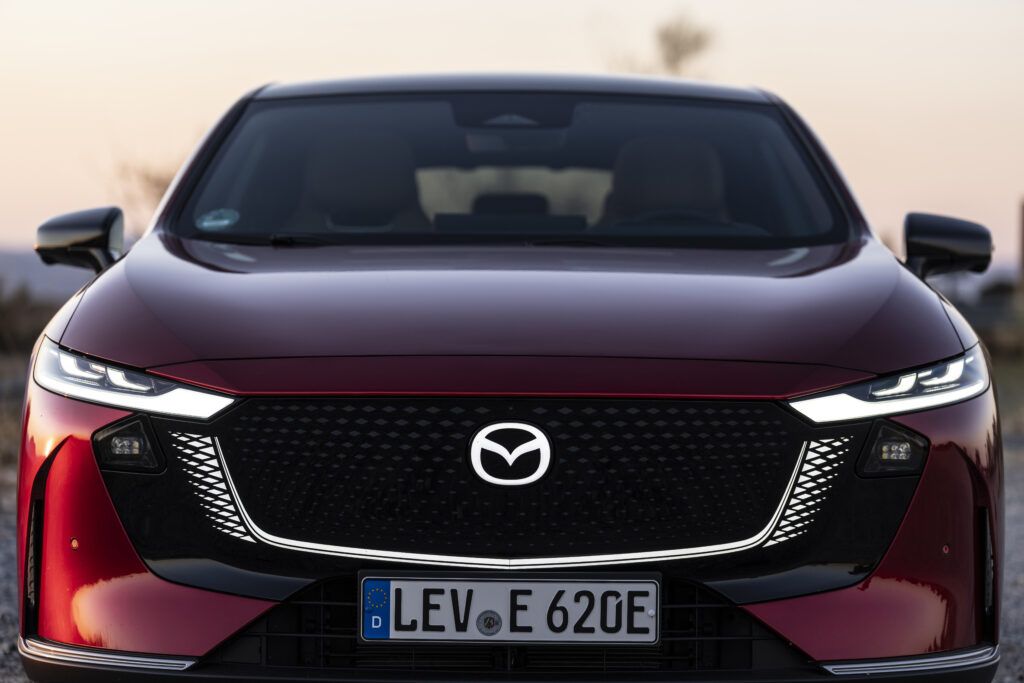
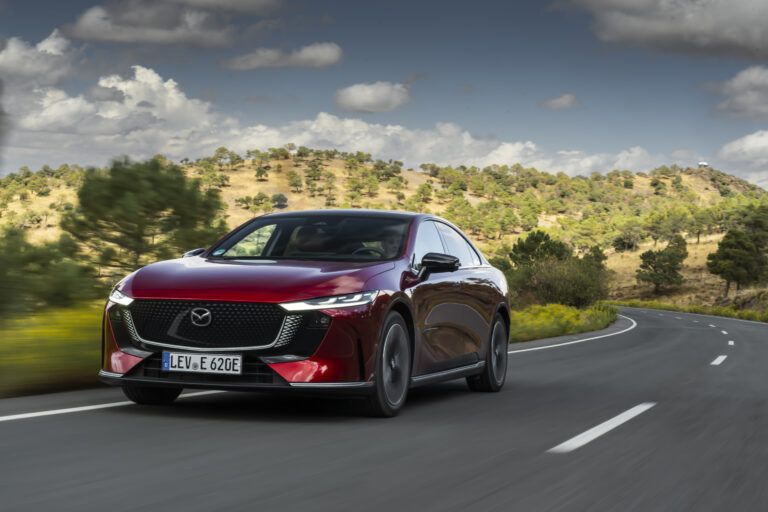
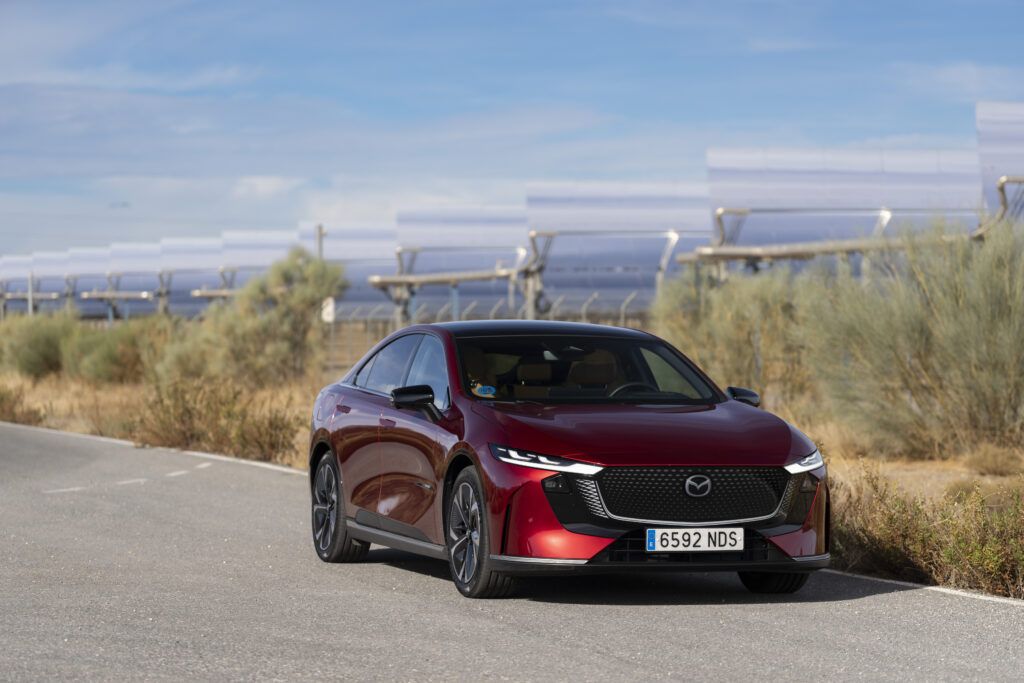
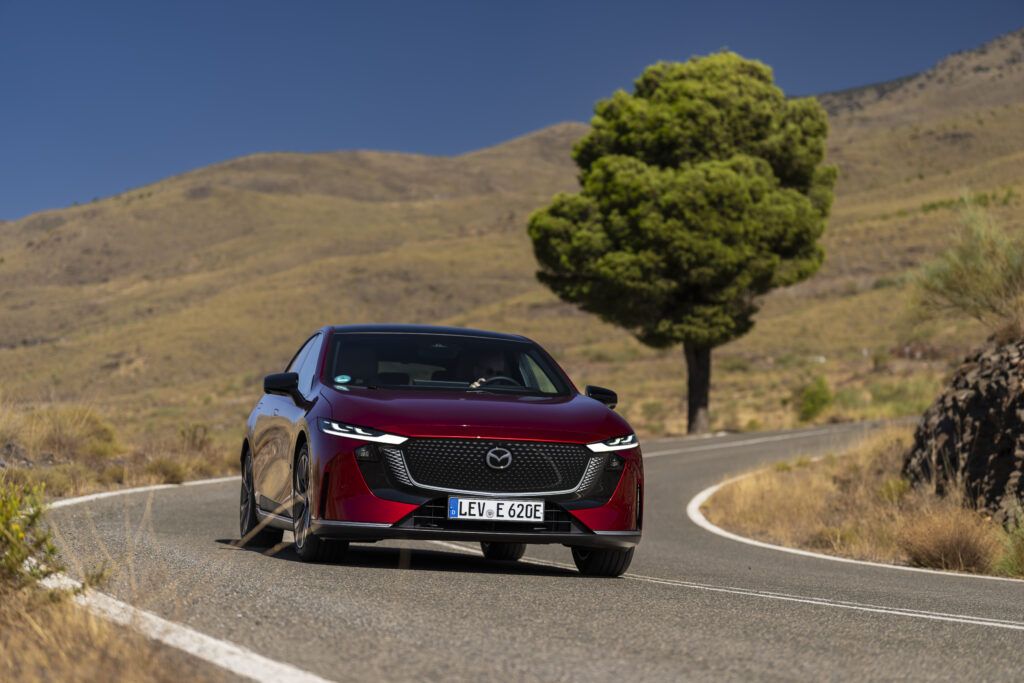
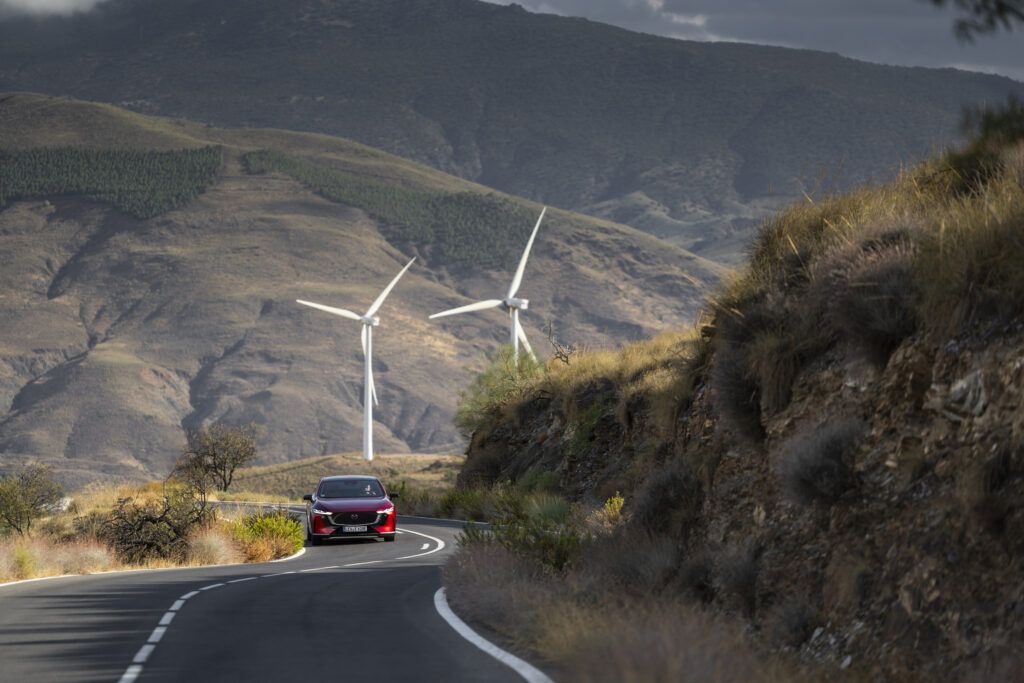
Mazda has started rolling out left-hand drive variants of the new 6e in European markets. Sold as the EZ-6 in China, the model is offered solely as an EV in Europe. The second electric model from the Japanese brand was launched in Spain’s Granada region, a leading area for wind and solar power.
An evolution of the manufacturer’s combustion-powered mid-sized sedan, it’s only 41mm taller than its predecessor. “It doesn’t look like a tall vehicle, although we have the batteries under the floor,” said Christian Schultze, deputy general manager and director, research and operations at Mazda Motor Europe. “Also, this gives us certain benefits in terms of lowering the center of gravity which helps the car’s dynamic performance around corners.”
To cater to different types of buyer, Mazda developed the 6e with two battery options: a 68.8kWh NMC battery with a range of 479km; and an 80kWh LFP battery with 552km of range. The smaller NMC battery can charge at speeds up to 165kW DC while the LFP battery can recharge at up to 90kW DC. In ideal conditions, 10% to 80% charge is said to be achievable in 24 minutes with the NMC battery while a comparable recharge would take 47 minutes with the LFP pack.
“One battery has a bit more range, and we believe it will be mainly chosen by people who have their own charging at home,” said Schultze. “And the other one, which has faster charging, but not as much capacity, is for people who know they will frequently charge enroute where charging speed is more important than range.”
According to Schultze, finding the sweet spot between range and battery size meant going back to basics. “When you have a certain package and set space for a certain battery, and you want to have more range, you can’t do it with the same chemistry because you’d need more space,” he said. “So, we had to find a chemistry that allowed us to make the same size battery with a bigger capacity.”
Until now, Schultze explained that Mazda has perhaps been overly conservative when estimating battery longevity but early results from the MX 30 show real-world use is outperforming the manufacturer’s predictions.
“We have MX 30 cars that have already achieved 200,000 km with the same battery. We were not sure at the beginning whether this would happen because if you have a vehicle with a short range, 200,000 km means far more recharges.
“Over the past 10 years, battery chemistry has developed dramatically. When you look to the future, there are more chemistries, for example sodium-based or other chemistries that will come, definitely. It’s always a question of raw material availability, preparation of the battery, lifetime, performance figures, cost etc.”
Digital and decarbonization
Due to the comparative simplicity of electric powertrains versus ICE, Schultze noted that the 6e’s development centered around digital interaction. The UI has been brought more in line with systems found in Chinese competitors sold in the European market. UX has also been expanded to include gesture control as well as voice recognition.
“With a modern vehicle like the Mazda 6e, the new challenge for us is the overall digital control of all systems, the connection to the outside world and the data operation inside of the car,” said Schultze. “That’s a new world for us where we must improve, learn and progress because more and more we will have an interaction between each vehicle and its entire environment.
Schultze highlights intelligent systems, traffic control, and flow control as examples. “Customers want to do new things in cars,” he says. “Not only do they want to listen to the radio but maybe the passengers want to watch streaming services or buy tickets to a museum you’re on the way to. We have to make these connections to all these different outside stakeholders.” Schultze noted that while a variety of in-car experiences are conceivable, they should not distract from the driving experience.
The launch of the Mazda 6e is part of the company’s wider decarbonization strategy which focuses on identifying compatible low or zero emission vehicles for specific markets. Rather than offering the same product range in all markets, the company plans to be more selective, especially for EVs where infrastructure in some areas makes the widespread viability of this technology more challenging.
In Mazda’s three-pronged approach to reducing emissions, one area encompasses electrification technology, looking at fully electric, plug-in hybrid and mild hybrid vehicles. The second development objective looks at alternative fuels including e-fuels, and lastly the company is trying to minimize the environmental impact of its manufacturing processes through the use of renewable energy.
“It’s not enough to just look at the tailpipe emissions,” said Schultze, “We need to approach this from a well-to-wheel approach where we consider all the CO2 emissions created from the production of the vehicle, the preparation of the fuel, the generation of electricity and the drive and use of the vehicle.”
Helping hands
Regulation and existing infrastructure is expected to influence which markets Mazda selects for certain powertrains. This includes regional variations in end-of-life vehicle processing legislation and recycling targets. Since vehicles sold into the European market will be recycled in Europe, Mazda is picking materials based on compatibility with the continent’s existing recycling methods.
While OEMs with localized manufacturing can work towards closed-loop recycling, Schultze argued that bringing recycled materials from Europe back to Japan to produce new vehicles would be antithetical. “We are using recycled materials but at this point in time not from end-of-life vehicles but from packaging materials, things like PET bottles,” Schultze said.
Considering the recyclability and long-term environmental impact of EVs, Schultze added, “We currently have issues with rare earths, so we need to think about magnets in the future. The European Commission is thinking about how we can recover the magnets from end-of-life EVs.” Schultze suggested the industry may need to explore synthesizing magnets or creating magnet-free vehicles through the development of new technologies.
Looking ahead to its future lineup, the manufacturer is optimizing its development strategy through its existing partnership with Changan. “We are currently developing a new BEV platform based on Mazda technology, the experience we have gained with our MX-30 and feedback from customers,” said Schultze. “We will further develop our own proprietary technology and introduce this new BEV around 2028.
In parallel with this BEV, Mazda is developing two further EVs as part of its global strategy to work together with partners on the development of new EVs. “We’re leveraging our alliance with our Chinese partner with whom we have worked together for more than 20 years on R&D and manufacturing,” said Schultze. “In the past, we engineered and developed all our products in house, but the speed of development has increased dramatically, and we understand that we need to use partnerships with external companies. Not only to speed up but to also gain technologies and capabilities we don’t have in-house.”
Discussing how the manufacturer’s market-specific strategy will be actioned, Schultze concluded, “We are a mid-sized company, so that means we cannot offer cars in every market differently. Standardization is one of the things we must make use of.”
Andasol Solar Power Station
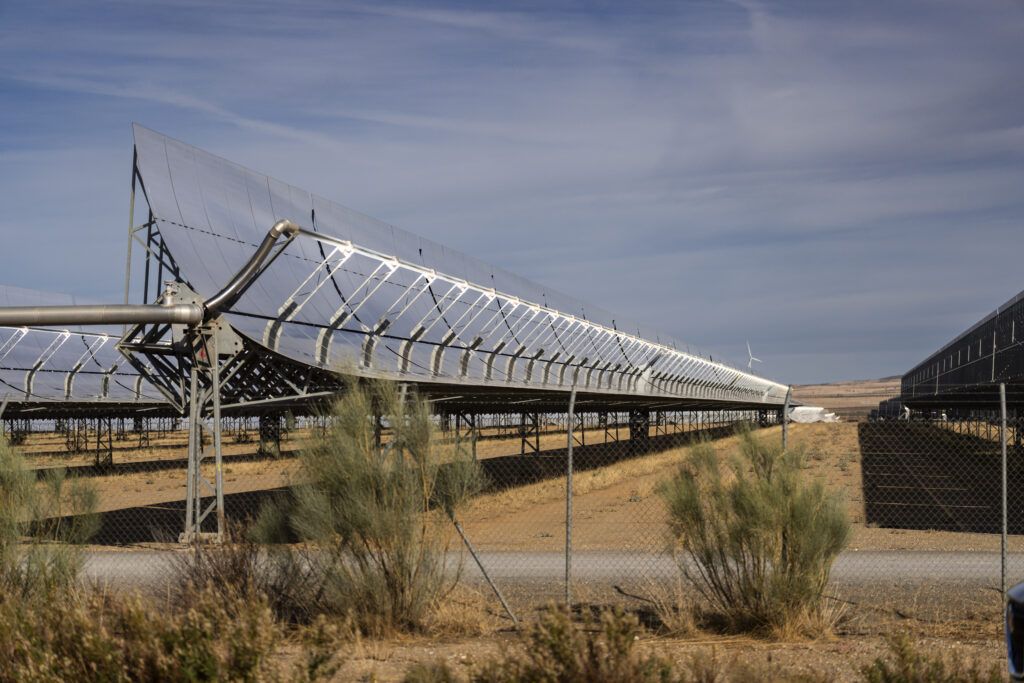
The 6e launch included a trip to the Andasol Solar Power Station in the Granada region. Unlike traditional solar power plants that use photovoltaic panels, Andasol uses concentrated solar power (CSP) technology.
Parabolic mirrors concentrate sunlight by a factor of 82 onto tubes with a diameter of 70mm. Inside the tubes, a thermal oil is heated from 290°C to 390°C along the loop. The hot oil passes through a heat exchanger where it creates steam to drive a turbine connected to a generator to produce electricity. Water cooling is used to reduce the temperature of the oil before it goes round the loop again.
One of the advantages of this system is that the hot oil also heats a molten salt mixture which comprises 60% sodium nitrate (NaNO3) and 40% potassium nitrate (KNO3). A ‘cold’ salt tank stores the mixture at around 290°C while the ‘hot’ tank holds it at up to 390°C. Excess energy produced during the day is stored here until the night or cloudy periods.
During the day, salt from the cold tank is pumped into the hot tank and heated with the oil. At night, the hot tank is pumped into the cold one to heat the oil. When the storage tank is full, it has enough energy to allow the plant to operate for around 7.5 hours in the dark. During the summer months, this means the facility can produce green electricity around the clock, significantly increasing its output compared to photovoltaic solutions.
To maximize light capture, mirror rows are aligned North-South, so they rotate from East to West tracking the sun. Built in three phases, the entire site has been producing energy since 2011. Andasol 3, the most recent phase of the project features 210,000 parabolic mirrors paired with a heat storage capacity of 29,000 tonnes of salt. Annual operating hours are estimated to be around 3700 at peak load. Together, Andasol 1, 2 and 3 produce around 150MW of green electricity every year.
Spanning around 600 hectares, the location was selected for its high altitude at 1100m above sea level, typically sunny weather and good access to water from the Sierra Nevada mountain range. Due to the number of wind farms in the local area, the site is also near high voltage power lines. To maintain the efficacy of the mirrors they are cleaned every night to remove dust and debris from the surface.
Spain leading the charge
“We are here because Spain is really a showcase of the sustainability transition,” Schultze explained. “Spain is a leader in the deployment of green electricity, and they are also very successful in deploying electrified mobility.”
Thanks to government incentives on the purchase price of new EVs and subsidies on home and public charging, Mazda expects the 6e to be well suited to the region. As the company assesses where to offer specific products, local green energy production is among its priorities. Schultze said, “If you have electricity that is made by coal and gas, then an EV is no greener than any other vehicle.”
In 2024, sustainable energy accounted for 56% of the country’s electricity production using energy generation methods such as wind, solar and hydropower. In the first half of 2025, spurred on by the MOVES III incentive for up to €7,000 off a new EV, more than 46,000 EVs were registered in Spain, a year-on-year increase of 84%.
“The public charging network is progressing steadily with more than 40,000 charge points. Even high-speed chargers are now coming to more remote areas. It shows very clearly that clean energy and clean mobility can go together if it’s planned well, where people live and where people drive,” Schultze added.