

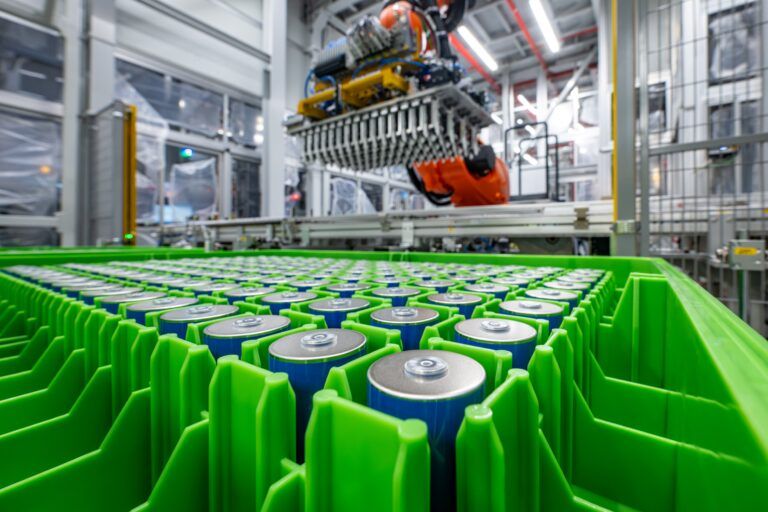
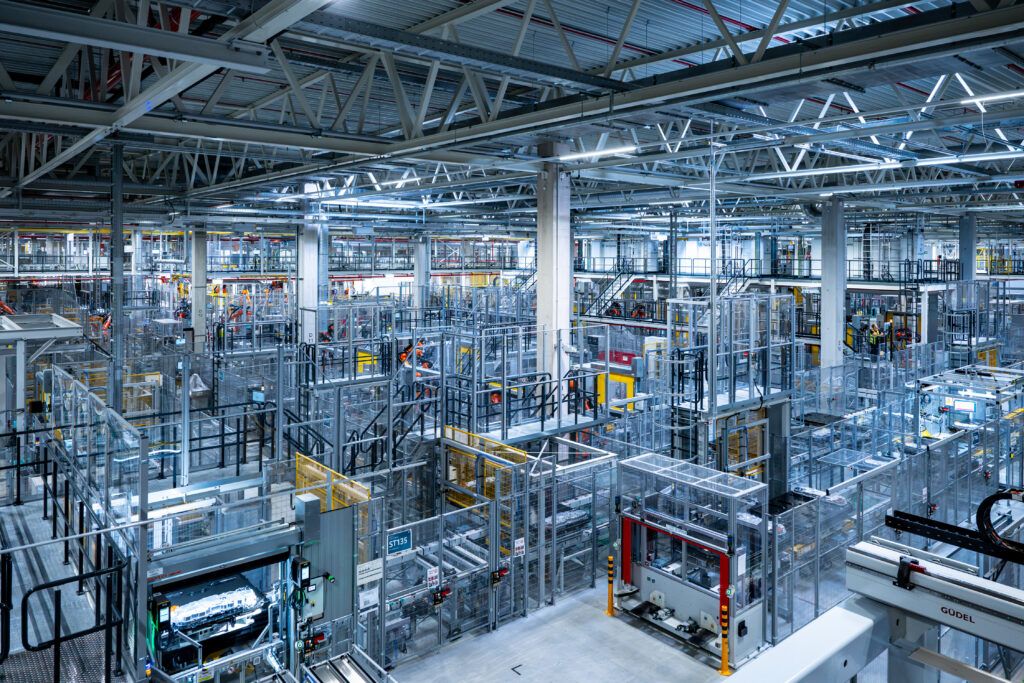
BMW Group has started series production of sixth-generation high-voltage batteries at its new €1bn Plant Irlbach-Straßkirchen in Bavaria, Germany. The plant supplies cylindrical-cell, cell-to-pack batteries to Plant Munich for the new BMW i3, which has 108.7kWh capacity. It will employ around 1,600 people on two production lines.
The BMW Group has started series production at its new Plant Irlbach-Straßkirchen in Bavaria, Germany, and is now supplying sixth-generation (Gen6) high-voltage batteries to BMW Group Plant Munich for installation in the new BMW i3.
The company says demand for its Neue Klasse models has driven a faster ramp-up than planned. Series production is already running on two shifts. Once fully operational, the plant will employ around 1,600 people and produce several hundred high-voltage batteries per day on two production lines.
“The new plant plays a key role in our production network: As the central platform, it will supply our German vehicle plants with sixth-generation high-voltage batteries,” says Raymond Wittmann, member of the board of management of BMW AG, responsible for production. “In this way, our high-tech plant in Irlbach-Straßkirchen is making a vital contribution to the ramp-up of the Neue Klasse.”
The BMW Group has invested around €1bn in the 60-hectare (148-acre) site. Construction began in April 2024, and the first pre-series battery was built in March 2026. In a September 2023 referendum, more than 75% of Straßkirchen residents voted in favor of the plant, with turnout of around 77%.
“With our Plant Irlbach-Straßkirchen, we are sending a strong signal: for our technological competitiveness, for electromobility – and for Germany as a business location,” Wittmann adds. “The decisive factor is a reliable and competitive framework.”
Cell-to-pack and pack-to-open-body
The Gen6 battery uses cylindrical cells integrated directly into the pack on a cell-to-pack principle. The pack also forms part of the vehicle’s body structure, a concept BMW calls pack-to-open-body. The cells come from external cell manufacturers and undergo incoming checks, including voltage measurements.
Assembly starts with cell clustering, where cells are connected to coolers for insulation and cooling. The cell clusters and cell contact system are then laser-cleaned and welded. A foaming process follows, binding all components into a single mechanical unit. The housing is then closed, sealed and riveted. Next, the Energy Master central control unit is fitted using a permanently elastic sealing adhesive. Every battery then goes through an end-of-line inspection.
More than 3,500 data points are recorded per battery in real time. BMW’s in-house artificial intelligence (AI) assistants and agents analyze this data alongside 500 robots across a 50,000m² (538,000ft²) production area. The company says the AI also improves overall equipment effectiveness (OEE).
According to Rudolf Hummelsberger, head of high-voltage battery production Dingolfing and Irlbach-Straßkirchen, “Plant Irlbach-Straßkirchen demonstrates how quickly we can scale a new battery concept to industrial production. The key factor is the interaction between a skilled and committed team and the continuous sharing of experience within the production network.”
i3 specifications
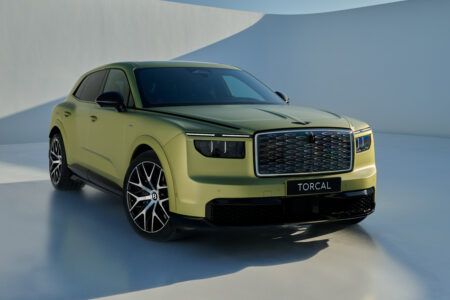
In the new BMW i3, the battery has a capacity of 108.7kWh. The i3 50 xDrive First Edition has a range of up to 906km (563 miles) under the Worldwide Harmonized Light Vehicles Test Procedure (WLTP). The car uses an 800V architecture and supports direct current (DC) charging at up to 400kW, adding up to 423km (263 miles) of WLTP range in 10 minutes, according to ISO 12906. It also supports bidirectional charging.
The Gen6 cells for the i3 use secondary material for part of their cobalt, lithium and nickel content. Renewable energy is used in anode, cathode and cell production. BMW says carbon dioxide equivalent (CO2e) emissions per watt-hour are around 33% lower than for the Gen5 cell in the previous model. The plant uses no fossil fuels in regular operation and no water in battery assembly. It gets part of its electricity from an on-site photovoltaic system and the rest from renewable sources.
Irlbach-Straßkirchen is one of five Gen6 battery assembly plants located near BMW vehicle plants. The others are in Debrecen (Hungary), Shenyang (China), Woodruff (USA) and San Luis Potosí (Mexico). The BMW Group’s Cell Recycling Competence Center in Salching, 16km from Straßkirchen, opened in December 2025. Encory GmbH operates the site and uses a BMW-owned direct recycling method that dismantles cells mechanically, without chemical or thermal processing.