


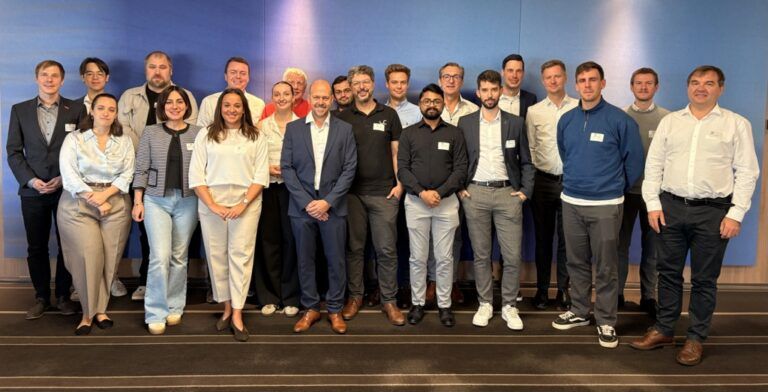
OCSiAl is supplying single-wall carbon nanotubes to ELEVATE, a Horizon Europe project developing battery cells above 400 Wh/kg for electric regional aircraft. The nanotubes support silicon-rich anodes and solvent-free dry-coated cathodes. The 11-member consortium includes cell developer UniverCell, aircraft developer Vaeridion, Daikin Chemical Europe, Uppsala University, CIDETEC and Addionics.
Carbon nanotube producer OCSiAl, based in Luxembourg, is supplying single-wall carbon nanotubes (SWCNTs) to ELEVATE, a Horizon Europe research project. The project is developing battery cells for electric regional aircraft, with a target energy density above 400 watt-hours per kilogram (Wh/kg).
The project centers on two electrode technologies: silicon-rich anodes and dry-coated cathodes. Dry coating removes the solvents used in conventional electrode production. The project’s aim is to deliver the higher energy density that regional aircraft require without reducing safety.
According to Andrej Seniut, head of energy projects at OCSiAl, the company’s nanotubes are used in both electrode designs. “OCSiAl’s single wall carbon nanotubes serve as enablers for silicon-rich anodes and dry-coated cathodes – two next-generation battery approaches expected to deliver energy density exceeding 400 Wh/kg while supporting more sustainable, solvent-free manufacturing,” he says.
The consortium covers the development chain from materials and cell design through production processes to aircraft integration. UniverCell contributes its expertise in cell development and manufacturing. Aircraft developer Vaeridion provides the link to electric aviation applications.
The other partners are OCSiAl, Daikin Chemical Europe, Technische Universität Braunschweig, EURA, Uppsala University, CIDETEC, Addionics, IKA and LEONHARD KURZ Stiftung. They contribute work on advanced materials, battery technologies and manufacturing. The group aims to move laboratory-scale battery developments toward use in electric aircraft.
Seniut explains that the nanotubes are effective in very small quantities. “At ultralow loadings, single wall carbon nanotubes create conductive reinforcing networks throughout the electrode, helping overcome key challenges related to conductivity, mechanical integrity, and cycle life,” he says.
Aviation is the project’s first target application. The partners expect the resulting technologies to also support the development of lighter, safer and higher-energy-density batteries for other electrification sectors.