

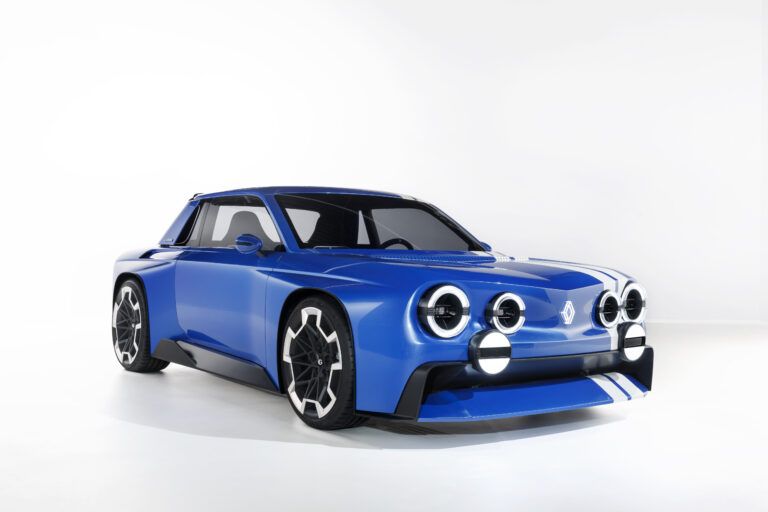
The Renault 8 Gordini Concept is a two-seat electric coupe reinterpreting Renault’s 1964 Renault 8 Gordini. It has a 270hp electric motor, carbon bodywork, six round headlights and 19in front and 20in rear wheels. It is not a production car and will go on display at the October 2026 Paris Motor Show.
Renault has revealed the Renault 8 Gordini Concept, a two-seat electric coupe that reinterprets its 1964 sports sedan with a 270 horsepower (hp) electric motor and rally-inspired proportions.
The one-off concept from Renault, based in Boulogne-Billancourt, France, is an exploratory design study, not a production model. It follows the R17 electric restomod developed with designer Ora Ïto and the Renault 5 Diamant art car created with Pierre Gonalons. Like those vehicles, it will join historic models, archive material and artworks at the Renault Collections museum in Flins, France, which the company expects to open to the public in around 15 months.
“With Renault 8 Gordini Concept, we wanted to spark emotion by drawing on both our heritage and modern times, bringing together the icons of yesterday and the future. This exercise in style sets out to reinvent Renault 8 Gordini for the modern day. The aim of this coupé is to inspire emotion and capture the imagination of all car enthusiasts. And when I talk about emotion, I’m not talking about nostalgia, but real passion for cars,” says Alexandre Malval, vice president of design at Renault.
The concept measures 4.12m (162in) long, 1.88m (74in) wide and 1.27m (50in) tall and rides on 19in wheels at the front and 20in wheels at the rear. Unlike the four-door original, it has two doors, a V-shaped prow and six round headlights. The wide rear bodywork references the original’s rear-mounted engine and rear-wheel-drive layout, and adds a slight rake the 1964 car lacked.
“We updated the distinctive styling of the original Renault 8, which was virtually symmetrical from front to rear, to give it a more dynamic look. With the flowing cabin lines, wide track, prominent wings and wheels of 19 inches at the front and 20 inches at the rear, it appears to hug the road. The decision to make the rear wheels larger creates a visual sense of momentum: a nod to the rear layout that was the hallmark of the hugely enjoyable ride delivered by the original,” Malval explains.
Unlike the R17, the design was developed entirely in-house. An internal competition at Renault Design generated more than 300 sketches, from which two proposals were built as 2:5 scale mock-ups before being merged into a single design.
The team followed a “café racer” approach borrowed from custom motorcycles, stripping out non-essential elements, as it did on the Renault 5 Turbo 3E. The chrome side molding of the original is now a feature line in the carbon bodywork, and the front end has no hood shut line, allowing the hood to be removed in one piece.
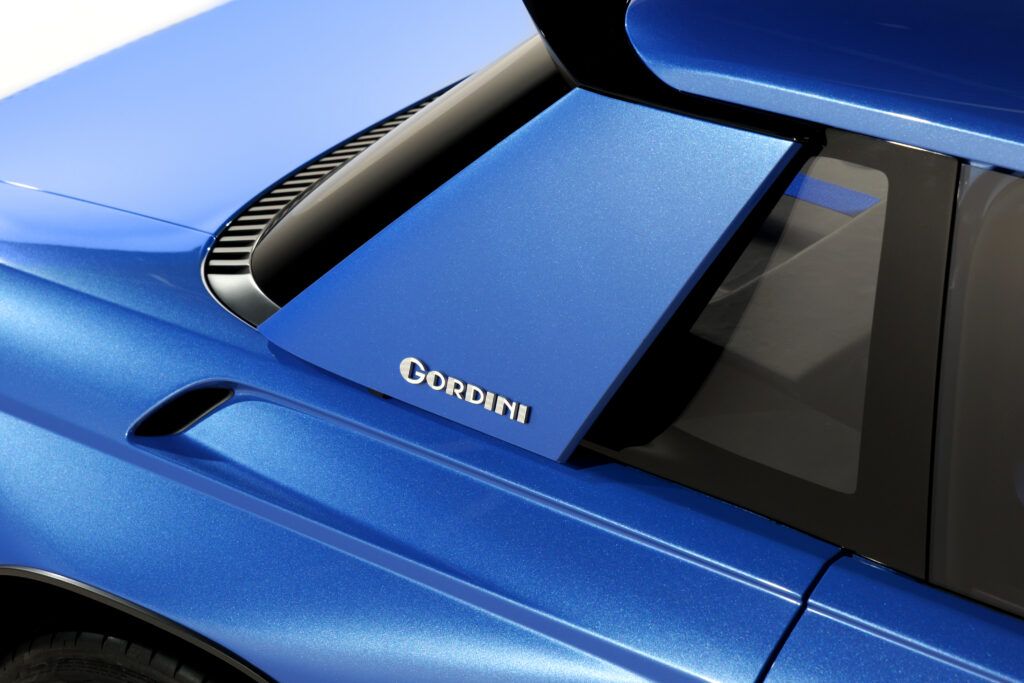
Carried-over cues include reworked Gordini lettering with the striations of the original badge, a new “8” emblem made of eight segments, squared-off wheel arches, shell-shaped mirrors and a full-width grille at the base of the windscreen. The recessed embossing along the waistline now channels air to a new vent, and the grille-less front integrates the additional headlights of the rally version into a six-lamp layout.
“Renault 8 Gordini Concept revisits the original headlights, amongst other features, as part of a highly graphic approach. At the front, the six round 3D headlights are set in the bodywork, while at the rear, the lights are perfectly flush. So much so that they are barely visible when switched off. This design enhances the car’s iconic signature,” says Malval.
“The squared-off wheel arches inherited from the original Renault 8 Gordini emphasise the muscular lines of the rear wing,” notes Kévin Goncalves, exterior designer at Renault.
The Gordini double white stripe now serves as a structural reference line, with the windscreen grille and the illuminated pattern in the rear lights aligned to it. It continues across the top of the dashboard, changing from white to blue.
“These are not simply decorative strips applied to a surface, but structural components that coordinate the design,” Goncalves adds.
The paint reinterprets the original’s Bleu de France. “This modern reboot is based on a construction in three layers, combining mother-of-pearl with a blue-tinted binder for greater depth and richness. Under the light, the historic shade of blue can be glimpsed along the edges, revealing in full the sculpted lines of the bodywork,” explains Thomas Altet, color and materials designer at Renault.
Inside, a horizontal brushed aluminum strip carries round digital displays with thick bezels echoing the headlights. Aluminum replaces plastic on controls and large surfaces, contrasting with Alcantara trim. Bucket seats feature blue corduroy centers, and a red stopwatch button sits in the middle of the dashboard.
“We drew inspiration from the original Renault 8 dashboard, taking its iconic design cues and reinterpreting them for today. The traditional metal panel with its circular dials has been repositioned horizontally to support and showcase a series of perfectly aligned round screens,” says Stéphane Maiore, interior design director at Renault.
“We limited the number of parts inside the cabin, meticulously crafting each one with understated lines. They are part of both the structure and the trim. Nothing is superfluous,” notes Robin Biondi, interior designer at Renault.
The original Renault 8 Gordini, developed with engine tuner Amédée Gordini, used a 95hp rear-mounted engine and served as a training car for drivers including Jean Ragnotti.
Following its unveiling at the Renault Carwalk on September 24, the concept will be displayed on Renault’s stand at the Paris Motor Show from October 12-18, 2026.