

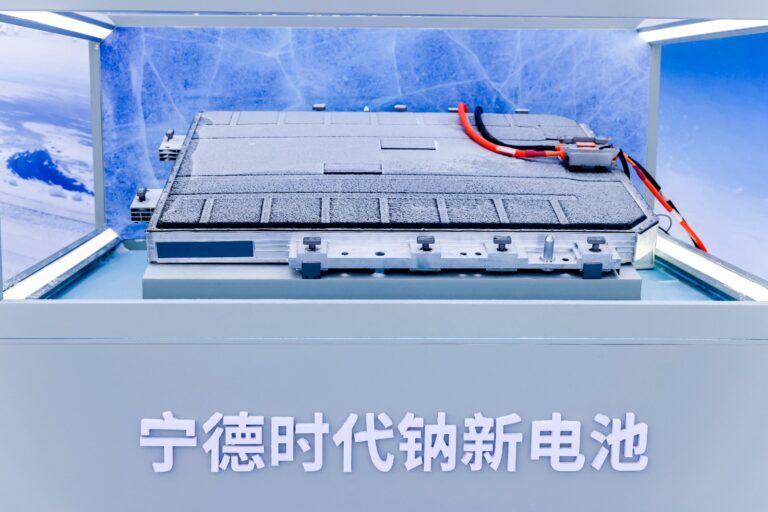
CATL is investing 5 billion yuan ($735 million) to add 40 GWh of annual sodium-ion battery production capacity at its Fuding Shidai site in Ningde, Fujian. The expansion follows a record 60 GWh sodium-ion supply contract with HyperStrong, signed in April, and supports CATL’s planned end-of-2026 mass production.
CATL is to invest 5 billion yuan (US$735 million) to add 40 GWh of annual sodium-ion power battery production capacity at its Fuding Shidai site in Ningde, Fujian, in what amounts to one of the largest single industrial commitments to the chemistry to date.
The expansion, the sixth phase at the Fuding base, was disclosed on May 7 in a public document released by environmental authorities in Ningde. The new line will operate independently of the existing facilities at the site and will be constructed by CATL’s wholly-owned subsidiary Fuding Shidai. Construction is expected to take 24 months, covering new battery cell, electrode, capacity testing and module facilities along with related auxiliary infrastructure. Once complete, total planned capacity at the Fuding base will reach 149 GWh.
CATL said it intends to procure leading battery manufacturing equipment to build a brand-new, large-scale sodium-ion power battery production line designed to meet anticipated market demand.
The capital commitment follows the largest-ever order for sodium-ion batteries. On April 27, CATL signed a three-year supply contract with Chinese energy storage system provider HyperStrong covering 60 GWh of sodium-ion cells for stationary energy storage. CATL described the order as marking the beginning of a phase of large-scale growth for the sodium-ion segment.
CATL launched its sodium-ion battery brand, Naxtra, in April 2025, and has invested heavily in the chemistry over the past several years. Official data shows that as of the end of 2025, the company’s cumulative investment in sodium-ion battery research and development had approached 10 billion yuan.
At its Super Tech Day in Beijing on April 21, CATL confirmed that mass production of Naxtra sodium-ion batteries would begin by the end of 2026. The current generation has a gravimetric energy density of around 175 Wh/kg, with the company targeting parity with lithium iron phosphate within three years and a CLTC driving range of up to 600 km. Sodium-ion cells retain approximately 90% of nominal capacity at -40°C and are projected to cost around 30% less than LFP equivalents at scale. Naxtra cells have also passed China’s GB 38031-2025 traction battery safety standard, which comes into force on July 1, 2026.
According to Robin Zeng, founder and chairman at CATL, the company is currently developing its sixth-generation sodium battery products to adapt to diverse scenarios. He told investors that, over the long term, low-cost sodium-ion technology is poised to replace 30% to 40% of the existing battery market share.
CATL remains the largest power battery maker globally, with a 40.7% share of EV battery installations in the first quarter of 2026, according to SNE Research data.
The Fuding capacity expansion is one of several commercial sodium-ion deployments now underway at CATL. Earlier this year, the company launched its Tectrans II light commercial vehicle solution using its first mass-produced sodium-ion system, and on February 5 it unveiled the first mass-produced sodium-ion passenger vehicle developed jointly with Changan Automobile. A sodium-ion variant of the Aion UT Super, co-developed with JD.com and GAC Group, is scheduled for production in Q2 2026.