

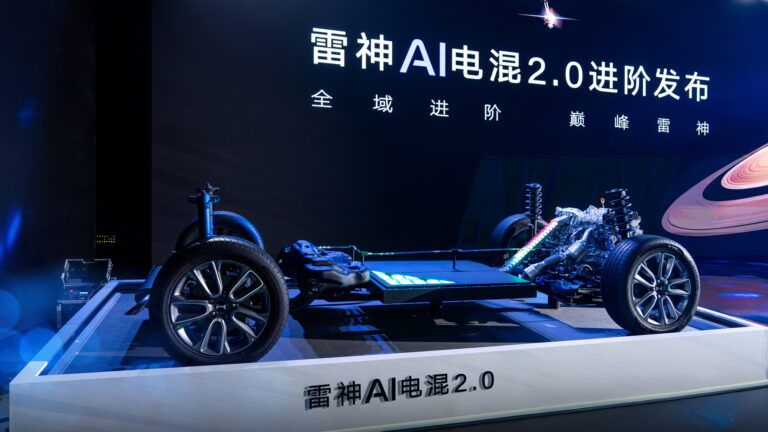
Geely Auto has launched what it calls the industry’s first AI-scenario based power domain system, the Xingrui AI Cloud Power 2.0, which powers the company’s upgraded EM AI Super Hybrid 2.0 technology. The system includes EM-i AI Hybrid and EM-P AI Hybrid variants, with press evaluations showing the EM-i test vehicle achieved fuel consumption of 2.49 liters per 100 kilometers across various road conditions.
The technology builds on Geely’s Xingrui Intelligent Computing Center 2.0, which the company says delivers 23.5E FLOPS of computing power. According to Geely, this makes it the top Chinese automaker in computing capability. The AI system optimizes the hybrid powertrain to reduce energy consumption while extending engine maintenance intervals by over 50% and increasing power battery lifespan by 15%.
Recent data from China Automotive Intellectual Property shows Geely leads in hybrid system control technology patents, holding 161 patent authorizations with a comprehensive innovation index of 145.69 and total innovation score of 90.
The EM-i AI Hybrid engine incorporates seven friction-reduction technologies, a variable-displacement oil pump, and optimized thermal management to achieve what Geely claims is an industry-leading thermal efficiency of 47.26%. The system uses global energy consumption optimization and what the company describes as the industry’s first map-free decision-making technology.
Under China Light-duty Vehicle Test Cycle conditions, the EM-i system achieved fuel consumption of 2.67 liters per 100 kilometers with low state-of-charge, delivering a range exceeding 2,100 kilometers. Independent media testing in China recorded fuel consumption of 2.49 liters per 100 kilometers under similar conditions.
The EM-P AI Hybrid features a five-power-source design with dynamic torque distribution. Combined with the AI system’s all-terrain recognition function, it distributes torque to all four wheels to prevent wheel slippage and provide stability control across different driving scenarios.
Geely’s hybrid technology development reflects broader industry trends toward AI integration in automotive powertrains. The company has positioned itself as a leader in combining traditional automotive engineering with artificial intelligence applications, particularly in the Chinese market where hybrid technology adoption continues to grow.
The AI-powered system analyzes driving scenarios in real-time to optimize power delivery between the internal combustion engine and electric motors. This approach differs from conventional hybrid systems that rely on predetermined maps and fixed algorithms for power management.
The technology is currently available only in mainland China, where Geely continues to expand its hybrid vehicle offerings. The company has not announced plans for international availability of the AI-powered system.