

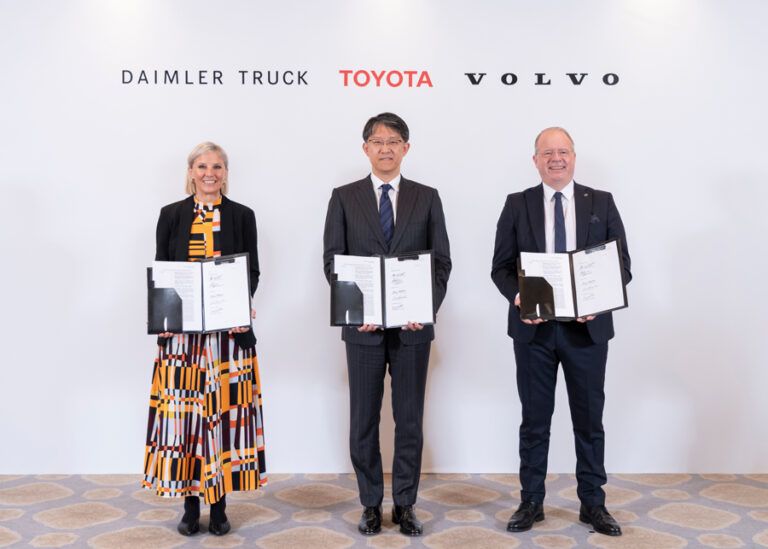
Toyota has signed a non-binding agreement to join Daimler Truck and Volvo Group as an equal shareholder in cellcentric, a fuel cell joint venture for heavy-duty vehicles. Toyota will invest via a capital increase and jointly develop fuel cell unit cells with cellcentric. A binding deal is pending regulatory approval.
Toyota Motor Corporation has signed a non-binding memorandum of understanding (MoU) to join Daimler Truck and Volvo Group as an equal shareholder in cellcentric, the fuel cell system joint venture focused on heavy-duty commercial vehicle applications.
Under the agreement, announced on March 31, Tokyo-based Toyota plans to participate in a capital increase in cellcentric, bringing the venture from a two-way to a three-way equal partnership. The parties say the move is intended to combine Daimler Truck and Volvo’s commercial vehicle expertise with Toyota’s more than 30 years of fuel cell development, production technology, and manufacturing experience from the passenger car sector.
Cellcentric was founded in 2021 by Daimler Truck and Volvo Group and develops, produces, and commercializes fuel cell systems for heavy-duty on- and off-road transport and stationary applications. The company has more than 560 employees across sites in Kirchheim/Teck, Esslingen, and Stuttgart in Germany, and Burnaby, Canada, and holds roughly 700 patents.
Beyond the shareholding, Toyota and cellcentric intend to jointly manage the development and production of fuel cell unit cells — the core component of fuel cell stacks — along with directly linked architecture and control elements. The goal is to create competitive products drawing on technology from both companies.
“Joining forces with the world’s largest automotive manufacturer and fuel cell pioneer is a privilege for us — and a game changer in making hydrogen in transportation a reality,” said Andreas Gorbach, Daimler Truck board member responsible for truck technology.
Koji Sato, president and chief executive of Toyota, said the partnership would allow cellcentric’s commercial vehicle expertise and Toyota’s passenger car fuel cell experience to combine. “Toyota will continue to contribute to realising a hydrogen society alongside like-minded partners,” he added.
Martin Lundstedt, president and chief executive of Volvo Group, said bringing Toyota onboard would help create the critical mass needed for hydrogen applications. “Given the importance of accelerating the transformation into net-zero transportation, the need of great companies coming together and collaborating is more important than ever,” he said.
Cellcentric will continue to operate as an independent entity serving a wide range of customers. The three companies will continue to compete independently in all other areas of their businesses. The agreement remains non-binding, with a legally binding deal still subject to board approvals and regulatory clearance.