

CSX is evaluating hydrogen fuel cell and battery-electric technologies to replace diesel locomotives on non-electrified routes. The company expects three battery-electric units to be operational by 2027, while hydrogen refueling infrastructure is not anticipated before 2030. Both technologies offer lower maintenance costs, but range and infrastructure challenges persist.
The decarbonization of rail freight operations has become an increasingly urgent priority as the transportation sector faces mounting pressure to reduce emissions. While rail transport already offers significant carbon efficiency advantages over road freight, the continued reliance on diesel locomotives on non-electrified routes presents a substantial challenge for operators seeking to meet environmental targets and comply with evolving regulations.
Full electrification of rail networks represents the ideal long-term solution, but infrastructure limitations across much of North America’s extensive rail system mean that alternative traction technologies must serve as interim solutions. Two primary technologies have emerged as leading candidates to replace diesel locomotives on routes without overhead electrification: hydrogen fuel cell systems and battery-electric powertrains. Each approach presents distinct advantages and limitations that operators must carefully evaluate as they chart their decarbonization strategies.
CSX, one of North America’s major freight rail operators, exemplifies the industry’s methodical approach to assessing these alternative technologies. The company has outlined four key performance indicators in its climate transition plan: improving locomotive fuel efficiency, increasing renewable energy use, expanding consumption of low-carbon alternative fuels, and implementing low-carbon locomotive technologies. These objectives reflect the complex, multifaceted nature of transitioning away from diesel power while maintaining the reliability and economic viability that freight operations demand.
Becky Hensley, senior manager of sustainability at CSX, provided insights into how the company views these emerging technologies. When asked how hydrogen fuel cell and battery-electric technologies compare for long-distance freight operation, Hensley explained that “CSX believes that zero emission locomotives can have the largest impact on the local communities and inner cities we operate in.”
Regarding hydrogen capabilities, Hensley noted that “hydrogen locomotives are capable of replacing diesel-electric locomotives in all but the longest routes. They have proved to be most effective in the yard and local duty-cycles due to refueling time and operations.” This assessment highlights the particular suitability of hydrogen systems for operations where locomotives need to return to service rapidly after refueling, though the technology’s effectiveness remains closely tied to the availability of hydrogen infrastructure, which presents cost challenges when hydrogen must be transported significant distances.
Battery-electric locomotives face a different set of constraints. Hensley stated that “continued energy density developments are needed for battery powered long-haul road service on most routes without overhead charging infrastructure.” Current energy density limitations mean that battery-powered units struggle to match the range and operational flexibility of diesel locomotives on long-haul routes. While battery technology continues to advance, substantial improvements are essential before battery-electric locomotives can serve most long-haul applications effectively. The challenge is particularly acute given that many freight routes span hundreds of miles through areas where installing charging infrastructure would be economically prohibitive.
Infrastructure requirements represent one of the most significant hurdles for both technologies. When asked about key infrastructure challenges, Hensley emphasized that “interoperability between CSX and other Class I partners is fundamental for the adoption of new locomotive technologies.” North American freight rail operations frequently involve locomotives from multiple operators working together, and any new technology must function seamlessly across this collaborative network. This requirement adds complexity to infrastructure planning, as charging and refueling facilities must be strategically located to serve not just a single operator’s needs but the broader rail network.
Hensley further explained that “equally important are fueling and charging logistics. Hydrogen is regionally available, but higher transport costs make it most efficient for yard and local services, while battery recharging in rural areas will require infrastructure improvements.” These logistics present different challenges for each technology. Hydrogen availability varies significantly by region, and the costs associated with transporting hydrogen to remote locations make it most economically viable for yard and local services where infrastructure can be centralized. Battery recharging in rural areas will require substantial infrastructure improvements, as many remote sections of rail networks lack the electrical capacity needed to support high-power charging installations.
From an operating cost perspective, both hydrogen and battery-electric locomotives offer advantages over conventional diesel units. Hensley noted that “hydrogen and battery locomotives are advantageous for their lower maintenance requirements and associated costs compared to diesel locomotives, as combustion, fuel systems and other mechanical components are eliminated.” These reduced maintenance requirements translate directly to lower operating costs over the locomotive’s service life.
She added that “zero-emission technologies have lower regulatory and environmental risks while promoting CSX sustainability goals. However, these technologies will be more widely utilized as the price of traditional petroleum fuels increase.” This price relationship creates uncertainty in long-term planning, as operators must make substantial capital investments in new technologies based on projections of future fuel cost trajectories that may or may not materialize as anticipated.
When asked which technology is most likely to scale first for heavy freight applications over the next decade, Hensley stated that “we continue to develop innovative methods and collaborate with industry partners to reduce our environmental footprint – hydrogen and battery technologies are at the forefront of those efforts.” This response reflects the company’s balanced approach to evaluating both technologies rather than committing exclusively to one pathway.
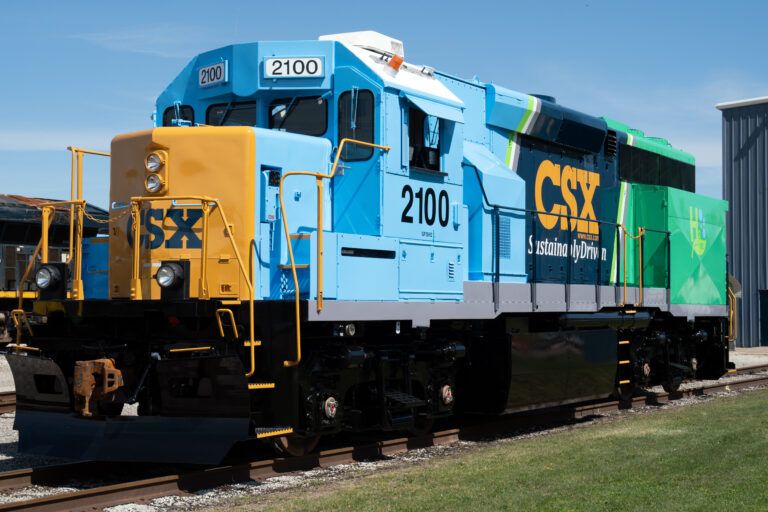
The company’s approach to technology adoption reflects a pragmatic, experimental strategy. CSX has leveraged access to federal grants to acquire three battery-electric locomotives expected to become operational by 2027. This timeline reflects the relative maturity of battery-electric solutions compared to hydrogen alternatives, which remain largely in demonstration phases with retrofit models. The quicker deployment timeline for battery-electric technology mirrors patterns seen in other transportation sectors, where battery solutions have generally reached commercial viability ahead of hydrogen systems.
Bryan Tucker, vice president of stakeholder engagement and sustainability at CSX, emphasized the collaborative nature of the industry’s decarbonization efforts. “For our industry and communities, we are working alongside our railroad stakeholders to reimagine a sustainable railroad; one that benefits stakeholders today and for the long haul,” Tucker said. “A major step forward not only for our company, but the industry, was the development and deployment of hydrogen fuel cell locomotive conversion kits for diesel-electric locomotives. This is just one example of how we are pairing today’s technological potential with the power of industrywide collaboration to create more low-carbon transportation opportunities for today’s customers while better serving the communities in which we operate.”
The conversion kit approach Tucker references represents an important pathway for technology adoption, potentially allowing existing diesel-electric locomotives to be retrofitted rather than requiring complete fleet replacement. This strategy could accelerate adoption by reducing capital costs and extending the useful life of existing equipment, though it remains to be seen how widely such conversion approaches will be deployed.
CSX’s infrastructure timeline projections reveal the extended horizon for building out supporting systems. The company anticipates that hydrogen refueling infrastructure will not reach viable scale before 2030, though such infrastructure should ultimately enable faster refueling times and longer operational ranges compared to battery-electric alternatives. Safety protocols, maintenance procedures, and fuel procurement arrangements were identified as critical components that must be established for successful hydrogen fuel cell locomotive deployment. These operational considerations extend well beyond the locomotives themselves, requiring comprehensive planning and workforce training.
Battery-electric infrastructure faces its own timeline challenges. Over the next three to five years, only approximately three locomotive models are expected to become commercially available. Charging infrastructure installation is projected to take more than two years to complete, competing for resources and attention with the rapidly expanding charging needs of electric cars and trucks. However, battery-electric charging installations may have less operational impact than overhead catenary systems, potentially making them more acceptable in contexts where full electrification would be disruptive.
Technical limitations continue to constrain battery-electric applications. Current technology provides inadequate range for duty cycles exceeding 350 miles, which encompasses many common freight operations. This limitation may drive hybrid approaches where batteries power locomotives through sections of routes that cannot easily accommodate overhead electrification, with diesel power or other technologies covering longer segments. Questions regarding battery longevity, safety performance across different temperature ranges, and suitability for varying terrain types remain areas requiring further development and real-world validation.
Ultimately, the path forward for rail freight decarbonization will likely involve a portfolio approach, with different technologies serving different operational contexts based on their respective strengths. While technical progress continues on both hydrogen and battery-electric fronts, commercial viability and regulatory frameworks will prove crucial in determining which technologies achieve mass adoption and on what timeline.