
Electric & Hybrid Vehicle Technology International
  • News
    • A-F
      • Battery Energy Storage Systems
      • Battery Technology
      • Buses & Commercial Vehicles
      • Charging Technology
      • Concept Vehicle
      • Electrification Strategies
      • Fuel-cell Technology
    • G-K
      • Hybrid Powertrain
      • Hybrid Architecture
      • Industry News
      • Joint Ventures
    • L-Q
      • Manufacturing
      • Materials Research
      • Motor Technology
      • Motorsport Electrification
      • OEM News
      • Powertrain Components
      • Pure-Electric Powertrain
    • R-Z
      • Range Extender
      • Solid-State Battery Technology
      • Testing
      • Transmissions
  • Features
  • Online Magazines
    • New issue available now! August 2026
    • March 2026
    • September 2025
    • June 2025
    • March 2025
    • Nov / Dec 2024
    • Archive Issues
    • Subscribe Free!
  • Technical Articles
  • White Papers
  • Subscribe Free
    • Free Email Newsletters
    • Subscribe to Magazine
  • Opinion
  • Supplier Spotlight
  • Webinars
  • Events
  • Podcasts
LinkedIn YouTube X (Twitter)
Subscribe to Magazine SUBSCRIBE TO EMAIL NEWSLETTER MEDIA PACK
LinkedIn
Login
Electric & Hybrid Vehicle Technology International
  • News
      • BESS
      • Battery Technology
      • Buses & Commercial Vehicles
      • Charging Technology
      • Concept Vehicle
      • Electrification Strategies
      • Fuel-cell Technology
      • Hybrid Powertrain
      • Hybrid Architecture
      • Industry News
      • Joint Ventures
      • Manufacturing
      • Materials Research
      • Motor Technology
      • Motorsport Electrification
      • Opinion
      • OEM News
      • Powertrain Components
      • Pure-Electric Powertrain
      • Range Extender
      • Solid-State Battery Technology
      • Testing
      • Transmissions
  • Features
  • Online Magazines
    1. New issue available now! August 2026
    2. March 2026
    3. September 2025
    4. June 2025
    5. March 2025
    6. Nov / Dec 2024
    7. Archive Issues
    8. Subscribe Free!
    Featured
    August 10, 2026

    New issue available now! August 2026

    Online Magazines By Web Team
    Recent

    New issue available now! August 2026

    August 10, 2026

    New issue available now! March 2026

    March 19, 2026

    New issue available now! September 2025

    September 9, 2025
  • Technical Articles
  • White Papers
  • Podcasts
  • Supplier Spotlight
  • Webinars
  • Events
LinkedIn
Electric & Hybrid Vehicle Technology International
Manufacturing

Ford LFP battery cell plant in Marshall, Michigan, starts shipping at 40 cells per minute

WebteamBy WebteamNovember 24, 20263 Mins Read
Share LinkedIn Twitter Facebook Email
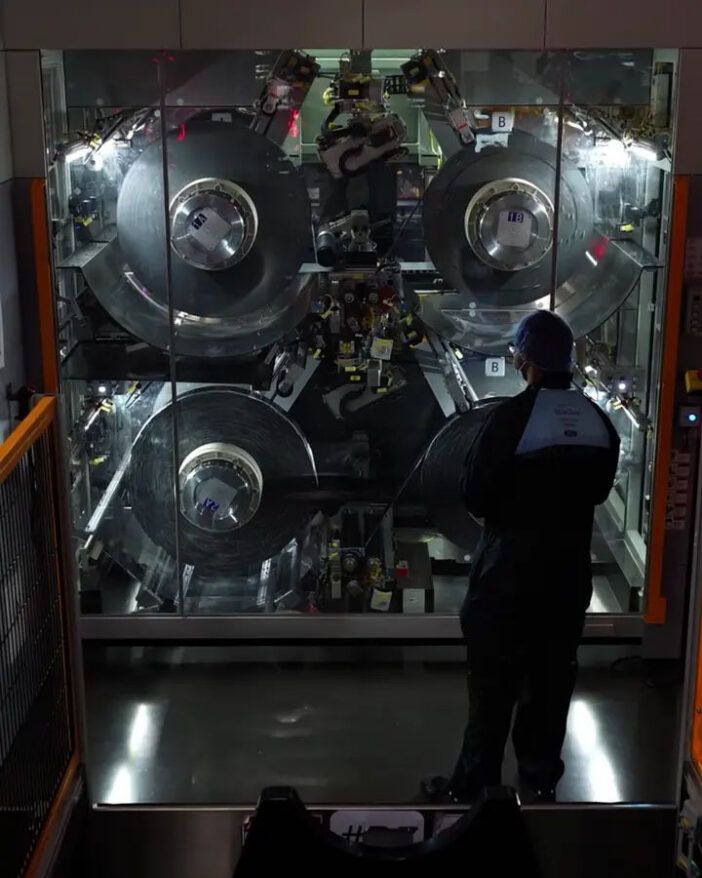
An operator monitors a cell winding machine, which winds electrode and separator material from large reels into jelly rolls, at BlueOval Battery Park Michigan in Marshall, Michigan.

Ford has begun shipping LFP prismatic battery cells from BlueOval Battery Park Michigan in Marshall to Louisville Assembly Plant for Fathom electric truck prototypes. The line produces 40 cells per minute using CATL technology. The cells form part of a structural pack. A Marshall pack plant is planned for 2027.

Ford has begun shipping lithium iron phosphate (LFP) prismatic battery cells from BlueOval Battery Park Michigan in Marshall, Michigan, to its Louisville Assembly Plant, where they will power prototypes of the Fathom midsize electric truck.

The cell plant is owned and operated by Ford. Its assembly lines can produce 40 cells per minute, which Ford says puts them among the fastest LFP prismatic lines outside China, measured by cells per minute. The site has capacity to increase output. Ford also says it will be the first company to deliver LFP batteries in the US for mainstream consumer automotive use.

The cell choice dates back to the development of Ford’s Universal Electric Vehicle Platform. Alan Clarke, vice president of advanced development projects, set the team the task of finding an efficient LFP prismatic battery to make electric vehicles (EVs) more affordable. According to Charles Poon, vice president of hardware engineering at Ford, that search led the company to CATL.

“We talked to battery companies around the world. We wanted a technology that was proven in the field, ready to manufacture at scale, and suited to what we were building,” Poon says.
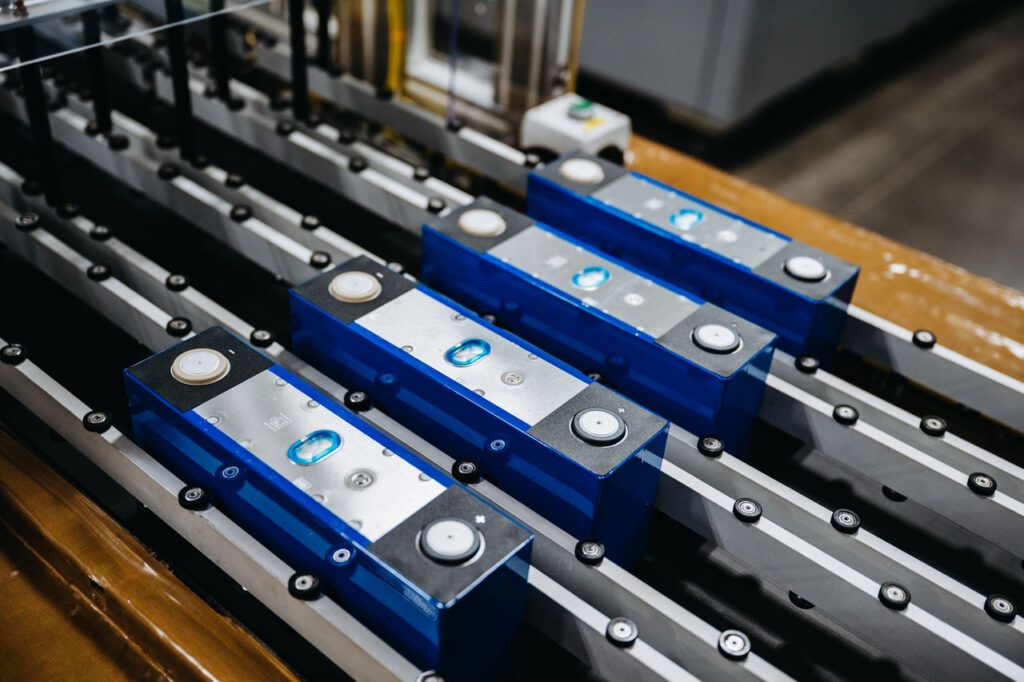
Finished LFP prismatic cells, wrapped in blue insulation film, at the end of the line.

LFP chemistry contains no nickel or cobalt, which Ford says helps control cost, and it is durable over years of charging. Ford says this durability supports alternating current (AC) bidirectional charging, which lets the Fathom draw power from a suitably equipped home and supply power back to it.

“A battery is one of the biggest contributors to an EV’s cost and weight,” Poon explains. “So, we asked: How do we get more out of the battery without simply adding more cells? Our answer was efficiency over excess.”

The battery pack forms part of the vehicle structure, and the rectangular prismatic cells were chosen because they fit directly into the chassis, reducing structural cost. Electrical and sensing connections are combined on a flexible circuit board, and compact power electronics are integrated into the pack. Ford says this architecture supports its Universal EV Production System.

“Our rule: The best part is no part, and the second-best part is one that serves multiple purposes,” says Poon.

On the production line, employees use artificial intelligence (AI)-based image recognition and other tools to detect defects. “Making a battery cell is one thing. Delivering high-quality cells consistently, at the required scale and pace, is another,” Poon notes. “Our goal is to make defective cells so rare that we track their frequency per billion cells rather than per million.”

Ford plans to start up a battery pack plant in Marshall in 2027, ahead of the Fathom’s launch. The cell work is also feeding into preparations by Ford Energy, the company’s battery energy storage business, for production in Glendale, Kentucky.

“The applications, customers, and products will be different, but the design expertise, controls, and manufacturing experience apply to both businesses,” Poon adds.

 

Share. Twitter LinkedIn Facebook Email
Previous ArticleBASF exits battery recycling to focus on cathode active materials
Webteam

Related Posts

Industry News

BASF exits battery recycling to focus on cathode active materials

November 24, 20263 Mins Read
News

Volvo compares 1976 Elbil electric prototype with EX60 as 31-mile range becomes 503 miles

November 24, 20263 Mins Read
Manufacturing

BMW iX4 enters production in Hungary with 828km range and 400kW charging

November 23, 20264 Mins Read
Latest Posts

Ford LFP battery cell plant in Marshall, Michigan, starts shipping at 40 cells per minute

November 24, 2026

BASF exits battery recycling to focus on cathode active materials

November 24, 2026

Volvo compares 1976 Elbil electric prototype with EX60 as 31-mile range becomes 503 miles

November 24, 2026
Our Social Channels
  • YouTube
  • LinkedIn
Getting in Touch
  • Free Email Newsletters
  • Meet the Editors
  • Contact Us
  • Media Pack
FREE WEEKLY NEWS EMAIL!

Get the 'best of the week' from this website direct to your inbox every Thursday


© Copyright 2026 Mark Allen Group. All rights are reserved, including those for text and data mining, AI training, and similar technologies.
  • Cookie Policy
  • Privacy Policy
  • Terms & Conditions

Type above and press Enter to search. Press Esc to cancel.

Sign In or Register

Welcome Back!

Login to your account below.

Lost password?