


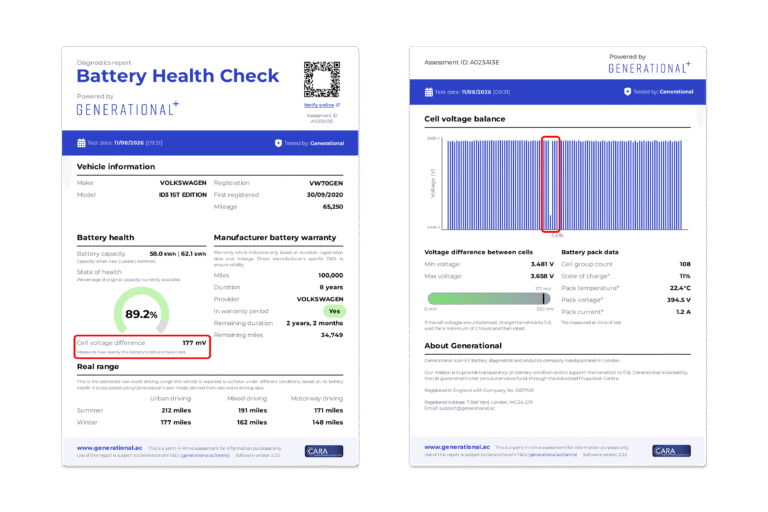
Generational’s analysis of around 10,000 used EV battery tests in the UK found 1 in 85 showed a cell-level voltage imbalance above 50 millivolts, and 1 in 200 exceeded 100 millivolts. The London-based diagnostics company says State of Health data alone does not reveal these hidden cell-level faults.
Generational, a battery diagnostics company based in London, UK, has published analysis of individual battery cells from approximately 10,000 used EV battery tests conducted through hundreds of automotive dealers across the UK.
The analysis found that around 1 in 85 tests showed a cell-level voltage imbalance above 50 millivolts (mV), a level the company says requires investigation. Around 1 in 200 tests showed an imbalance exceeding 100 mV, which some manufacturers’ own inspection procedures treat as a failed pack. The median vehicle in the dataset showed just an 8 mV difference between its highest and lowest cell voltages, indicating that most used EV batteries remain well balanced.
According to Oliver Phillpott, chief executive of Generational, State of Health (SoH) reporting does not tell the full story of battery condition. “It measures capacity, not necessarily whether the cells inside the pack are functioning correctly,” he says.
In a modern EV battery pack, hundreds of individual cells operate together as one system, and must remain closely balanced for the pack to deliver reliable performance. If a cell drifts materially away from the others, the battery management system may limit charging or discharging to protect the weakest cell, potentially affecting range, state-of-charge estimates and charging behavior, and in more serious cases requiring module or battery replacement.
“Cell imbalance problems are often imperceptible, while the battery is developing a fault that could affect range, charging or value later on,” Phillpott says. “The only practical way to see that risk early is to test for it.”
Where a vehicle is flagged, Generational instructs the dealer on how to attempt a rebalance of the cells. Around half of issues persisted after this process was followed, with the company noting that severity predicts whether a problem can be cleared; more extreme imbalances are unlikely to be addressable without repairs.
Phillpott says the cell-level testing adds a layer of transparency to the market. “It also helps strong vehicles prove their quality, and it helps dealers identify the small number of vehicles that need attention before they become a customer problem,” he says. “That is how we build a healthier, more confident used EV market.”
The Society of Motor Manufacturers and Traders (SMMT) reported that used battery-electric vehicle (BEV) transactions reached record levels in the first quarter of 2026, as the UK’s EV parc continues to age. Generational said EV batteries can represent over 40 percent of a vehicle’s cost, and that industry understanding of battery condition has not kept pace with the volume of vehicles now passing through the used market.
The analysis builds on Generational’s Battery Performance Index, based on more than 8,000 EV battery assessments across the UK, which found average battery SoH stood at 95.15 percent, with variance between vehicles increasing with age.