
Electric & Hybrid Vehicle Technology International
  • News
    • A-F
      • Battery Energy Storage Systems
      • Battery Technology
      • Buses & Commercial Vehicles
      • Charging Technology
      • Concept Vehicle
      • Electrification Strategies
      • Fuel-cell Technology
    • G-K
      • Hybrid Powertrain
      • Hybrid Architecture
      • Industry News
      • Joint Ventures
    • L-Q
      • Manufacturing
      • Materials Research
      • Motor Technology
      • Motorsport Electrification
      • OEM News
      • Powertrain Components
      • Pure-Electric Powertrain
    • R-Z
      • Range Extender
      • Solid-State Battery Technology
      • Testing
      • Transmissions
  • Features
  • Online Magazines
    • New issue available now! August 2026
    • March 2026
    • September 2025
    • June 2025
    • March 2025
    • Nov / Dec 2024
    • Archive Issues
    • Subscribe Free!
  • Technical Articles
  • Subscribe Free
    • Free Email Newsletters
    • Subscribe to Magazine
  • Opinion
  • Supplier Spotlight
  • Webinars
  • Events
  • Podcasts
LinkedIn YouTube X (Twitter)
Subscribe to Magazine SUBSCRIBE TO EMAIL NEWSLETTER MEDIA PACK
LinkedIn
Electric & Hybrid Vehicle Technology International
  • News
      • BESS
      • Battery Technology
      • Buses & Commercial Vehicles
      • Charging Technology
      • Concept Vehicle
      • Electrification Strategies
      • Fuel-cell Technology
      • Hybrid Powertrain
      • Hybrid Architecture
      • Industry News
      • Joint Ventures
      • Manufacturing
      • Materials Research
      • Motor Technology
      • Motorsport Electrification
      • Opinion
      • OEM News
      • Powertrain Components
      • Pure-Electric Powertrain
      • Range Extender
      • Solid-State Battery Technology
      • Testing
      • Transmissions
  • Features
  • Online Magazines
    1. New issue available now! August 2026
    2. March 2026
    3. September 2025
    4. June 2025
    5. March 2025
    6. Nov / Dec 2024
    7. Archive Issues
    8. Subscribe Free!
    Featured
    August 10, 2026

    New issue available now! August 2026

    Online Magazines By Web Team
    Recent

    New issue available now! August 2026

    August 10, 2026

    New issue available now! March 2026

    March 19, 2026

    New issue available now! September 2025

    September 9, 2025
  • Technical Articles
  • Videos
  • Supplier Spotlight
  • Webinars
  • Events
  • Podcasts
LinkedIn
Electric & Hybrid Vehicle Technology International
Electrification Strategies

Hyundai reveals in-house battery cells and targets 60% electrified sales mix by 2030

Web TeamBy Web TeamAugust 26, 20264 Mins Read
Share LinkedIn Twitter Facebook Email
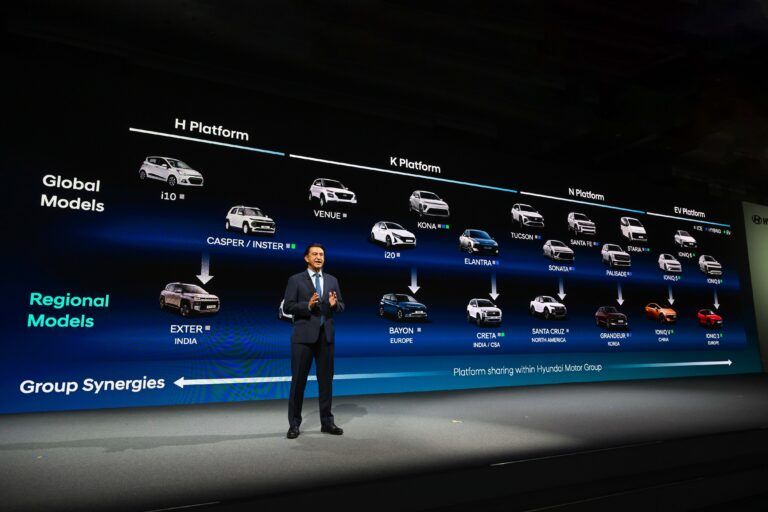
José Muñoz, President and CEO of Hyundai Motor Company, makes the announcements at the companies 2026 CEO Investor Day.

Hyundai Motor Company plans to raise EVs to 60% of global sales by 2030, launching its first Extended Range Electric Vehicle, the Santa Fe EREV, in 2027 with over 600 miles of range. New in-house battery cells double output and cut charging time 40%, alongside a Thermal Runaway Protection safety system debuting on the Genesis GV90.

Hyundai Motor Company has set out plans to raise EVs to 60 percent of its global sales mix by 2030, up from 23 percent in 2025, as part of a broader product and technology roadmap announced at its 2026 CEO Investor Day in Seoul, South Korea.

The company reaffirmed a 2030 target of 5.55 million global vehicle sales, representing a 6 percent global market share, and said it plans more than 100 global product launches and refreshes by 2030, including 18 or more entries into new market segments.

Central to the electrification push is Hyundai’s first Extended Range Electric Vehicle (EREV), which combines a battery electric drivetrain with an onboard generator. The Santa Fe EREV, targeting more than 600 miles (966 km) of total range, is scheduled to launch in the first half of 2027 and will be built in the US at Hyundai Motor Manufacturing Alabama (HMGMA).

According to José Muñoz, president and chief executive of Hyundai Motor Company, the company’s financial position allows it to keep investing while competitors pull back. “We are bringing more than 100 new models to market by 2030 with multiple powertrain options and raising our operating margin above 9 percent,” he says.

Hyundai said it has independently developed new in-house battery cells that deliver more than double the output of its previous high-nickel cells, while cutting charging time by 40 percent. These cells will be applied to the 2027 EREV, which the company said uses less than half the battery capacity of a comparable EV while matching its performance and driving dynamics. Separately, EV models launching next year will use mid-nickel NCM cells, which Hyundai said reduce battery cost by around 30 percent while maintaining performance under real-world driving conditions.

The company also plans to enhance its cloud-based battery management system (BMS) to extend battery life by an average of 20 percent by 2028. A new Thermal Runaway Protection (TRP) technology, which blocks heat transfer between adjacent cells during a battery fire rather than merely delaying it, will debut on the Genesis GV90. Hyundai said it has verified TRP through more than 200 repeated tests on prismatic and pouch nickel-cobalt-manganese (NCM) batteries.

In Europe, Hyundai aims to expand EV sales to more than 420,000 units by 2030, from 116,000 in 2025, with 85 percent of the market covered by a fully electrified portfolio including five new SUV and light commercial vehicles. The IONIQ 3 goes on sale this month, offering 309 miles (497 km) of range and becoming the first vehicle in Europe to feature the Pleos Connect infotainment platform.

Genesis, Hyundai’s luxury brand, will add its first EREV SUV, targeting more than 640 miles (1,030 km) of range, in early 2027, alongside the GV80 Hybrid, its first hybrid model, arriving in the fourth quarter of 2026.

In Korea, a new EV facility at Hyundai’s Ulsan operations will begin production with the Genesis GV90, deploying 108 advanced manufacturing tools alongside AI-enabled quality control and inspection systems.

In North America, Hyundai is raising its 2030 local parts sourcing target from 60 percent to 80 percent and will offer more than 10 hybrid models by 2030, with hybrids reaching a 50 percent sales mix in the region. Cumulative hybrid sales in North America have passed one million units, while IONIQ 5 sales rose 9 percent in the first half of 2026.

Global manufacturing capacity will expand by 1.27 million units by 2030, including 500,000 units in North America and 200,000 in Korea, the latter including the new Ulsan EV plant.

Hyundai reported first-half 2026 revenue of 95.2 trillion won and an operating profit margin of 5.6 percent. The company raised its 2030 consolidated operating profit margin target to above 9 percent, up from a previously guided 8 to 9 percent range.

 

Share. Twitter LinkedIn Facebook Email
Previous ArticleGenerational analysis flags cell imbalance risk in used EV batteries
Next Article FEATURE: How Škoda’s RegioPanter BEMUs prove battery-electric rail works
Web Team

Related Posts

News

Generational analysis flags cell imbalance risk in used EV batteries

August 26, 20263 Mins Read
Manufacturing

Aptera partners with Launch Design to scale solar EV manufacturing

August 26, 20263 Mins Read
News

Chery Automobile picks UTAC Millbrook for new UK engineering base

August 26, 20263 Mins Read
Latest Posts

FEATURE: How Škoda’s RegioPanter BEMUs prove battery-electric rail works

August 26, 2026

Hyundai reveals in-house battery cells and targets 60% electrified sales mix by 2030

August 26, 2026

Generational analysis flags cell imbalance risk in used EV batteries

August 26, 2026
Our Social Channels
  • YouTube
  • LinkedIn
Getting in Touch
  • Free Email Newsletters
  • Meet the Editors
  • Contact Us
  • Media Pack
FREE WEEKLY NEWS EMAIL!

Get the 'best of the week' from this website direct to your inbox every Thursday


© Copyright 2026 Mark Allen Group. All rights are reserved, including those for text and data mining, AI training, and similar technologies.
  • Cookie Policy
  • Privacy Policy
  • Terms & Conditions

Type above and press Enter to search. Press Esc to cancel.