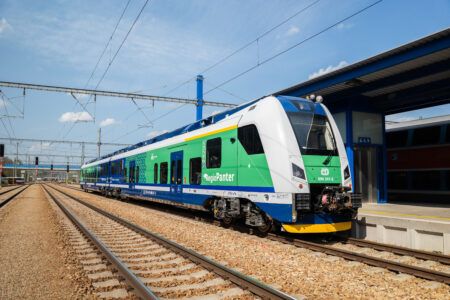


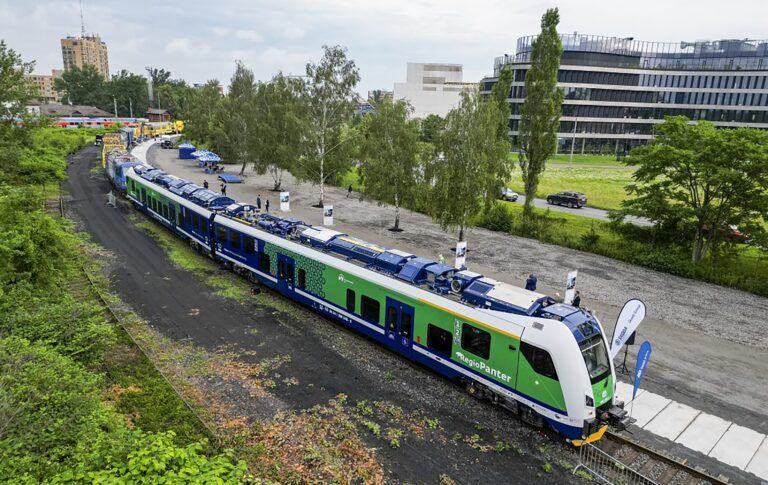
Škoda Group’s RegioPanter battery electric multiple units (BEMUs) have covered 500,000 kilometers in Czech Republic service, proving battery-electric rail works on partially electrified networks. With 80 km battery range and 160 km/h catenary speeds, fifteen new-generation units enter service in early 2027, offering diesel-free regional transport without major infrastructure investment.
The international unveiling of Škoda Group’s next-generation RegioPanter battery electric multiple units at Trako 2025 in Gdańsk marked the transition of battery-electric trains from experimental curiosity to proven operational reality – a shift underwritten by half a million kilometres of real-world service data from the Czech Republic’s Moravian-Silesian Region.
For engineers watching rail electrification strategies evolve, the RegioPanter BEMU programme offers a compelling case study in pragmatic deployment. While the industry pursues long-term full network electrification, Škoda’s approach addresses an immediate challenge: eliminating diesel traction on partially electrified networks without waiting decades for infrastructure investment.
The new-generation units build directly on operational experience from four earlier two-car BEMU sets that entered service in December 2024. “České dráhy has been operating the first four Škoda RegioPanter electric units with batteries in trial service for almost a year,” said Michal Krapinec, Chairman of the Board and CEO of České dráhy. “In that time, they have covered half a million kilometres in combined operation, both under catenary and on batteries.”
This represents months of intensive regional service, providing detailed data on battery degradation, energy consumption, and system reliability. Krapinec is emphatic: “This is clear proof that this technology is the future of regional transport.”
The technical specifications reflect careful balance. Maximum speeds reach 160 km/h under catenary and 120 km/h in battery mode – a deliberate trade-off prioritising range over top-end performance off-wire. Battery range stands at 80 kilometres, calibrated for Czech regional networks where non-electrified sections typically fall within this envelope.
The architecture centres on continuous charging. Units recharge from catenary during electrified sections and switch to battery power elsewhere. Regenerative braking provides additional energy recovery, extending range and reducing peak charging demand when reconnecting to overhead lines.
For transport authorities, the value proposition centres on deployment speed. As Petr Novotný, CEO of Škoda Group, frames it: “RegioPanter battery units are clean and efficient solution for regional transport that can be deployed immediately, without waiting for major infrastructure investments.”
Traditional electrification involves years of planning, assessment, construction, and commissioning. Catenary installation can exceed £2 million per route kilometre, with timelines stretching beyond five years. Battery-electric units circumvent this entirely.
The Ostrava-Veřovice route illustrates the model. “On the Ostrava–Veřovice line, thanks to the new catenary-and-battery trains, we have seen passenger numbers increase by up to twenty percent,” said Krapinec. BEMU units eliminated transfers at electrification boundaries, improving journey times and passenger experience simultaneously.
Novotný sees significant market potential: “Thanks to the catenary-and-battery concept, which combines continuous charging under overhead lines with battery operation in non-electrified sections, they bring operators lower operating costs and passengers faster, more comfortable, transfer-free connections,” he said. “We see strong export potential for this solution in many regions – especially in Central and Eastern Europe.”
This relevance to Central and Eastern European networks is acute, where Soviet-era electrification created islands of catenary interspersed with non-electrified sections. Battery units deliver immediate emissions reductions while preserving options for future full electrification.
The environmental case is straightforward. The four initial BEMUs save at least 200,000 litres of diesel and around 500 tonnes of CO₂ annually. Extrapolated across fifteen new-generation units entering service in early 2027, potential annual savings approach 750,000 litres and 1,875 tonnes of CO₂. The true benefit depends on the electricity generation mix, but point-source emissions elimination remains valuable for air quality, particularly where diesel particulates and NOx affect public health.
Operational data indicates robust performance across seasonal temperature variations. The first four units covered more than 500,000 kilometres in ten months, with almost half in battery mode – suggesting effective thermal management and conservative battery sizing capable of handling Czech winters.
The programme also demonstrates how rolling stock technology can influence mode shift. Modern trains with shorter journey times have driven ridership growth of up to 20 percent on affected routes, improving cost recovery through increased fare revenue.
“With the support of the Moravian-Silesian Region, we became the first operator in the Czech Republic to deploy battery units,” said Krapinec. “And the newly presented train type will soon expand their use across the entire region.”
The broader industry trajectory points toward diversifying electrification strategies. Pure battery trains suit shorter routes with predictable schedules. Hydrogen fuel cells attract interest for long-distance, low-density routes where electrification economics prove challenging. The catenary-and-battery hybrid occupies middle ground: networks with substantial but incomplete electrification, where extending battery-electric operation into the gaps delivers immediate value.
European operators are watching closely. Germany, Poland, and Italy all operate regional networks with partial electrification, and several have initiated procurement for battery or hybrid units. The UK’s battery trials and Scotland’s commitment to hydrogen and battery traction reflect similar thinking – using advanced rolling stock to eliminate diesel without comprehensive electrification.
Škoda’s production approach – fifteen units for 2027 – represents targeted deployment proving the concept at scale before broader adoption, managing technical and financial risk while building the operational dataset necessary for export sales.
As Novotný observes, battery units represent “a fast and effective solution” for regions with partially electrified networks. By operating on batteries, they deliver the comfort and journey times of electric trains where diesel units currently run, increasing the attractiveness of rail transport and improving access to smaller towns.
The question facing the industry isn’t whether battery-electric trains work – the Czech experience conclusively demonstrates they do. It’s determining where this technology fits within a broader portfolio of electrification strategies, each suited to different networks and constraints.