

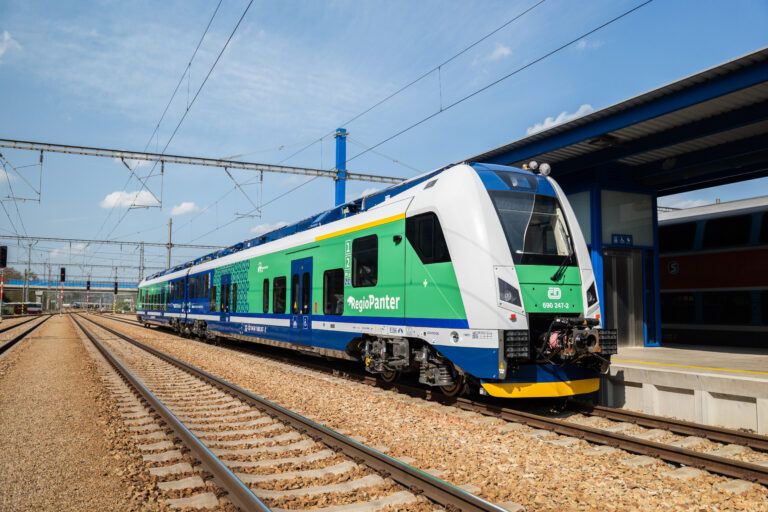
Škoda Group debuted its new-generation RegioPanter battery electric multiple unit at InnoTrans Berlin. The train combines overhead-line and battery power for non-electrified routes. Over 100 units are on order across Europe; the first four, in Czech Republic’s Moravian-Silesian Region, have cut diesel use and lifted passenger numbers by 20%.
Škoda Group, the rail and transport vehicle manufacturer based in Plzeň, Czech Republic, presented its new-generation RegioPanter battery electric multiple unit (BEMU) at InnoTrans in Berlin on September 22, 2026, the train’s first appearance at the international transport technology trade fair.
The RegioPanter combines conventional running under overhead electric lines with battery-powered operation on non-electrified track, allowing operators to run zero-emission services without electrifying an entire route. Škoda Group said it currently has more than 100 units featuring battery technology at various stages of production and order fulfilment for customers in several European countries.
According to Tomáš Ignačák, deputy chairman of the board at Škoda Group, InnoTrans is where the rail industry converges, and battery trains represent an established export product rather than a future concept. He says the technology allows operators to offer electric-rail-standard comfort on partially non-electrified networks without lengthy infrastructure projects.
The first four Škoda battery units entered service in the Moravian-Silesian Region of the Czech Republic in December 2024 and have since covered around 1.25 million kilometers over roughly 21 months. On these routes, the units run on battery power over non-electrified sections and switch to overhead-line power on electrified corridors, removing the need for passengers to change trains for journeys to the regional capital, Ostrava.
Škoda Group said passenger numbers on selected services have risen by up to 20% since introduction, which it attributes to the availability of direct connections. The company said the first four units save at least 200,000 liters of diesel and approximately 500 tonnes of CO2 emissions annually.
Ignačák adds that a battery train’s value lies not in the battery itself but in the ability to eliminate transfers, shorten journeys and improve comfort while replacing diesel operation.
The new RegioPanter was designed from the outset as a dedicated BEMU, with a revised roof-mounted battery arrangement and an optimized traction system. In battery mode the train has a range of at least 80 km and a top speed of 120 km/h; under overhead lines it reaches 160 km/h. Continuous power output is 1,360 kW in both modes, using a traction system with silicon carbide (SiC) converters. The unit uses lithium titanate oxide (LTO) batteries. Škoda Group said the new design cuts vehicle weight by several tonnes and lowers energy consumption compared with the previous generation.
The two-car, 52.9-meter unit seats 150 passengers, including eight in first class, with total capacity for 323. It is equipped with European Train Control System (ETCS) Level 2 Baseline 3 and operates on both 3 kV DC and 25 kV 50 Hz AC electrified lines.
Škoda Group is manufacturing 15 new-generation units for Czech operator České dráhy for the Moravian-Silesian Region, and holds contracts for up to 36 battery trains in Slovakia and up to 16 BEMU units in Latvia. Contract values and delivery schedules for the Slovakia and Latvia orders were not disclosed.
The company said its use of battery traction dates back to locomotives it built in the 1920s and 1930s; since 2015 its battery trams have run in Türkiye, and it also applies battery technology in trolleybuses.