

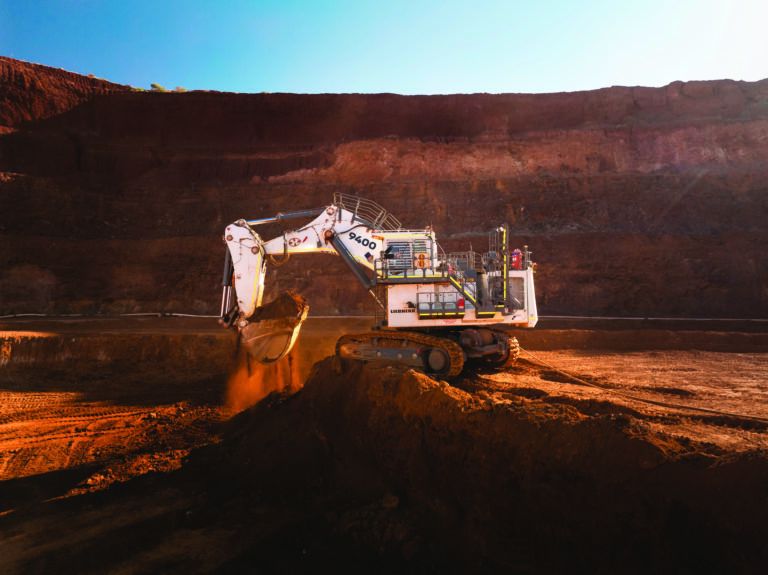
Liebherr and Fortescue signed a $2.8 billion deal—the largest in Liebherr’s history—for 475 zero-emission mining machines, including 360 autonomous battery-electric trucks, 55 electric excavators, and 60 battery dozers. Deployed across Fortescue’s Australian iron ore operations, the partnership uses fast-charging, dynamic power transfer, and regenerative braking to prove mining electrification is viable.
The mining sector has long been viewed as one of the most difficult industries to decarbonize, but a landmark partnership between equipment manufacturer Liebherr and Australian mining company Fortescue is demonstrating that large-scale electrification represents both a technically feasible and economically viable pathway forward.
The $2.8 billion contract stands as the largest equipment deal in Liebherr’s 75-year history and represents Fortescue’s biggest procurement agreement to date. The partnership encompasses 475 zero-emission machines, including approximately 360 autonomous battery-electric trucks, 55 electric excavators, and 60 battery-powered dozers that will be deployed across Fortescue’s iron ore operations in Australia.
Dr Jörg Lukowski, executive vice president of sales and marketing at Liebherr-Mining Equipment, characterizes the arrangement as significant for the broader industry. “Our collaboration with Fortescue is an important step forward in our shared goal to decarbonize mining activities worldwide,” he says.
For Fortescue, this partnership forms a central pillar of its Real Zero initiative, which aims to eliminate carbon emissions from its Australian iron ore operations by 2030. Dr Andrew Forrest, Fortescue’s executive chairman, frames the effort as simultaneously addressing environmental necessity and business opportunity. Speaking at construction trade fair Bauma last year, Forrest emphasized urgency. “The world needs Real Zero now – it simply cannot afford to wait,” he said. “The green solutions we need are here today, and Fortescue Zero is supplying them and rolling them out across our massive mining operations.”
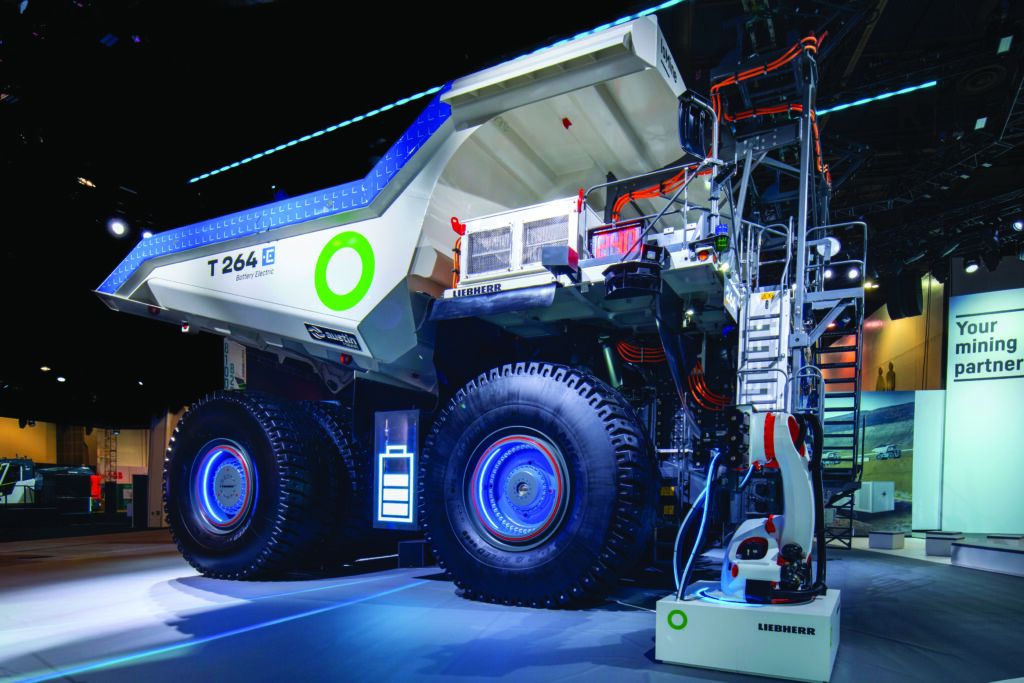
The centrepiece is the T 264 battery-electric rigid mine hauler, manufactured at Liebherr’s Newport News, Virginia facility. “Fortescue Zero is our battery power system supplier,” says Richard Kraemer, haulage electrification solutions manager for Liebherr. “They make all the sub packs and all the necessary components that go with it, which we integrate into our truck.”
Fortescue’s electrification capabilities originated with its 2022 acquisition of Williams Advanced Engineering, the battery and technology division of the Williams Formula One racing team based in Oxfordshire, England. The subsidiary was rebranded in 2024.
Fortescue Zero has engineered a 3.2MWh battery system to power the 240-tonne capacity truck, with three distinct charging methodologies. The first approach uses static fast-charging technology that delivers up to 6MW of power through an automated robotic connection arm employing two Megawatt Charging System connectors. This method enables 30-minute fast charging, helping maintain operational continuity.
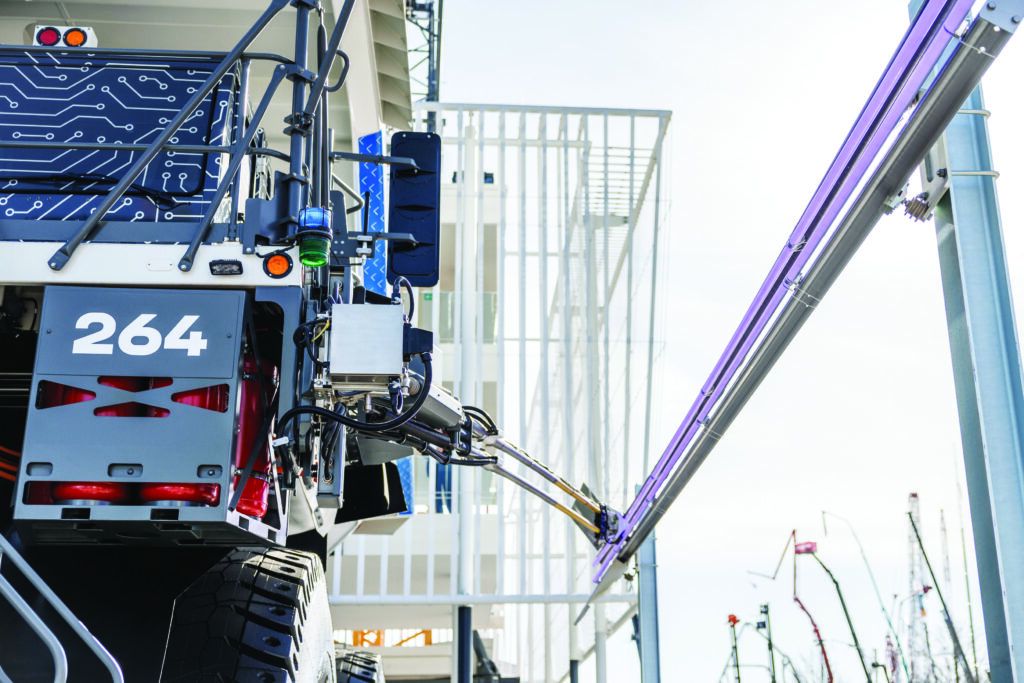
The second charging option utilizes dynamic power transfer through a system called the Power Rail, which represents an evolution of established trolley bar technology. Kraemer explains the innovation: “This takes the traditional benefit of trolley assist, which is done through overhead lines, but does it through a side-mounted rail. This optimizes installation time and reduces cost, while also providing an efficient means of power transfer to the truck.”
The third energy recovery method leverages regenerative braking technology. “While the truck is operating downhill, in a typical diesel truck, that energy would be released through braking. Now it is captured on the onboard battery power system,” Kraemer says.
Fortescue Zero has developed two battery configurations to address different operational scenarios. The energy capacity battery operates similarly to a large fuel tank, providing extended running times where charging infrastructure may be limited. This configuration requires approximately one hour to charge and offers a lifecycle of two to three years with roughly 3,600 charging cycles.
The power battery charges within 12 minutes and is designed for operations where charging infrastructure is readily accessible. While offering less energy storage capacity, it provides more frequent charging cycles and an extended overall lifecycle. This dual battery approach provides operational flexibility, enabling mine sites to select the configuration that best aligns with their specific infrastructure capabilities and operational requirements.
The partnership implications extend beyond Fortescue’s operations. Both companies have confirmed that their zero-emission mining ecosystem will become available to the broader mining industry. “The technology developed as part of this record-breaking deal will not only support our customers along their decarbonization journeys but also help us honor our commitment to offer completely fossil fuel free hauling, loading and dozing solutions by the end of the decade,” says Dr Lukowski.
Forrest characterizes the transition as fundamentally driven by economic rather than purely environmental considerations. “We’re not here to be altruistic or philanthropic,” he says. “We’ve got to pay the wages. We’re going to pay off the construction equipment we buy. Yes, we have a return to shareholders. Otherwise, we can’t pay our taxes.”
Analysis from Fortescue suggests that renewable energy solutions can compete directly with alternative low-emission power sources. The company’s data indicates operating costs between $15 and $45 per megawatt hour, which compares favorably with liquefied natural gas at $90 to $100 per MWh and nuclear power at $60 to $70 per MWh.
The T 264 trucks incorporate autonomous operation capabilities in addition to electric powertrains. The vehicles can operate with an Autonomous Haulage Solution jointly developed by Liebherr and Fortescue Zero, which integrates energy management with fleet optimization. Oliver Weiss, executive vice president of research and development, engineering and production at Liebherr-Mining Equipment, explains the design philosophy. “We wanted to design and build an intelligent, state-of-the-art system that not only includes the know-how from both an OEM and a mining operator generated over the last few years but will also be able to integrate with new zero emission solutions in the future,” he says.
The system includes an Energy Management System that coordinates static recharge assignments and optimizes charger utilization to avoid operational bottlenecks. Weiss elaborates: “The fleet management assignment engine at the core of the AHS monitors fleet energy levels so that jobs and energy replenishment tasks can be assigned efficiently within zero emission fleets equipped with this system.”
With more than 200 autonomous trucks across its mine sites, traveling the equivalent of two trips to the moon and back each month, it is imperative for Fortescue that they operate efficiently and at maximum capacity. Both the battery systems and autonomous haulage solution are designed to be retrofitted onto existing Liebherr haul trucks, ensuring that current equipment investments remain viable during the transition to electrification.
The partnership also encompasses 55 R 9400 E cable-powered electric excavators in both backhoe and face shovel configurations. These 350-tonne machines combine four decades of Liebherr electric excavator experience with innovations including cable reel solutions that offer up to 300 meters of autonomous cable management.
Fortescue first adopted this technology in 2023 with Australia’s first operational electric excavator. Three R 9400 E excavators are now operational across company sites, providing real-world validation of technology that delivers equivalent power and productivity to internal combustion engine counterparts. The agreement also includes 60 battery-powered versions of Liebherr’s flagship PR 776 mining dozer.
This partnership demonstrates the technical and economic viability of large-scale mining electrification. With both companies committed to making their zero-emission ecosystem available throughout the industry, this collaboration could catalyze wider adoption of electrification technologies across the mining sector. The validation timeline through 2026 will provide essential real-world performance data on these integrated systems under actual mining conditions, potentially establishing a template for industry-wide transformation.