

Škoda Group has delivered the first two of 52 battery trolleybuses ordered by Esslingen am Neckar, Germany, as the city moves toward 100% electric public transport by the end of 2026. The trolleybuses run on overhead lines and battery power, with up to 25 kilometers of range off-wire.
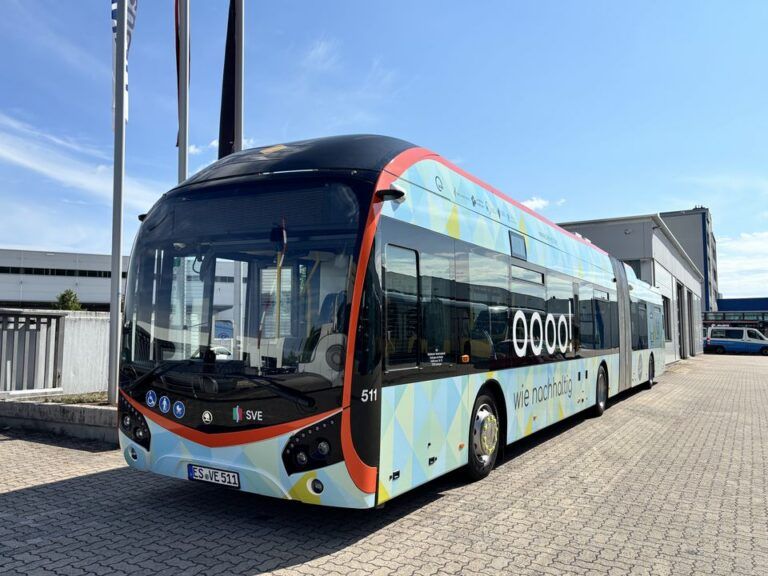
Škoda Group has delivered the first two battery trolleybuses to Esslingen am Neckar, Germany, marking the start of a contract to supply 52 trolleybuses to the city.
The vehicles were presented today alongside representatives of the City of Esslingen am Neckar, in the German federal state of Baden-Württemberg, and the public transport operator Städtischer Verkehrsbetrieb Esslingen am Neckar (SVE). The contract also includes an option for nine additional vehicles.
The order comprises ten 12-meter Škoda 32Tr trolleybuses and 42 18-meter articulated Škoda 33Tr trolleybuses. The vehicles combine operation under overhead lines with battery power away from the overhead contact network, offering a range of up to 25 kilometers (15.5 miles), which the company says will let the city develop electric routes where overhead line infrastructure has not been built. Deliveries will continue gradually through the end of 2026.
“The presentation of the first trolleybuses for Esslingen is confirmation that the project is progressing according to plan,” said Karel Majer, chairman of the board of Škoda Electric at Škoda Group. “The new battery trolleybuses combine proven electric traction technology with the flexibility of operation away from overhead lines and will offer passengers modern, reliable and comfortable transport.”
The delivery supports Esslingen’s “100% Electromobility in Public Transport” project, which aims to make the city’s urban transport network fully electric by the end of 2026. The city is expanding its roughly 29-kilometer (18-mile) trolleybus network with additional sections to support electric operation on all urban routes, using green electricity supplied by municipal energy company Stadtwerke Esslingen.
“With the new battery trolleybuses, we are investing in modern, high-performance and climate-friendly public transport,” said Matthias Klopfer, mayor of the City of Esslingen am Neckar.
The 12-meter Škoda 32Tr vehicles will be delivered in a two-door configuration, while the 18-meter articulated Škoda 33Tr vehicles will have three doors. Both feature barrier-free boarding, modern passenger information systems, Wi-Fi, intercity-style seating, an electric ramp for wheelchair and pram users, and remote diagnostics. The vehicles also use energy recuperation technology that returns braking energy, such as on downhill sections, to the batteries.
The articulated trolleybuses use a dual-motor drive with two driven axles. The delivery includes service support intended to maintain the vehicles’ long-term operational reliability.
“Esslingen is a highly significant project for us,” said Jan Harder, president of region West at Škoda Group. “This project reinforces our strong position in the German market and demonstrates that our electric mobility solutions effectively meet the needs of cities striving for sustainable transport.”
The order marks Škoda’s return to the German trolleybus market, following historic deliveries of 205 trolleybuses to the former German Democratic Republic between 1955 and 1987. Škoda Group has also recently announced or concluded trolleybus contracts for cities including Tallinn, Sofia, Jihlava, Hradec Králové, Ostrava, Ústí nad Labem, Chomutov, Jirkov and Banská Bystrica.