

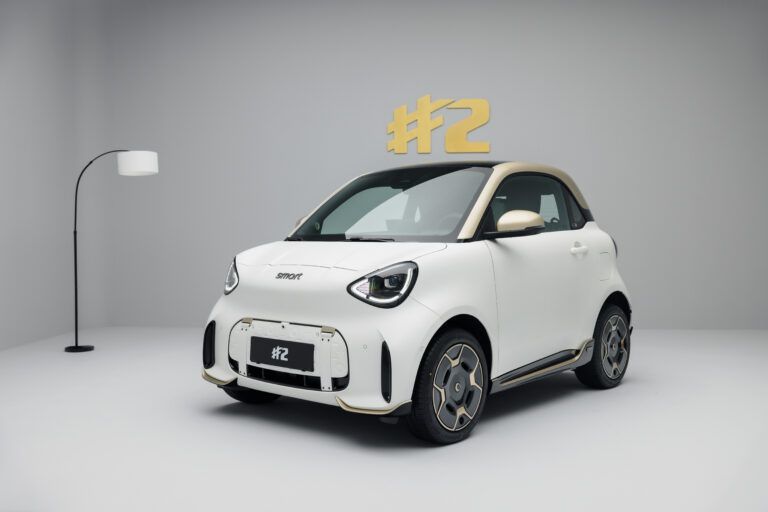
The smart #2 is a battery-electric two-seater revealed at the 2026 Paris Motor Show. Built on smart’s new ECA platform, it is 2,746 mm long, has a 6.95 m turning circle, a 60 kW rear motor, 35.8 kWh LFP battery, up to 290 km WLTP target range and 65 kW DC charging.
smart Europe GmbH, based in Leinfelden-Echterdingen, Germany, has revealed the smart #2, a battery-electric two-seater built on a new dedicated platform, at the Paris Motor Show. The 2,746 mm (108.1 in) car uses a rear-mounted 60 kW motor driving the rear wheels, a 35.8 kWh lithium iron phosphate (LFP) battery and a five-link rear suspension, which the company says is a first in the car’s class.
The model is the successor to the smart fortwo. The original smart two-seater concept was unveiled in Paris 30 years ago.
The motor produces 130 Nm of torque. smart gives a target range of up to 290 km (180 miles) on the combined Worldwide Harmonized Light Vehicles Test Procedure (WLTP) cycle. Direct current (DC) fast charging peaks at 65 kW, taking the battery from 10% to 80% state of charge in 20 minutes. Alternating current (AC) charging of up to 11 kW is also offered, and the car supports vehicle-to-load (V2L) operation for powering external devices.
“For me, the smart #2 is much more than a new addition to our portfolio. It marks the return of a true automotive icon, reimagined for the cities of today,” says Wolfgang Ufer, chief executive at smart Europe.
The new Electric Compact Architecture (ECA) platform was engineered specifically for the two-seater. The car has wider tires at the rear than at the front, and its floor-mounted battery lowers the center of gravity. According to smart, this, combined with the five-link rear axle, allows a more direct steering geometry. The wheels sit at the corners of the body, and the turning circle measures 6.95 m curb-to-curb.
“Getting the balance right in a car this compact meant tuning every detail, from chassis hard points and steering ratio to the right tyre compound for both city streets and open highways,” explains Dr. Tilo Schweers, vice president R&D Europe at smart Europe. “We tested the smart #2 on proving grounds, in wind tunnels, and on public roads across different climates, because confidence behind the wheel must hold up in the real world, not just on paper.”
The body structure uses the Tridion Cell Evo, a development of the safety cell used in previous smart models. Standard advanced driver assistance systems (ADAS) include smart Pilot Assist, adaptive cruise control (ACC) with Stop & Go and Highway Assist, Blind Spot Detection, Rear Collision Mitigation and Rear Cross Traffic Alert.
Inside, a 10.1in central screen is paired with an 8.8in driver display, with 4G, Wi-Fi and Bluetooth connectivity backed by an eight-year connected services package. The cabin uses bench-style seating and a dashboard mount, called the smart Pillar, for small accessories.
European launch trims are Pure, Pure+ and Premium. Pure+ adds 11 kW AC charging and a heated driver’s seat; Premium adds a glass roof, heated synthetic leather seats and a seven-speaker Sennheiser sound system. A Couture Edition limited to 999 units in Europe has full Premium specification, matte white paint with a gold-colored roof, 16in wheels and a numbered interior badge.
“Technology has moved forward, cities have changed, and the need for clever urban mobility is more relevant than ever,” Ufer adds.
smart Europe is a subsidiary of smart mobility International, the joint venture between Mercedes-Benz AG and Geely Holding Group.