


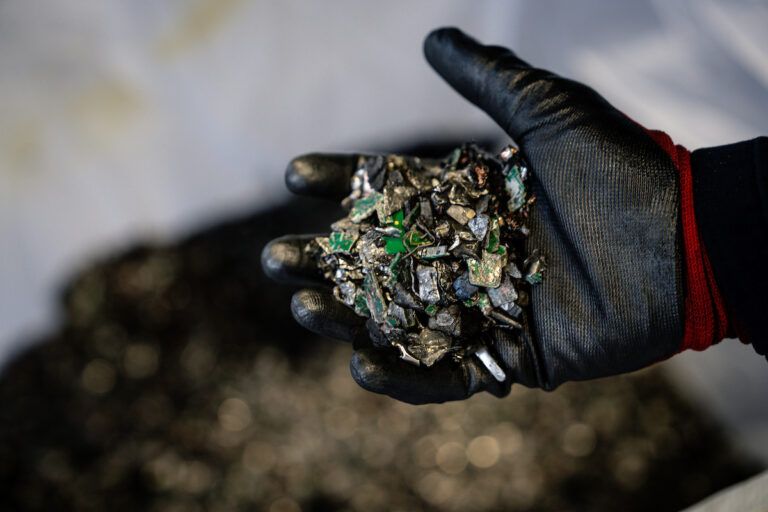
A UK consortium comprising UKBIC, Watercycle Technologies, Recyclus Group and Polaron has received government funding to develop ReCAM, a single-step process converting li-ion battery black mass into cathode active material domestically. The project targets the UK’s lack of viable black mass processing, with annual volumes projected to reach 94,000 tonnes by 2040.
A four-organization UK consortium has been awarded funding through the government’s Battery Innovation Programme to develop a domestic recycling process that converts end-of-life lithium-ion (li-ion) battery waste directly into cathode active material (CAM) for use in new batteries.
The project, known as ReCAM, brings together the UK Battery Industrialisation Centre (UKBIC), Watercycle Technologies, Recyclus Group Ltd and Polaron. The Battery Innovation Programme is a £452 million initiative running from 2026 to 2030, delivered by Innovate UK — part of UK Research and Innovation (UKRI) — and supported by the Department for Business and Trade as part of the government’s Industrial Strategy.
The UK is projected to generate up to 94,000 tonnes of black mass annually by 2040 as electric vehicle (EV) adoption increases. Black mass — produced during the disposal and recycling of li-ion batteries — contains lithium, nickel, cobalt and manganese. Currently, the UK has no viable domestic processing route for the material, meaning it is exported overseas, with the associated economic losses, emissions and supply chain dependencies that entails.
ReCAM introduces a patented short-loop refining process that converts black mass into high-value CAM in a single step, contrasting with conventional multi-stage chemical processes that break materials down into individual metals. The system is designed as a modular, on-site solution capable of processing 250 kg of material per hour, and operates as a zero-waste process that also recovers lithium efficiently.
“By establishing a viable UK-based route for refining battery waste into reusable materials we can unlock significant economic value, reduce emissions associated with exports and enhance the resilience of the UK battery ecosystem,” says Dr Ahmed Abdelkarim, co-founder at Watercycle Technologies, which led the funding application.
Robin Brundle, executive chairman at Recyclus Group, says the project reflects a deliberate focus on domestic capability: “This is a British-centric programme built around UK resilience and that is something we at Recyclus are extremely proud of.”
Polaron’s role in the consortium is to apply its AI-based materials platform to characterise and optimise the recycled cathode materials, linking process conditions to microstructure and electrochemical performance. The company, a spin-out from Imperial College London, will also use its AI-driven cell design tools to accelerate the path from recycled material to usable battery electrodes and cells.
“For recycled battery materials to be used again at scale, they need to prove they can be performant,” says Dr Isaac Squires, chief executive and co-founder of Polaron. “Our role in ReCAM is to help the consortium understand how process conditions shape cathode microstructure and performance, so promising recycled materials can move closer to battery-grade use as quickly as possible.”