


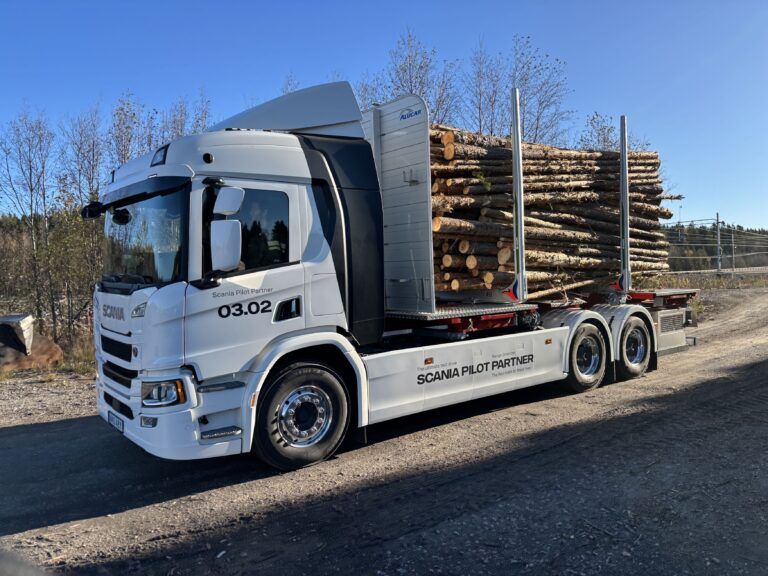
Hybrid range-extender system enables electric timber trucks to operate efficiently in remote Swedish forests without charging infrastructure
Horse Powertrain has supplied its range-extender technology for a Scania pilot vehicle currently hauling timber loads for SCA, one of Europe’s largest forestry companies. The collaboration, part of Scania’s Pilot Partner program, addresses a critical challenge in transport electrification: maintaining productivity in remote areas without reliable charging access.
The system combines a battery-electric drivetrain with a 120-kilowatt range-extender unit powered by Horse Powertrain’s 2.0-liter multi-fuel engine. Unlike traditional hybrid systems, the engine functions exclusively as an onboard generator, supplying electricity to the battery packs when needed rather than directly driving the wheels.
Operating on a 16-kilometer route, the truck completes seven to eight rounds daily – matching diesel truck performance while eliminating charging downtime that would limit a pure battery-electric vehicle. The configuration proves particularly valuable during extended hauls, temperature extremes, or unexpected delays when battery reserves might otherwise run low.
“Forestry logistics represents one of the toughest challenges for electrification,” said Matias Giannini, CEO at Horse Powertrain. “You can think of our range-extender as a powerbank for a heavy-duty truck: silent, efficient, and always there when you need it.”
The technology builds on promising earlier results. A German logistics trial earlier this year saw a similar vehicle travel nearly 22,000 kilometers, operating over 90 percent of the time on pure electric power and achieving more than 90 percent CO₂ reduction compared to diesel trucks.
Horse Powertrain’s modular architecture adapts technology originally developed for passenger vehicles to meet heavy-duty demands. The engine operates across its full power band rather than at fixed speeds, optimizing efficiency while minimizing fuel consumption, noise, and vibration.
Real-world data from the Swedish pilot will inform future deployments across forestry and other heavy-duty applications, supporting decarbonization efforts in sectors where full electrification faces infrastructure constraints.


