

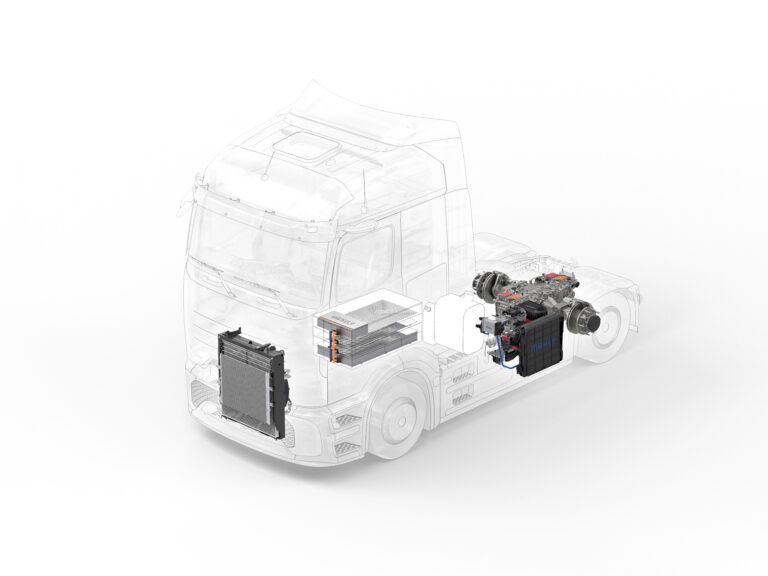
MAHLE is launching a range extender system for battery-electric trucks, extending total range beyond 800 km while cutting CO2 emissions by over 80%. The company is also unveiling the MCT, a rare earth-free electric motor for heavy trucks, at IAA Transportation 2026, alongside calls for greater technology diversity in EU regulation.
MAHLE has launched its first specific projects with commercial vehicle manufacturers to build prototypes and test vehicles for its new range extender system for battery-electric trucks, ahead of the technology’s world premiere at IAA Transportation 2026 in Hanover, Germany.
According to Arnd Franz, chairman of the management board and chief executive of MAHLE, the interest reflects demand for practical electrification options. “The positive response from our customers shows that the market needs economical, practicable solutions for electrification,” he says.
The range extender is a compact unit combining a generator, internal combustion engine, thermal management system, fuel tank, AdBlue tank and exhaust gas treatment, designed to integrate into existing battery-electric vehicle platforms. Its main component is a high-voltage generator with continuous output of 110 kW and peak output of up to 130 kW, reaching a power density of more than 7 kW per kilogram through a newly developed oil cooling system. The integrated thermal management system provides 48 kW of high-temperature and 15 kW of low-temperature cooling capacity.
MAHLE said the range extender replaces about one-third of a battery-electric truck’s existing battery capacity, cutting rear axle load by around 400 kg and total vehicle weight by around 600 kg. A truck fitted with the system can reach a total range of more than 800 km, split between roughly 400 km from the battery and 400 km from the range extender. According to MAHLE, carbon dioxide (CO2) emissions in real-world operation can be reduced by more than 80% compared with a conventional drive system, and can approach zero when using HVO100 renewable fuel.
“Range extenders may represent a breakthrough for the electrification of road transport at the same time as safeguarding fleet economics,” Franz says.
MAHLE is also presenting a second world premiere in Hanover: the MAHLE Contactless Transmitter (MCT), a permanent magnet-free electric motor for heavy trucks that eliminates the need for rare earth elements. The company said the motor saves up to 3 kg of rare earth magnets per vehicle compared with a conventional permanent magnet synchronous motor, while offering peak output of 370 kW and torque of more than 900 Nm. The drive system is up to 10 kg lighter than comparable solutions and reaches 95% efficiency on the Vehicle Energy Consumption Calculation Tool (VECTO) cycle, with higher real-world efficiency than comparable permanent-magnet motors, according to MAHLE.
The company said it continues to develop combustion engines for use with renewable fuels including hydrogen, bio-ethanol, HVO100 and bio-LNG, alongside its electrification work. According to Franz, a mix of technologies is needed to meet climate targets. “Technology diversity does not present a conflict for defossilization; on the contrary, it is a prerequisite,” he says. MAHLE is calling for a review of European CO2 regulations for heavy commercial vehicles to better reflect market conditions.
MAHLE said it supplies components used in almost all battery-electric and fuel cell trucks in Europe and is involved in nearly all current hydrogen engine projects, serving 120 commercial vehicle customers. “For customers who need technological expertise and system competence, MAHLE is the right address,” Franz says. “Over the next five years, we intend to grow faster than the market with our commercial vehicle business.”
MAHLE is exhibiting at Hall 11 of the Hanover Exhibition Center at IAA Transportation, which runs September 15-20.