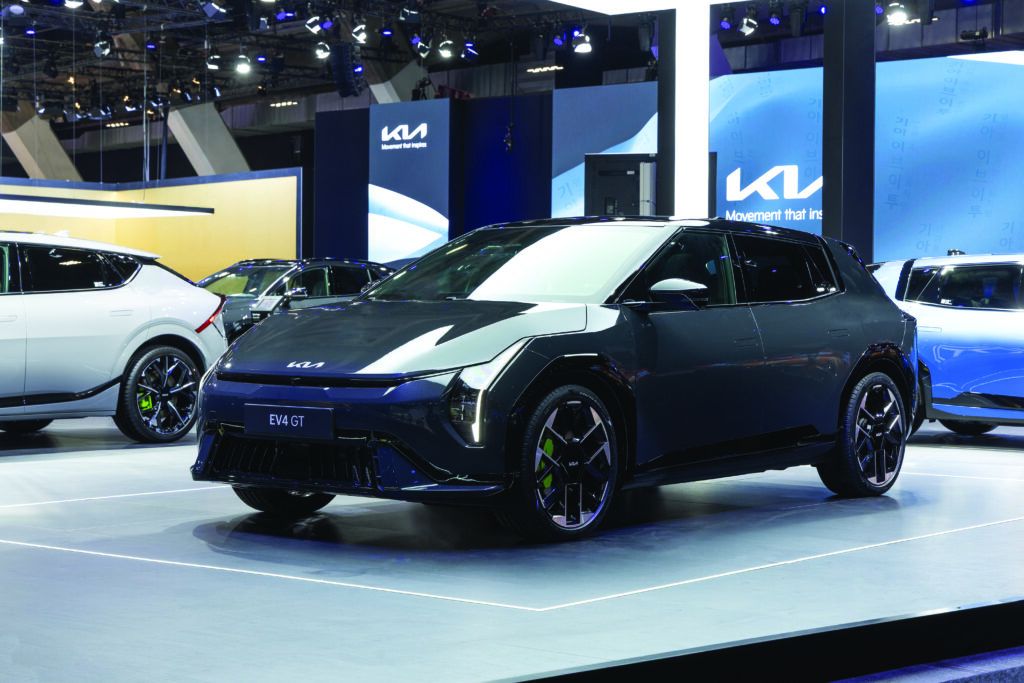


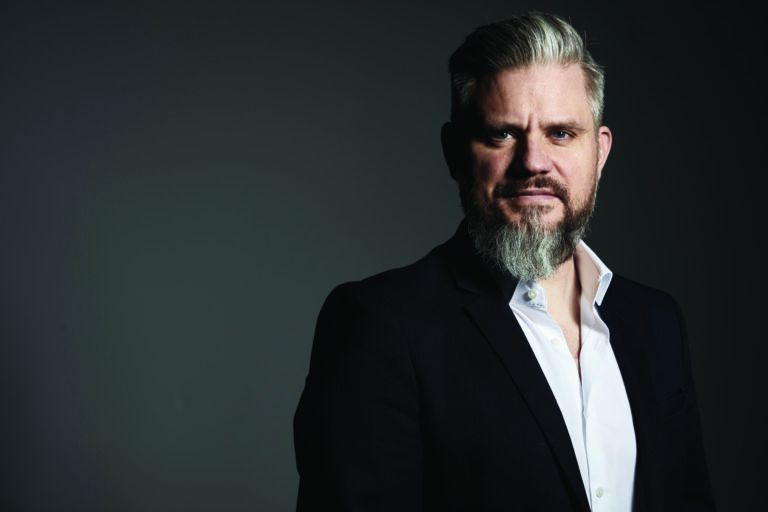
Jochen Paesen, vice president of Kia’s future design group, has an unenviable task of trying to stay ahead of the competition, while maintaining the success the Korean company has seen with its EV sub-brand
The arrival of Chinese manufacturers into the European automotive sector has, in some ways been likened to that of the Koreans a generation ago and, before them, the Japanese brands. For Kia – one of the many companies in that collective – the design journey has broadly moved from conventional to desirable. Think back to the Kia Pride and then consider the likes of the Stinger. By the time the first hybrid – the Optima – arrived in Europe in 2012, the design team had realized the potential of having a good-looking vehicle on the market. Therefore, over the course of the next decade, Kia models kept getting better – a far cry from the Pride and the original Sportage.
There is very much a family face to Kia’s EV range, and the design language ensures no one is under the illusion that it was born in the company’s main design center in Namyang. Supported by facilities in the US (California) and Europe (Frankfurt), it is here that designers aim to emulate the current designs with future automotive interpretations, which fall under the remit of Jochen Paesen, vice president of Kia’s future design group.
Having been at Kia for nearly six years, Paesen has seen the rise of the EV series designs. He is also no stranger to groundbreaking automotive designs, having been involved with the introduction of the BMW i8 – the culmination of a long career with the German manufacturer.
Now, he says, his main task is all about building on what has been created at Kia – but not just by tinkering or fine-tuning what it already out in the open. “We don’t just stop and realize that we’ve got a nice progressive lineup. We’ve got an opportunity to add a different value,” he explains. “Having spent six years in Seoul, I have an idea of what works, what doesn’t work and where we have opportunities. So now we must start looking slightly further ahead than Kia traditionally has done.”
Despite the ‘future’ part of Paesen’s job title suggesting far away models, he says he and his team are concerned with vehicles that are due for release as near as 2028. “If it’s something that we need to challenge, or something for the next generation [of a model], it can be quite a close timescale. It depends on the project, but we often work on strategic elements such as how we can push Kia to the next level,” he reasons. “We’ve built a good foundation, and we have a good presence in the market, but now it is all about becoming more aspirational. How do we start to get people to walk in the showroom and say, ‘I want that Kia because…?’. From a design point of view, we have a stronger leverage to steer that and to keep that momentum going.”
Emotional connectivity
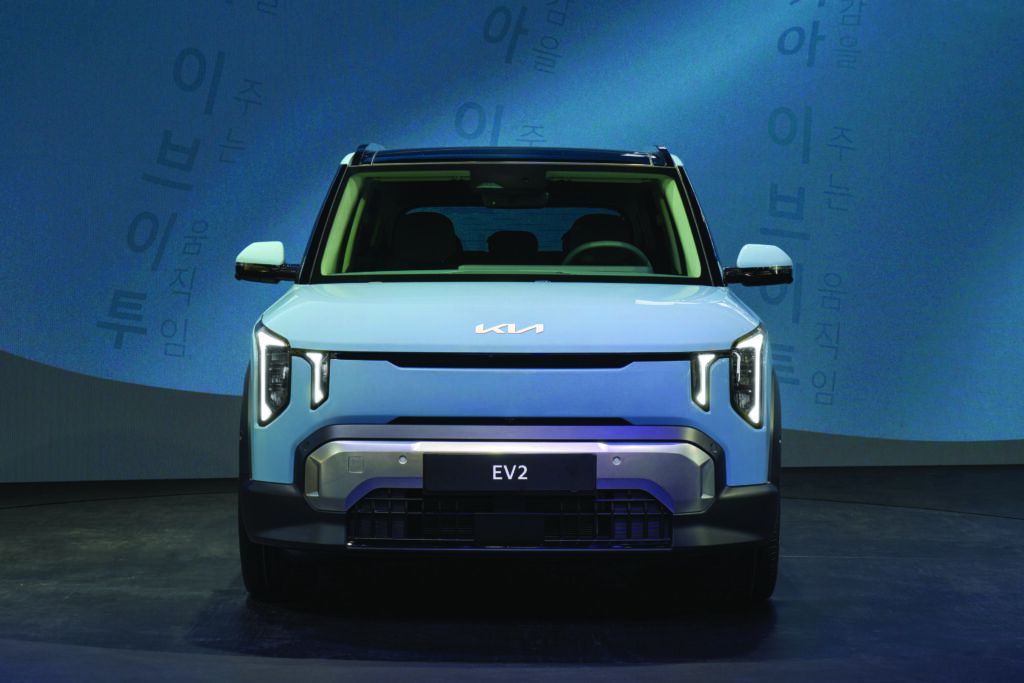
EHV’s audience with Paesen was at the unveiling of the EV2, seen by many as the final piece in Kia’s BEV jigsaw – a view that he doesn’t immediately shut down. “What’s important for us, as we keep developing, is that we don’t start repeating ourselves,” he says. “So, for us, it’s not necessarily a hard close and then onto the next chapter, but more a case of now we’ve achieved a certain level of understanding – of the brand and our products – and how we keep developing that further.”
The Belgian stresses that it is becoming more important to have a strong identity and a reason for why a brand makes the decisions it does from a design standpoint. “I think we see the China perspective where they are strong and very, very aggressive in terms of features and possibilities,” says Paesen. “I think, in the future, we need to filter that and work out what is important to us as a brand. It’s also important to create something that makes people say: ‘Oh yeah, that’s what I want.’ I think you see the beginnings of that with EV2, where we talk about space, flexibility and simplicity. We don’t want our cars to be overloaded, but to give people just what they need – not too much.”
Paesen says he is also aiming for an improvement in a different kind of connectivity. “We want to bring an element of more emotional connectivity – the connection between you and the vehicle,” he reveals. “It’s no longer just a product. It has a relevance to you, and you feel that you have a bond with it. That’s the homework for us to make sure that we have an innate value within a million choices. A wonderful thing that I’ve learned at Kia is to continuously build on these factors. How do we improve space? How do we make something that is high tech – and will become increasingly high tech – feel more soft, friendly and warm?”
An important part of the process for Paesen and his team is identifying that sweet spot without overcomplicating things. “The combination of sustainability and the types of materials we’re able to use now is beneficial to us. When you combine those elements with technology, you create something that’s unique – and neither of those can just be copied. You need to put the effort in, invest the time and the money, then find the solution.
“As a brand, we are progressive; we are pushing and we’re not afraid to look forward. We look back, of course, to learn, but not in a ‘This was great, why don’t we keep it?’ way,” says Paesen, adding that Kia does not have that kind of mindset. “We always look at everything in front of us, and this is also what we’re working on in future design. That means identifying what is relevant, what is right and how to strike the balance between pushing the boundaries, but making sure we bring existing customers along. They’ve got to feel trust and have confidence in your brand – and if you go one way and then another, you lose that trust and confidence.”
Next generation
Attracting younger consumers can prove difficult for a lot of car manufacturers, but Paesen believes Kia’s designs can help here. “Young people look at things very differently than previous generations did. But what is still important is the ability to make people of any age still turn around and take notice,” he reveals. “That’s where we, as a brand, are on the right path. I think people are starting to notice us, but it’s something we still need to work on. Whether we make a small change or a big change, it must feel relevant. That’s so important to us.”
Technology and design go hand in hand in many respects – and it is another aspect that is vital to future generations – and future Kia customers. “We need to realize that people are living in a connected, digital world,” Paesen says. “So how do we find the right way to make sure people are connected in such a way that it’s effortless and helpful? As opposed the whole process being painful and feeling like you’re trying to make a piece of technology do what you want it to do.” Part of the answer, believes the Kia man, is AI, which is where the younger generations can help manufacturers succeed. “The next challenge is figuring out how you own that? It’s evident to the younger audience that technology is what they need. And if you don’t give that to them, they’re not interested.”
One clue to where Kia may go next from a future design perspective could be the Vision Meta Turismo concept. Although it was revealed late last year, according to Paesen it was meant to be kept under wraps. “It was a great project and was meant to be an internal study, but it happened to find its way out into the public,” he says. “Vision Meta Turismo was a huge piece of homework for us because it asked how we create something that is emotional yet still has the core values of driving. It feels like it can go very fast – if you’re in the right mood, it can be a performance machine. But, at the same time, we had to embrace the question of how you judge excitement for people who’ve grown up in a digital world. It looks at a more emotional form of language, but at the same time asks questions around how you use technology. For example, fewer screens but a richer experience.”
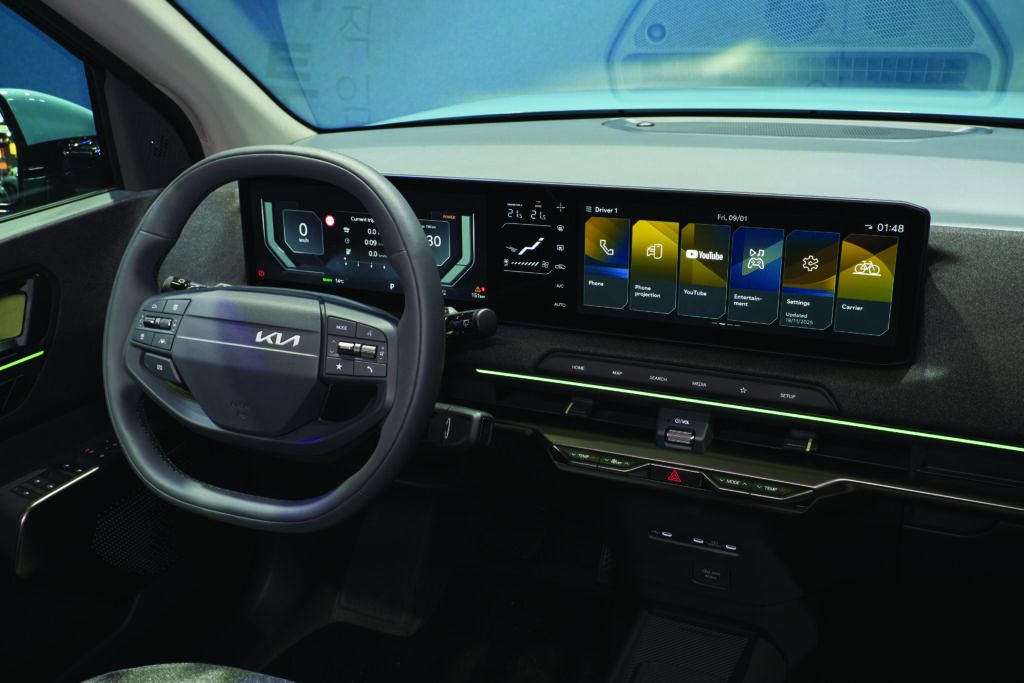
Speaking of displays, going ‘full screen’ is something that Kia has shied away from with the EV2 – but will that still be the case in the future? “We’re in what I would call no man’s land, where technology has moved on,” says Paesen. “We know that digital can add a lot of value but is also means many more options and functions. If you were to put buttons for every one of those functions in the dash, it would look like the cockpit of a 747. The reality is that we do need to embrace digital opportunities it, but we need to strike the balance.”
For Paesen, there’s no right and wrong. “Tesla has been working for a long time on just a screen and it’s been largely accepted. It has a huge following and it works for that company. But for us, it is more important to be inclusive. Not all Kia drivers love driving, so making them feel comfortable and have trust in our brand, is important. We are building on that and, in hindsight, it’s probably a good thing for us that we never left that path [of removing physical controls]. Whereas some brands have gone completely digital and are now having to come back. Not everything is perfect with our interiors, but we’ve learned a lot from the process, and we can transition further from that.”