

Since three Bosch engineers won Germany’s Deutscher Zukunftspreis 2025 for their hydrogen fuel cell power module for heavy-duty trucks, several thousand FCPM-equipped trucks are now operating globally, with next-generation systems in development.
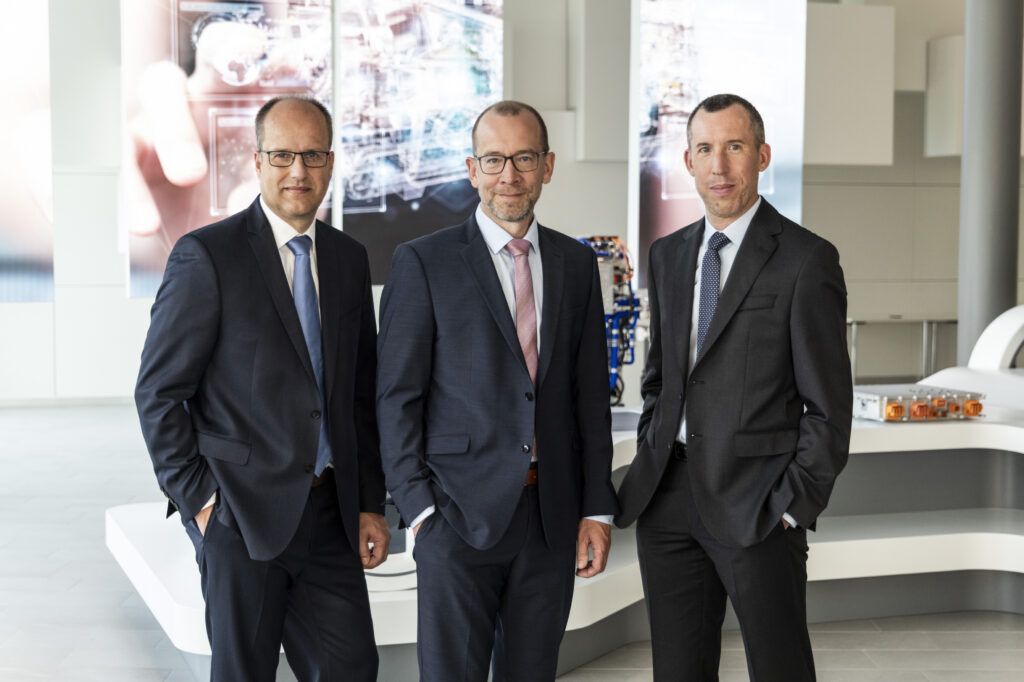
Three engineers from Bosch GmbH have won the Deutscher Zukunftspreis 2025 — Germany’s federal president’s prize for technology and innovation — for developing a hydrogen fuel cell power module (FCPM) now in volume production for heavy-duty commercial vehicles.
Christoffer Uhr, Kai Weeber, and Pierre Andrieu received the €250,000 award at a ceremony in Berlin on November 19, with German Federal President Frank-Walter Steinmeier recognizing the system as a key technology for climate-neutral mobility. It is the Stuttgart-headquartered company’s fourth Zukunftspreis win, following previous awards for piezo injectors (2005), smart sensors (2008), and ultrashort pulse lasers (2013).
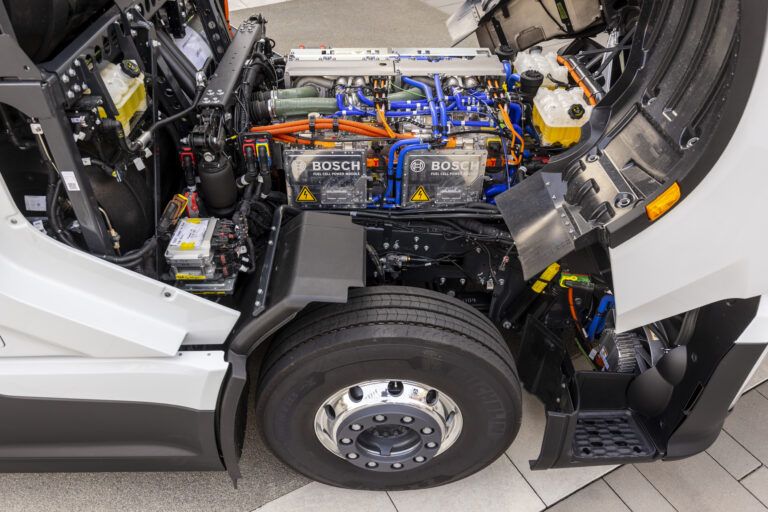
The FCPM converts hydrogen and oxygen into electrical energy, producing only water vapor as a byproduct. Weighing approximately 500kg and containing more than 1,000 individual parts, Bosch describes it as the most complex system in its nearly 140-year history. All key components — including the fuel cell stack, hydrogen metering valve, hydrogen recirculation pump, and electric air compressor — are developed and manufactured in-house.
“This award is outstanding recognition for the entire team,” says Dr. Stefan Hartung, chairman of the board of management at Bosch. “It shows the innovative potential of hydrogen — and the decisive role that Bosch is playing in it.”
From lab to logistics
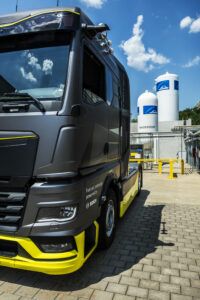
Several thousand trucks fitted with the FCPM are now operating globally, and in October 2025 Bosch began deploying the technology in its own plant logistics for the first time. An Iveco S-Way platform truck equipped with the FCPM entered service at the company’s Nuremberg facility, transporting manufacturing products on a fixed route operated by freight forwarder Schäflein via truck rental company Hylane.
The 40-ton vehicle carries five hydrogen tanks holding up to 70kg at 700 bar, delivering a total fuel cell system output of over 200kW and a gross vehicle weight rating of up to 44 metric tons. The system is paired with an e-axle and two centrally mounted battery packs for energy storage, producing a combined system output of 400kW.
“When we decided to make our plant traffic more climate-friendly, it was clear that we wanted a truck featuring Bosch’s FCPM,” says Alexander Weichsel, commercial plant manager in Nuremberg. “The fact that several thousand trucks with Bosch fuel-cell systems are already on the road worldwide shows that the concept is proving its worth.”
Bosch says the primary purpose of the Nuremberg deployment — which targets 12,000km per year — is to accumulate real-world operating data. Each FCPM operates alongside a digital twin in virtual space, continuously monitoring parameters including temperature, pressure profiles, and component wear. Fleet data has already driven second-generation design changes, including revised cooling strategies to address localized hot spots not predicted by laboratory modeling, and recalibrated hydrogen recirculation dynamics observed under real-world loading conditions.
Operational data from the Nuremberg truck is feeding directly into development of next-generation modules: the Compact 190 and Compact 300. The latter features a horizontal double stack architecture targeting 300kW output with an improved power-to-weight ratio and higher degree of system integration. At the 2025 Advanced Clean Transportation (ACT) Expo in Anaheim, California, Bosch also unveiled a compact gas compressor capable of compressing more than 11 standard cubic meters of hydrogen per hour to pressures of up to 350 bar.
Manufacturing and supply chain
Volume production of the FCPM launched at Stuttgart-Feuerbach in mid-2023, with a second line at Chongqing, China following shortly after. The Bamberg plant supplies the fuel cell stack, while the Homburg facility produces components including the electric air compressor and recirculation blower. The system incorporates 1.2km of laser weld seams per unit — each helium leak-tested — and is designed to fit the space previously occupied by a combustion engine in over 95% of existing truck platforms.
Unlike battery packs, the FCPM requires minimal critical raw materials such as lithium or cobalt, a factor Bosch highlights as reducing supply chain vulnerability. Trucks running on the system offer refueling times of approximately 15 minutes and a range of up to 1,000km on a single tank of around 70kg of hydrogen, depending on vehicle layout and driving conditions.
In China, Bosch’s Chongqing facility has launched 80kW, 134kW, and 190kW systems serving applications from urban transport to long-distance logistics. A 300kW module is being tested in customer vehicles that have collectively exceeded 3.6 million kilometers. Over 120 hydrogen fuel cell vehicles now operate along the Chengdu-Chongqing Hydrogen Corridor.
Closing the hydrogen loop
Bosch is also applying its fuel cell technology in reverse. In November 2025, the company commissioned its first in-house electrolyzer at the Bamberg site, built around two Hybrion proton exchange membrane (PEM) electrolysis stacks manufactured on-site. The 2.5MW system produces more than one metric ton of hydrogen daily — enough, Bosch says, to power a 40-ton FCPM truck for up to 14,000km. The hydrogen feeds directly into an on-site “lifetime container” for continuous endurance testing of fuel cell modules.
Commercially, the Hybrion stacks launched in March 2025, with deliveries to partners including Kyros Hydrogen Solutions, Neumann & Esser, Pietro Fiorentini, and subsidiary Hyter. Bosch secured pre-orders amounting to around 100MW before the official sales launch. According to Dr. Markus Heyn, member of the board of management and chairman of Bosch Mobility, the company expects hydrogen-related sales revenue to run into the billions by 2030.
Between 2021 and 2026, Bosch has committed to investing approximately €2.5bn in hydrogen technology development and manufacturing.
Infrastructure remains the bottleneck
Hartung has called for faster hydrogen infrastructure development. “We urgently need to start building a hydrogen economy along with the corresponding infrastructure for the production, storage, and use of hydrogen,” he says. “China and India are showing us how this can be done. As an industry, we stand ready with technical solutions — the FCPM is a first building block.”
The EU’s Alternative Fuels Infrastructure Regulation (AFIR) mandates hydrogen refueling stations every 200km along the Trans-European Transport Network (TEN-T) core network by 2030. As of late 2025, approximately 80 public hydrogen refueling stations were operational across a Germany-Benelux-France corridor, with H2 Mobility, Europe’s largest operator, planning an additional 100–120 heavy-duty-capable stations by 2026.
However, industry groups including IRU, ACEA, and Transport & Environment have warned the European Commission of a potential funding gap in 2026–2027, as the current Alternative Fuels Infrastructure Facility (AFIF) nears exhaustion with no confirmed successor instrument before the 2028 Multiannual Financial Framework.
The market also faces headwinds from battery electric competition. Bosch itself suspended a planned $200m fuel cell production line at its South Carolina facility in March 2025, citing unfavorable market conditions and delayed hydrogen mobility demand in the U.S.
The economics remain application-dependent. Fuel cell trucks offer payload advantages over battery electric equivalents — with hydrogen vehicles losing approximately 500lb of cargo capacity versus diesel, compared to an estimated 4,000–20,000lb for battery electric trucks, according to Clean Air Task Force analysis. But total cost of ownership currently favors battery electric vehicles in markets where hydrogen remains expensive.