

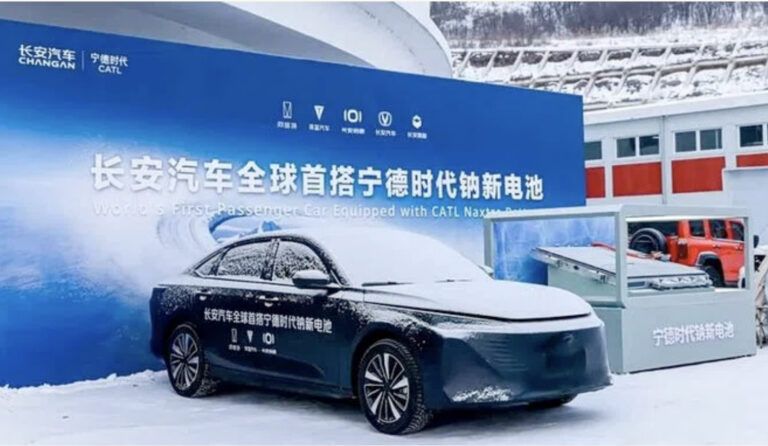
Changan Automobile and CATL have unveiled the first mass-production sodium-ion battery passenger vehicle, due on sale by mid-2026. The CATL Naxtra cells offer 175 Wh/kg energy density, 400 km-plus range, and strong cold-weather performance down to –50°C.
Chinese automaker Changan Automobile has unveiled what it claims is the first mass-production passenger vehicle equipped with sodium-ion batteries, developed in partnership with cell manufacturer CATL.
The vehicle, revealed at an event in China, is expected to reach the market by mid-2026. CATL will supply its Naxtra sodium-ion cells across Changan’s full brand portfolio, including Avatr, Deepal, Qiyuan, and UNI.
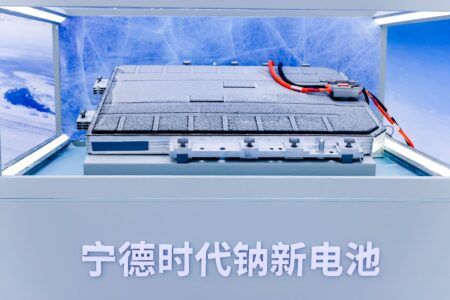
CATL’s Naxtra battery achieves an energy density of up to 175 Wh/kg, which the company says is the current benchmark for mass-produced sodium-ion technology. Using a cell-to-pack system and intelligent battery management system (BMS), the pack enables a pure-electric range exceeding 400 km. As supply chains mature, CATL projects ranges of 500–600 km for pure-electric variants and 300–400 km for range-extended and hybrid configurations.
Cold-weather performance is a key selling point for the chemistry. According to CATL, the Naxtra cell delivers nearly three times the discharge power of equivalent lithium iron phosphate (LFP) batteries at –30°C, retains over 90% capacity at –40°C, and maintains stable power delivery at temperatures as low as –50°C. The company says the battery remains smoke- and fire-free under crush, drill, and saw testing.
“The arrival of sodium-ion technology marks the beginning of a dual-chemistry era,” says Gao Huan, chief technology officer of CATL’s China e-car business. “Changan’s vision shows both its responsibility for energy security and its strategic foresight. Much as it embraced electric vehicles years ago, Changan is once again taking the lead with its sodium-ion roadmap.”
Gao adds that CATL “fully supports” Changan’s strategy, “combining our expertise to bring safe, reliable, and high-performance sodium-ion technology to market.”
Sodium-ion batteries use more abundant raw materials than lithium-based chemistries and offer advantages in cold-climate performance and recyclability. According to Precedence Research, the global sodium-ion battery market is expected to grow from US$1.39bn in 2025 to US$6.83bn by 2034.
CATL began sodium-ion research in 2016, investing nearly 10 billion RMB (approximately US$1.4bn) and developing close to 300,000 test cells. The company’s sodium-ion research and development team comprises more than 300 personnel, including 20 PhDs.
To support wider adoption, CATL plans to open more than 3,000 Choco-Swap battery swap stations across 140 cities in China by 2026, with over 600 located in colder northern regions.