

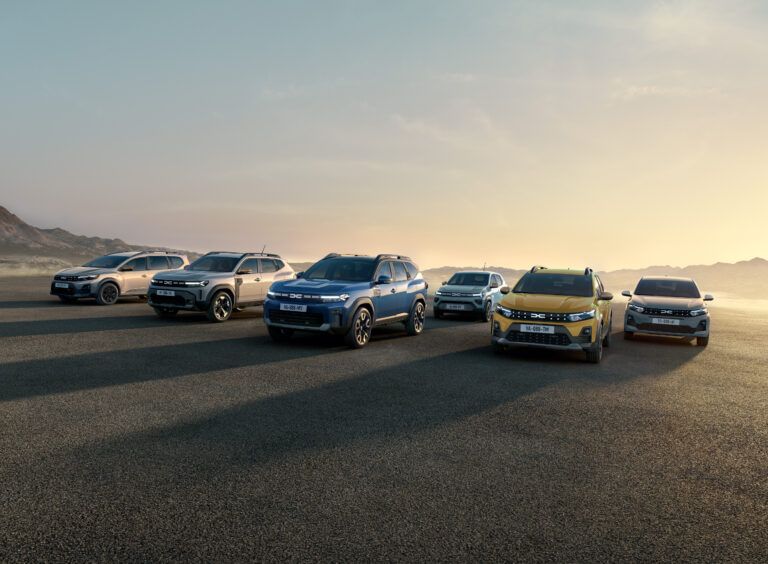
Dacia has announced 2026 powertrain updates across five models: a claimed world-first LPG flex-fuel hybrid 4×4 for the Duster and Bigster, Hybrid 155 for the Jogger, an automatic LPG gearbox for the Sandero range, and a new 24.3 kWh LFP battery for the Spring.
Dacia has announced a broad set of powertrain updates for 2026, covering five models across its lineup — the Sandero, Sandero Stepway, Jogger, Duster, Bigster and Spring — with new hybrid systems, revised liquefied petroleum gas (LPG) options and an updated battery electric platform for its entry-level battery electric vehicle (BEV).
A world-first powertrain for Duster and Bigster
The most technically notable addition is the hybrid-G 150 4×4 for the Duster and Bigster, which Dacia claims is the first production powertrain to combine LPG flex-fuel capability, 48V mild-hybrid technology and all-wheel drive (AWD). A 103 kW (140 hp) 1.2-litre 48V mild-hybrid petrol/LPG engine drives the front wheels through a six-speed dual-clutch automatic gearbox; a 23 kW (31 hp) electric motor at the rear — operating through a two-speed gearbox with a disengageable axle — completes the AWD system. Combined output is 113 kW (154 hp), with 230 Nm from the combustion engine and up to 87 Nm from the rear motor.
Dacia says the two-speed rear electric gearbox arrangement is itself a world first for a 48V motor, with its neutral mode eliminating friction losses during two-wheel drive operation. Over an urban cycle, the Duster and Bigster hybrid-G 150 4×4 can run in all-electric mode for up to 60% of driving time, with the 0.84 kWh lithium-ion battery self-charging on the move. Fuel consumption is rated at 7.2 l/100 km on LPG and 5.9 l/100 km on petrol (Duster, Worldwide Harmonised Light Vehicle Test Procedure, or WLTP), with CO₂ at 117 g/km and 134 g/km respectively. Compared with the outgoing mild-hybrid 130 4×4, Dacia says running costs fall by 30% and CO₂ by 20 g/km. With two 50-litre tanks — one petrol, one LPG — the Duster offers a stated range of up to 1,500 km without refuelling. Six driving modes are available: Auto, Eco, Snow, Mud/Sand, Lock and Hill Descent Control.
Hybrid 155 and LPG auto transmission for Sandero and Jogger
The Jogger gains the Hybrid 155 system — a 155 hp full hybrid combining a 109 hp 1.8-litre four-cylinder petrol engine, a 50 hp drive motor, a high-voltage starter/generator, a 1.4 kWh battery and a clutchless automatic electric gearbox. Dacia rates the system at 10% lower emissions and fuel consumption than the outgoing Hybrid 140, with combined consumption of 4.6 l/100 km and CO₂ of 104 g/km (WLTP). The Jogger can drive in electric-only mode for up to 80% of urban journeys and always starts in electric mode. The Hybrid 155 is also coming to Sandero and Sandero Stepway, with sales starting in Q4 2026.
Across the Sandero, Stepway and Jogger range, the Eco-G LPG powertrain gains both a power increase — from 100 hp to 120 hp (90 kW) — and, for the first time, an automatic gearbox option: a six-speed dual-clutch unit with steering-wheel paddles, the latter also a Dacia first. LPG tank capacity grows from 40 litres to 49.6 litres on Sandero and Stepway, and to 48.8 litres on Jogger, increasing LPG-mode range by 20%. Total combined range (LPG plus petrol) reaches 1,590 km for Sandero, 1,480 km for Stepway and 1,450 km for Jogger.
All three models also receive an updated exterior design — including a new inverted ‘T’ LED daytime running light signature — new Starkle body protection (a Dacia-developed material incorporating 20% recycled plastic, used unpainted) on Stepway and Jogger, a 10-inch infotainment screen with connected navigation, wireless phone charging and updated automatic emergency braking meeting current European safety standards.
Spring gets new battery and motors
The Spring BEV receives structural and powertrain updates focused on efficiency and dynamics. A new 24.3 kWh lithium iron phosphate (LFP) battery using cell-to-pack technology replaces the previous unit, housed in a reinforced central platform section that Dacia says improves weight distribution. Two new electric motor options — 52 kW (70 hp) and 75 kW (100 hp) — replace the previous 33 kW and 48 kW units, delivering torque gains of up to 20% between 80 and 120 km/h.
An anti-roll bar is fitted as standard for the first time, alongside retuned suspension. Aerodynamic improvements — underbody fairing and a new tailgate spoiler — reduce the drag-area figure (CdA) from 0.745 to 0.660 on 14-inch wheel variants and from 0.743 to 0.665 on 15-inch variants. Stated WLTP range holds at 225 km on 15-inch wheel versions, while energy consumption falls 9% to 12.4 kWh/100 km.