

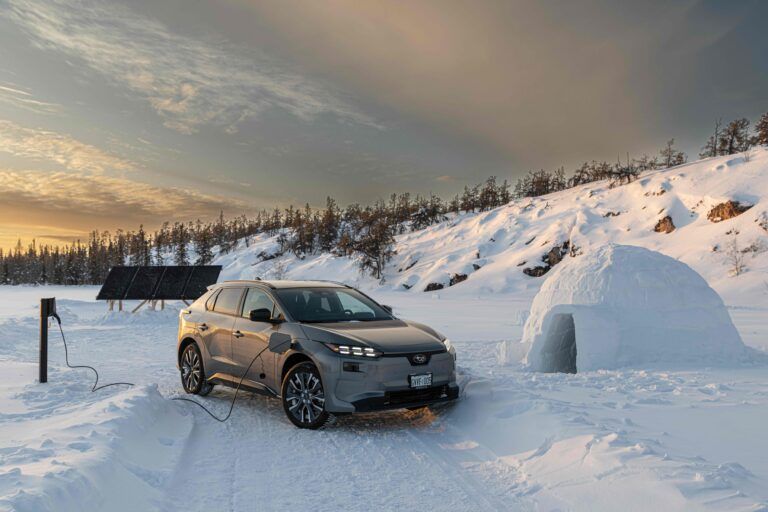
Easee and Subaru Canada have completed an off-grid EV charging pilot in Canada’s Northwest Territories, using four portable solar panels and a battery storage system to charge a Subaru Solterra in sub-Arctic February conditions, with no grid connection required.
Norwegian smart charging company Easee has completed an off-grid electric vehicle (EV) charging pilot in Canada’s Northwest Territories, using portable solar panels as the sole power source to charge a Subaru Solterra in sub-Arctic February conditions.
The trial was carried out in collaboration with local technicians and observed by members of the Inuit community. The test rig comprised four latest-generation solar panels connected to an EcoFlow battery and inverter system. Despite winter light levels, the vehicle charged at approximately 25% of the rate of a conventional 7kW home or public charger.
“Together with Subaru, we’ve demonstrated that smart EV charging can operate beyond traditional grid infrastructure,” says Anthony Fernandez, chief executive at Easee, which is headquartered in Stavanger, Norway. “Using portable solar power in sub-Arctic conditions, we’ve shown that electrification is viable even in remote environments.”
Fernandez adds that the rationale extends beyond proof-of-concept: “Our purpose is to make electrification effortless for everyone. That includes communities that depend on transported fuel and face increasing climate pressure. With renewable generation, storage and intelligent charging working together, clean mobility can strengthen energy resilience and reduce reliance on imported fuels.”
Madison Marple, PR specialist at Subaru Canada, says the test environment was a deliberate choice. “This project was a natural fit for the Subaru Solterra — it’s important to continue to demonstrate the durability and viability of electric vehicles in more extreme climates, and we are grateful for the help of Easee and our other project partners to bring this demonstration to life.”
The Northwest Territories presents an acute test case for off-grid electrification. Canada’s Arctic and sub-Arctic regions are warming at approximately three times the rate of temperate and tropical zones, while communities in the area remain heavily dependent on fossil fuel transported over long distances. Solar adoption is already accelerating in and around Yellowknife, with more remote communities exploring renewable-plus-electrification strategies to reduce fuel dependency.
The pilot also generated interest from the local Inuit community, who see portable renewable energy as relevant to maintaining traditional nomadic travel across their lands. During the demonstration, the EV’s battery was used to power a light inside an igloo, illustrating the potential for battery electric vehicles to serve as mobile energy sources. Community members discussed the future possibility of using flexible, roll-up solar panels and portable wind turbines to charge electric snowmobiles.
Easee says its charging technology is designed to integrate with renewable energy systems and to optimize performance in both grid-connected and off-grid scenarios.