

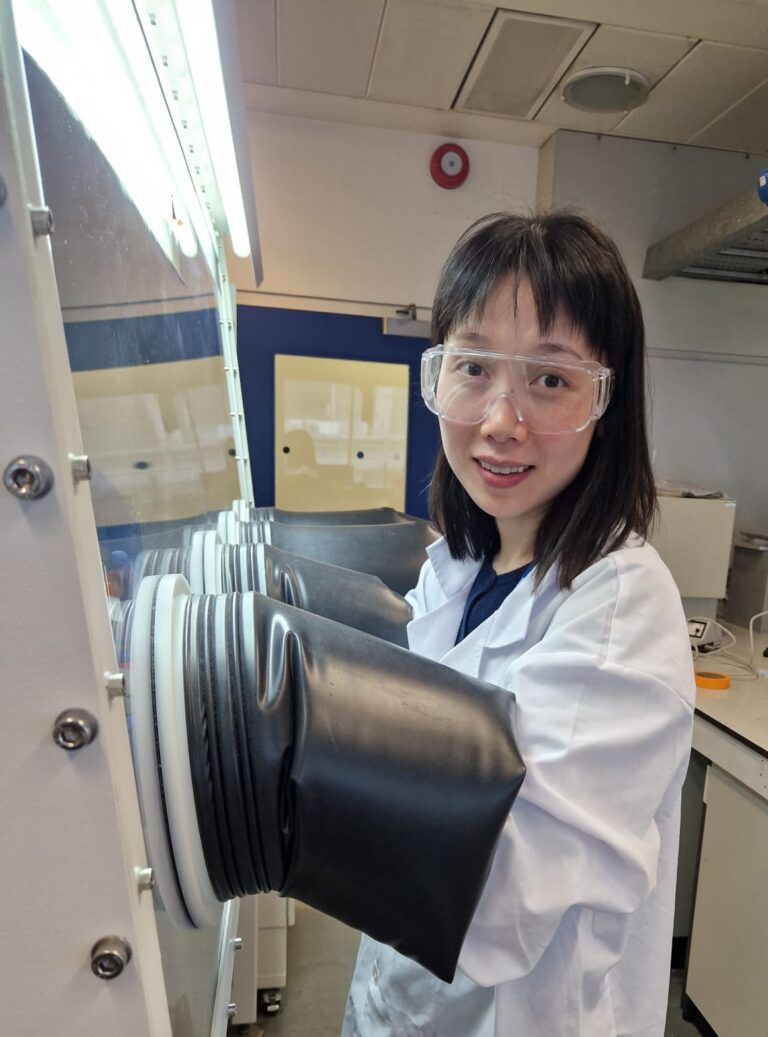
Advanced B-Solv Technology, an Imperial College London spinout founded by Dr Chun Ann Huang, has won the Armourers & Brasiers’ Venture Prize for a solvent-free dry electrode manufacturing process. The patented technology compresses powder into battery electrodes without toxic solvents or drying ovens, cutting cost, energy use and environmental impact.
Advanced B-Solv Technology (B-Solv), a spinout in development at Imperial College London, has won the Armourers & Brasiers’ Venture Prize for a dry electrode manufacturing technology that removes the toxic solvent from battery electrode production.
The London-based company, founded by battery materials specialist Dr Chun Ann Huang, has developed a solvent-free dry electrode coating process intended to reduce the cost, energy use and environmental impact of battery manufacturing. The technology eliminates the toxic solvents and energy-intensive drying ovens used in conventional electrode production while improving battery performance and manufacturability, the company says.
The patented process compresses powder materials into battery electrodes without using solvent, reducing manufacturing complexity and energy consumption. Dr Huang says the technology is designed to drop into existing factory production lines.
The £25,000 award will support demonstration of the technology’s commercial scalability to prospective customers and partners. The prize recognizes materials science innovation with commercial potential, and is judged by a panel including members of the Armourers and Brasiers’ Company with expertise in venture capital, materials science research and the commercialization of scientific research.
“Our technology addresses a key challenge in battery manufacturing,” says Dr Chun Ann Huang, founder and director of Advanced B-Solv and associate professor in energy storage materials at Imperial College London. “Dry electrode coating has attracted a lot of attention because of its potential to cut costs and emissions. However, maintaining electrode integrity and consistency has prevented widespread adoption. Our innovation aims to overcome these barriers with equipment that can easily drop into existing factory production.”
According to Julian Beare, chairman of the Armourers & Brasiers’ Venture Prize judging panel, the company demonstrates how UK scientific innovation can drive savings and environmental gains in battery manufacturing. “Our mission is to foster scientific entrepreneurship and help promising ventures achieve real-world impact,” he says.
B-Solv is aligned with the Faraday Institution’s “Nextrode — Next Generation Electrodes” programme and its “LEAP: Lithium-ion: Enhancing and Accelerating Performance” programme, drawing on those organizations’ industrial network and commercialization expertise.
Dr Huang brings more than 16 years of battery research experience to the company. She completed her BEng in materials science and engineering at Imperial College London and a PhD in materials science at the University of Oxford. The founding team currently comprises technical specialists and a commercial lead alongside Dr Huang.
The global battery market is forecast to reach approximately US$400 billion by 2030, driven by demand for electric vehicles, renewable energy storage, portable electronics and aerospace applications.