

BMW Group and the University of Zagreb’s CRTA have developed AI systems that reduce time and materials in battery cell production steps by over 50%. The “Insight” project uses real-time and historical data to predict cell performance, reduce test series, and potentially eliminate the post-charge quarantine storage phase.
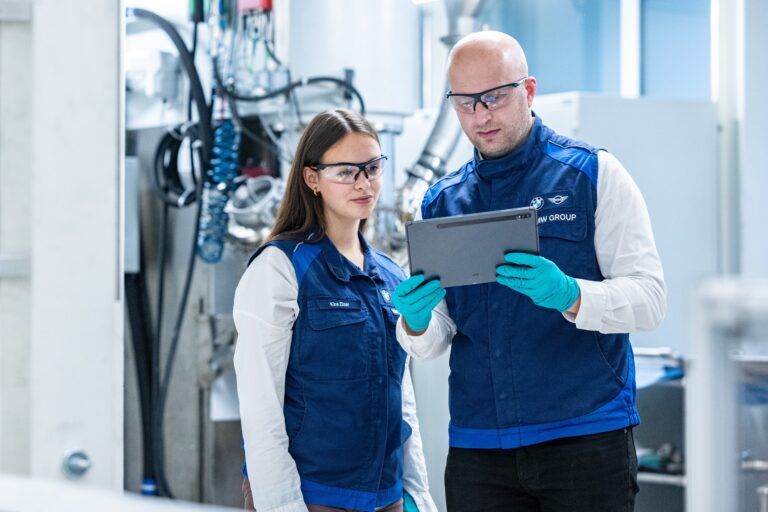
The BMW Group has developed artificial intelligence systems capable of reducing the time and materials required in individual battery cell production steps by more than 50%, as part of a joint research project with the University of Zagreb’s Regional Centre of Excellence for Robotic Technology (CRTA) in Croatia.
The “Insight” project, launched in 2024, covers the entire battery cell value chain — from electrode production through to end-of-line testing and direct recycling. At the heart of the system is an AI network that draws on existing test data alongside real-time production data to predict battery cell process parameters and performance outcomes, reducing the number of test series required without compromising quality.
The work is centered on BMW’s Battery Cell Competence Center (BCCC) in Munich, Germany, where the company develops battery cells for future high-voltage battery generations. Test series at the facility have traditionally required substantial time, materials, and manufacturing and laboratory capacity.
Beyond reducing test series, the AI models are also being applied to final cell approval. After initial charging, battery cells must currently be stored for a defined period at precise temperatures — a phase known as “quarantine” — before installation in a battery housing. The project’s AI systems can perform a full cell analysis in advance, with the potential to eliminate this storage step entirely.
“We are working on scaling the newly developed AI models from the prototype environment,” says Christian Siedelhofer, head of technology development lithium-ion battery cells at the BMW Group. One option under consideration is enabling cell manufacturers to use the models directly. “We are also examining to what extent these models are suitable for additional use cases within our production network,” he adds.
Doctoral candidates and students at the University of Zagreb are collating and structuring production data and using it to build AI models capable of identifying process patterns and generating optimization predictions.
The collaboration is also framed as a talent development initiative. “Our joint project gets doctoral candidates and students interested in AI and battery cells and the exciting work we do at our Battery Cell Competence Centers,” says Stefan Kerscher, head of technology development battery cells at the BMW Group. “We are delighted when young talents decide to embark on a career with our company.”
BMW consolidates its battery cell expertise across three competence centers: the BCCC in Munich handles research and development; the Cell Manufacturing Competence Center (CMCC) in Parsdorf produces cells under near-series conditions; and the Cell Recycling Competence Center (CRCC) in Salching, Lower Bavaria – operated with Encory GmbH – implements a direct recycling concept for which BMW holds the intellectual property.