


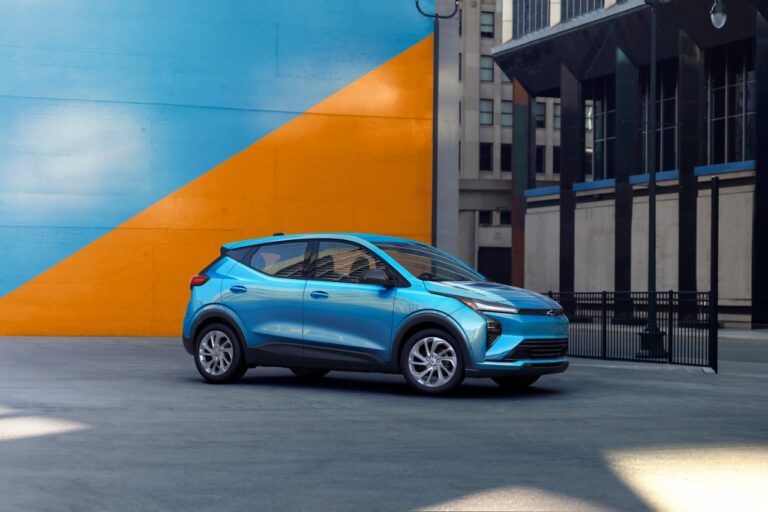
General Motors has officially announced the relaunch of its popular, affordable EV the Chevrolet Bolt for 2027, with new lithium iron phosphate battery chemistry enabling faster charging.
The announcement marks a step change for the automaker, which is positioning the revived model as a limited-run celebration of customer loyalty and EV affordability.
“After production ended, we heard our customer’s feedback and their love for this product,” said Scott Bell, vice president of Global Chevrolet, according to GM’s official announcement. “So the Bolt is coming back – by popular demand and better than ever – for a limited time. This is a celebration of what Bolt means to our customers and to Chevrolet.”
The 2027 Bolt will launch in the US with a starting price of US$29,990 for the LT trim, with an even more affordable base LT variant arriving later in the model year at $28,995, though to be cheapest EV announced in America to date.
New battery chemistry, faster charging
The new Bolt addresses what was widely considered its predecessor’s biggest weakness: slow DC fast charging. The 2027 model features a 65kWh lithium iron phosphate (LFP) battery capable of charging at speeds up to 150kW—more than 2.5 times faster than the original Bolt, which maxed out at 50kW.
One of the key differences between the original and 2027 models is the shift from nickel-cobalt chemistry (supplied by LG) to the more cost-effective lithium iron phosphate (LFP) chemistry (supplied by CATL) on the new Ultium platform.
The 2027 Bolt uses a 65kWh lithium iron phosphate (LFP) battery in prismatic can cells, according to GM’s official specifications. The cells are supplied by CATL, the Chinese battery manufacturer, though GM is reported to have plans to begin making the cells in the US.
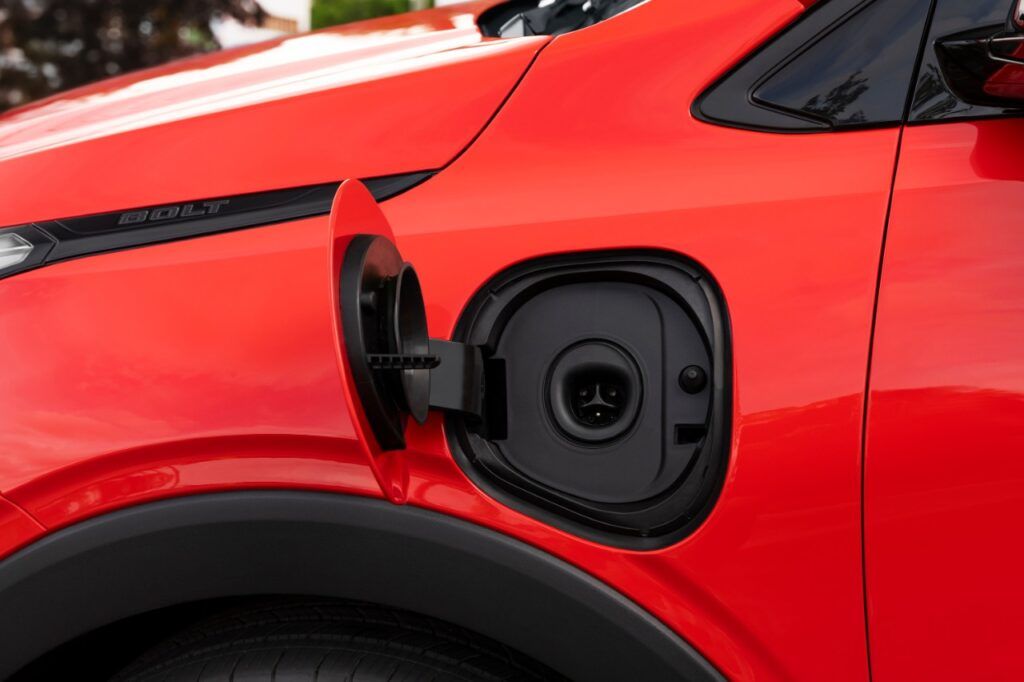
“With DC public fast charging, drivers can now go from 10% to 80% battery charge in 26 minutes,” GM stated in its announcement. The vehicle offers an estimated 255 miles of range and becomes Chevrolet’s first model to feature a native NACS charging port, providing direct access to Tesla’s Supercharger network without an adapter.
In a notable addition for an affordable EV, the 2027 Bolt features bidirectional charging capability at 9.6kW when paired with GM Energy’s home products. GM stated that the feature means the vehicle “could provide power to a properly equipped home during an outage” when paired with a GM Energy Home System.
Design and Technology Evolution
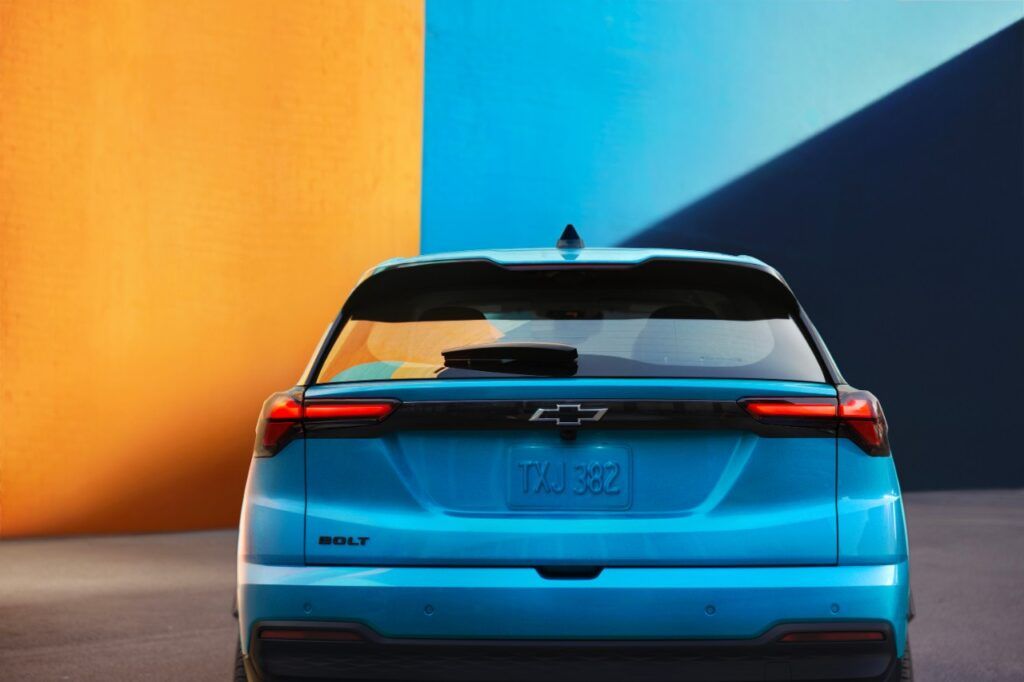
The 2027 Bolt maintains a familiar silhouette remarkably similar to its predecessor, the Bolt EUV. Phil Zak, executive design director for Global Chevrolet, explained the approach: “We took feedback directly from customers to make sure the 2027 Bolt delivers improved technology and expanded features without compromising space, usability or style.”
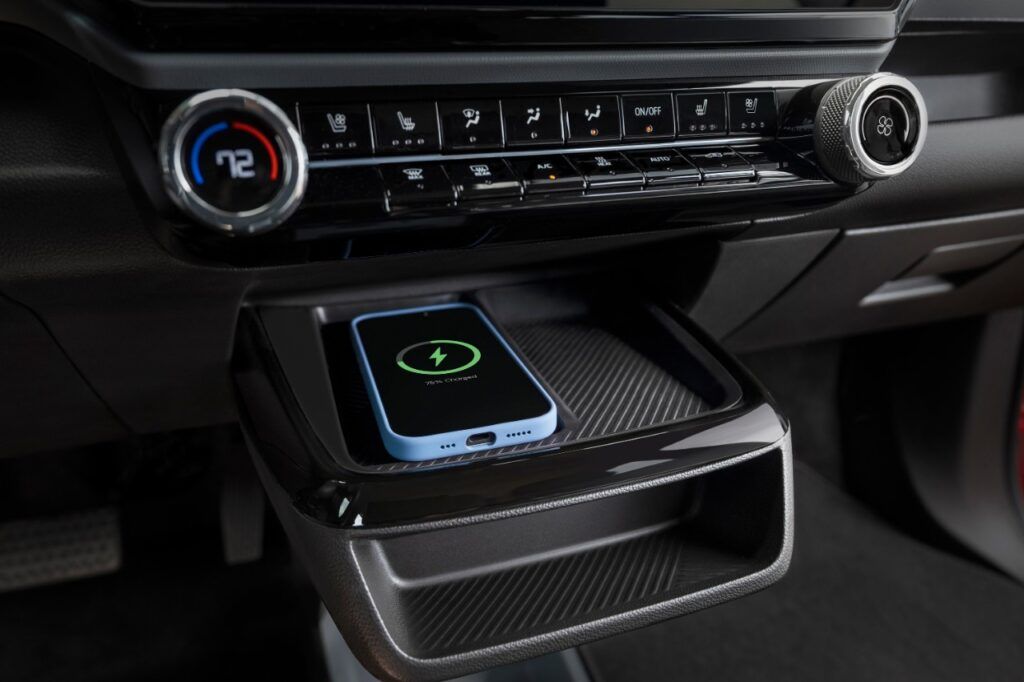
The interior receives more substantial updates, including an 11.3-inch center infotainment screen and 11in driver information display, both larger than before. A new column shifter creates more space between front seats, and the vehicle offers available Super Cruise driver assistance technology. However, one controversial change is the elimination of Apple CarPlay and Android Auto in favor of GM’s Google built-in system.
A winding road to return
The original Bolt debuted in 2016 as the 2017 model year and won MotorTrend’s Car of the Year award. “The Chevrolet Bolt was the industry’s first affordable mass-market, long-range EV and it commanded one of GM’s most loyal customer bases thanks to its price, versatility and practicality,” said Bell.
According to MotorTrend, “It was GM’s first pure electric car and put Tesla on notice to launch the Model 3 at a competitive price point.”
Despite its popularity – sales doubled in 2023 according to MotorTrend, reaching 49,492 units through Q3 – GM ended production to transition facilities to its newer Ultium platform. The decision proved controversial with customers, prompting the reversal.
The Bolt’s return follows a winding path through GM’s EV strategy revisions. CEO Mary Barra first announced the model’s discontinuation in April 2023, then reversed course by summer, confirming at an Automotive Press Association event in December 2023 that it would return. “That’s been something that has been really great this year, and that informed the decision that we’ll have that back again in ’25,” Barra said at the time, according to Automotive News via InsideEVs.
The vehicle will be assembled at GM’s Fairfax Assembly plant in Kansas City, Kansas, rather than the Orion, Michigan facility that produced the original. Production is scheduled to begin late this year, with customer deliveries starting in early 2026.
According to InsideEVs, a Reuters report based on UAW negotiations indicated the union had secured a $391 million investment for the “future electric vehicle” at Fairfax Assembly.
Limited production run
GM emphasized that the 2027 Bolt will be a “limited run model,” suggesting it serves as a bridge vehicle while the automaker develops its broader affordable EV strategy. Bell’s messaging reinforced urgency: “It’s your chance to own a popular EV that’s affordable. So, if you’ve been waiting, this is the moment. Don’t miss it.”
The new Bolt will be available at Chevrolet dealers beginning in the first quarter of 2026, joining the Equinox EV in what GM expects will account for most of Chevrolet’s 2026 EV volume.
Images ©GM