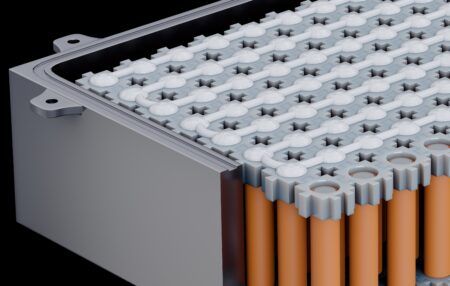



Range extenders are back, and markets in China, Europa and North America need flexible solutions that can be scaled to local customer requirements.
Range-extender drives are staging a notable comeback, particularly in China, North America and Europe. Magna meets the need of this market with two dedicated systems: the single-motor DHD REX and the dual-motor DHD Duo, both scalable across vehicle segments from B to E, including SUVs, LCVs, and light trucks.
The revival has distinct regional drivers. In China, several OEMs – particularly start-ups – hold only licences for battery-electric vehicles (BEVs) and purely serial Range-Extended Electric Vehicles (REEVs). Under the Chinese standard GB/T 19596-2017, a REEV must not permit any mechanical connection between the combustion engine and the wheels. Established OEMs operating under traditional licences may also produce plug-in hybrid electric vehicles (PHEVs) with a parallel mode. Both serial and serial-parallel architectures coexist in the Chinese market.
In North America, the rationale is more practical. Range-extender vehicles deliver the driving experience of a BEV whilst eliminating range anxiety. Additional utility value matters too: the ability to power tools, supply a home or tow heavy trailers is a purchase criterion for many customers. Both serial and serial-parallel configurations are under consideration, depending on the use case.
Europe has traditionally favoured parallel plug-in hybrids, and serial hybrids have remained a niche. However, the BEV-first approach is prompting growing interest in range extenders as variants of existing electric platforms. Moreover, the European Commission has proposed replacing the current 2035 requirement of a 100% CO₂ reduction vs. 2021 for new cars and vans with a 90% tailpipe CO₂ reduction target, with the remaining emissions to be compensated; if enacted, this would create additional regulatory headroom for PHEVs and REEVs.
Magna’s DHD REX and DHD Duo are designed to serve all these markets from a common architectural logic, whilst remaining adaptable to their differing requirements.
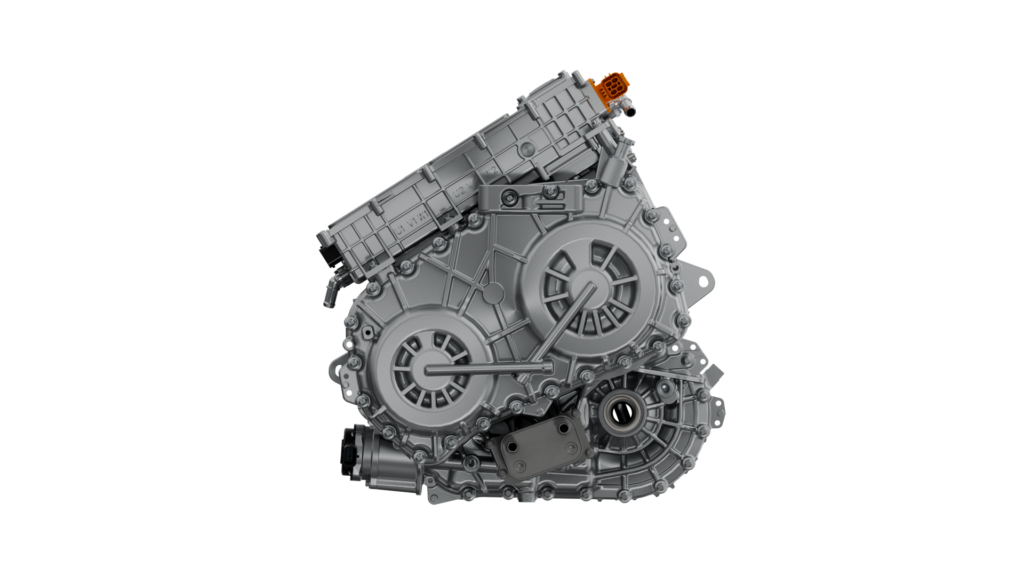
Compact efficiency
The DHD REX is a single-motor system available in transverse and longitudinal configurations. Its single e-motor can be switched between two roles: traction (eDrive mode) and generation (charging mode). The clutch C0 connects or disconnects the combustion engine; C1 connects or disconnects the e-motor to the driven wheels. In serial mode, C0 is closed, and the combustion engine drives the generator. In eDrive mode, C1 is closed, and the e-motor contributes to traction. The e-motor cannot generate and drive simultaneously.
In practice, this switching capability enables temporary on-demand all-wheel drive. When traction support is required, the system can switch from generating to eDrive mode within fractions of a second. The DHD REX thereby fulfils Chinese REEV requirements in full, as no mechanical path between engine and wheels ever exists. For markets without this regulatory constraint, an optional parallel mode is available by operating with both clutches closed, typically at motorway speeds.
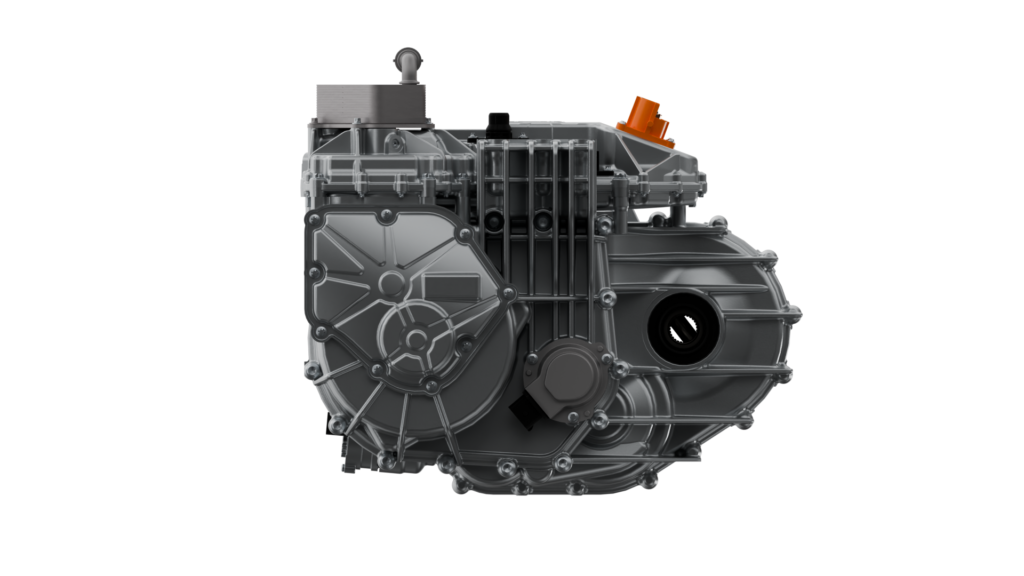
Built-in scalability
The DHD Duo takes a different approach, with two dedicated e-motors rather than one. One motor functions permanently as the generator (P1), the other as the drive motor (P3). Generation and traction operate independently and simultaneously.
In its basic form – without a gearset – the DHD Duo operates as a pure serial hybrid and is also suitable for 2WD applications. However, the DHD Duo’s additional capability lies in its scalability via an optional one- to four-speed gearset. This adds serial-parallel operation to the serial mode. The number of gears is application-dependent. A single additional gear suffices to improve efficiency at constant higher speeds, avoiding the conversion losses inherent in serial mode at higjer engine loads. Additional gears extend the engine’s usable speed range, which is particularly relevant for towing applications. At low speeds and light loads, serial operation is prioritised, keeping the combustion engine at its most efficient operating points.
The DHD Duo is available in both P1/P3 configuration, with a fixed connection between the engine and the generator, and P2/P3 configuration, which allows the engine to be decoupled and the power of both e-motors to be combined during pure-electric driving. The choice between the DHD REX and DHD Duo depends on use-case priorities. The DHD REX is the more compact and cost-efficient option. It provides on-demand AWD capability by switching to eDrive mode when needed.
The DHD Duo, by contrast, offers permanent AWD capability in both electric and range-extender modes, making it the more appropriate choice for demanding applications such as continuous all-wheel drive or towing heavy loads.
Enabling progress
Across all configurations, both systems share a key characteristic: the hybrid components – engine, generator, and gearset, where fitted – can be fully decoupled from the drivetrain. Electric driving efficiency is therefore on a par with that of a dedicated BEV and is not compromised by parasitic losses.
The broader trajectory for these scalable range-extender solutions is clear, even if its precise pace is not. Serial and serial-parallel REEVs offer a credible intermediate step towards full electrification, with substantial platform-level benefits for OEMs already developing or producing BEVs.