

As extreme weather threatens electric rail services, engineers are racing to retrofit ageing infrastructure and design new systems that can withstand temperatures that were never anticipated when tracks were first laid.
The UK summer of 2022 was a watershed moment for Britain’s railways. As temperatures soared to a record breaking 40.3°C on July 19, large sections of the East Coast Main Line – a 393-mile-long electrified railway between Edinburgh and London – were forced to close as a safety precaution. Overhead power lines expanded and sagged in the heat, threatening to snag on passing trains. It was a glaring reminder of a growing problem: much of the UK’s electric rail infrastructure was not designed for the climate it now faces.
According to the World Meteorological Organization (WMO), 2024 was the warmest year on record globally and the first year likely to exceed 1.5°C above pre-industrial levels. For the railway industry, these rising temperatures represent both an immediate operational challenge and a long-term infrastructure crisis. Climate change is already costing the UK rail network £200-£300m annually, according to Network Rail.
The heat is on
When talking about four-wheeled electrification, the extreme weather that causes problems is colder. But for trains, the problems arise at the other end of the thermometer. Work is underway by rail electrification experts to both examine the impact extreme weather is having on overhead line equipment (OLE), and to determine what can be done to safeguard infrastructure from extreme weather. Electrification firm Furrer+Frey, for example, has carried out an extensive research project called Climate Resilience in Rail Electrification, which has provided some surprising findings. “We expected wind to have a much greater impact on OLE than it is projected to have, for example,” explains Noel Dolphin, managing director of Furrer+Frey UK. “However, heat presents the biggest challenge.”
The physics are straightforward but unforgiving, Dolphin notes. Metal expands at high temperatures, and railway systems sit exposed under full sun. When overhead contact lines heat up, they lengthen and sag. If the tension isn’t maintained, trains must slow down or stop entirely to avoid damaging the equipment. During the July 2022 heatwave, the consequences were evident across the network – but not uniformly.
“We noticed that newer lines performed better; ageing infrastructure lacked climate resilience,” says Dolphin. “On newer Great Western lines, there were no failures of the electrification in the 2022 heatwave. Still, it was a very different story on those systems built 40 or 80 years ago.”
The problem extends beyond the overhead lines themselves. Earthworks – the foundations upon which tracks are laid – face mounting pressure from increasingly volatile weather patterns. “Dry summers and wet winters lead to huge issues,” Dolphin notes. “Although this does not sound like an electrification issue, since the whole railway is supported on earthworks, it impacts everything.”
Jonathan Ridley, associate director and UK head of electrification at Arup, confirms that climate change is testing infrastructure limits. “Overhead line equipment, particularly systems installed in the 1970s and 1980s, is vulnerable to high winds and extreme temperatures,” he says. “The UK recorded a temperature of 40.3°C in 2022 – exceeding the maximum operating threshold of the UK Master Series OLE system, which is specified for all new electrification projects. These conditions are no longer rare events.”
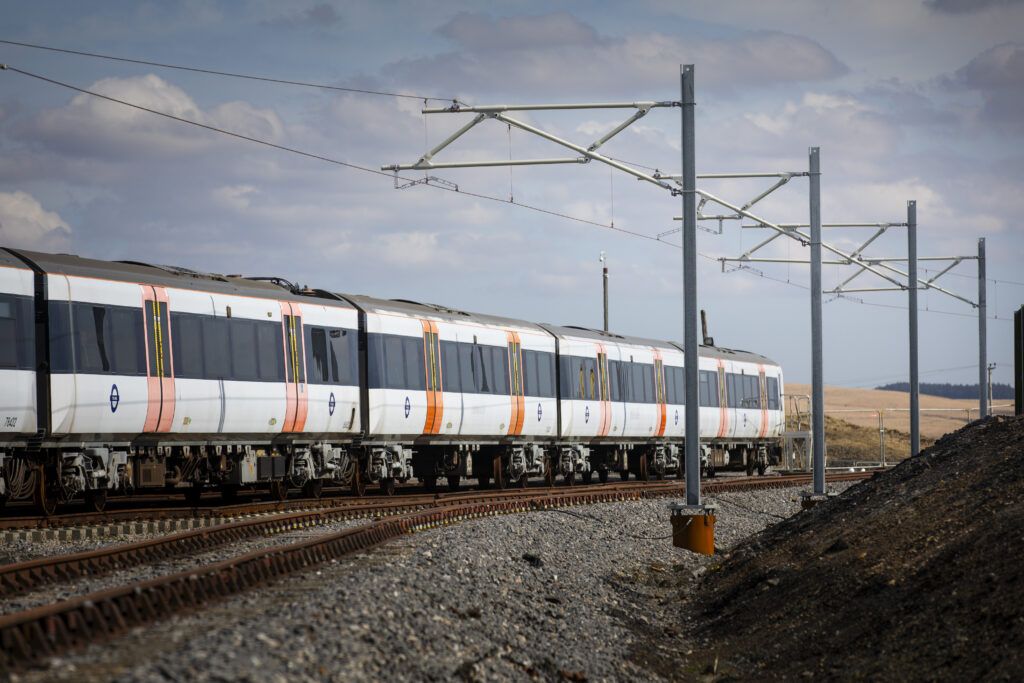
The legacy challenge
Perhaps the most troubling aspect of the UK’s climate vulnerability is the age and variability of its infrastructure. While some sections have been modernized, others have been designed for a climate that no longer exists.
Dolphin identifies the Hadfield and Glossop to Manchester routes as the least climate-resilient electrification in the UK. “They still run on a “Fixed Termination” system, which lacks any dynamic response to temperature,” he explains. “So, on hot summer days, there can be significant disruption on this commuter route into Manchester.” Some systems in northern England and Scotland were designed to cope with temperatures up to just 25°C – inadequate for a climate where 40°C summers are now possible.
The contrast with newer infrastructure is stark. High Speed 1 and the Great Western electrification, built to contemporary standards, weathered the 2022 heatwave successfully. “Somehow, we expect something designed in the 1950s to still cope today,” Dolphin adds.
Network Rail’s Fourth Adaptation Report reveals a trend shift in recent years, with wind, flooding, heat, and subsidence becoming the leading causes of delay minutes in the past decade. As extreme weather events increase in frequency and intensity, the gap between what infrastructure can handle and what nature delivers will widen.
Redesigning for resilience
The engineering response to climate change operates on two fronts: upgrading existing systems and designing new infrastructure with future conditions in mind. For new installations, the approach has changed. “What we do now is design for a much wider range of temperatures than would have been considered historically,” says Dolphin. “That means our systems can tolerate increasingly extreme heat.” Modern overhead line systems incorporate auto-tension technology, for example, which maintains wire tension regardless of temperature fluctuations, a critical improvement over fixed-tension legacy equipment.
At Arup, Ridley emphasizes that while industry standards have evolved, they haven’t gone far enough. “Designers face a challenge persuading clients to go beyond minimum specifications in a budget-constrained environment,” he says. The firm has developed a Rail Resilience Framework to help identify where upgrades are most needed. “It helps clients move beyond minimum compliance toward performance-led design, even in budget-constrained environments,” Ridley adds.
Practical solutions are already being implemented. On the London Paddington to Heathrow route, legacy spanwire catenary systems are being retrofitted with mechanically independent registration to reduce wind damage consequences. Arup has also led work on the East Coast Main Line converting headspan systems to portal structures, limiting the risk of multi-track outages. “These upgrades may not prevent extreme weather events, but they significantly reduce the impact – turning potential system-wide failures into isolated incidents,” Ridley explains.
Meanwhile, Furrer+Frey is exploring more radical innovations. The company is researching composite materials as an alternative to traditional metals. “British Rail had experimented with this in the 1980s, but the scope has since expanded massively,” Dolphin says. “Composites are inherently more climate-resilient in many respects.”
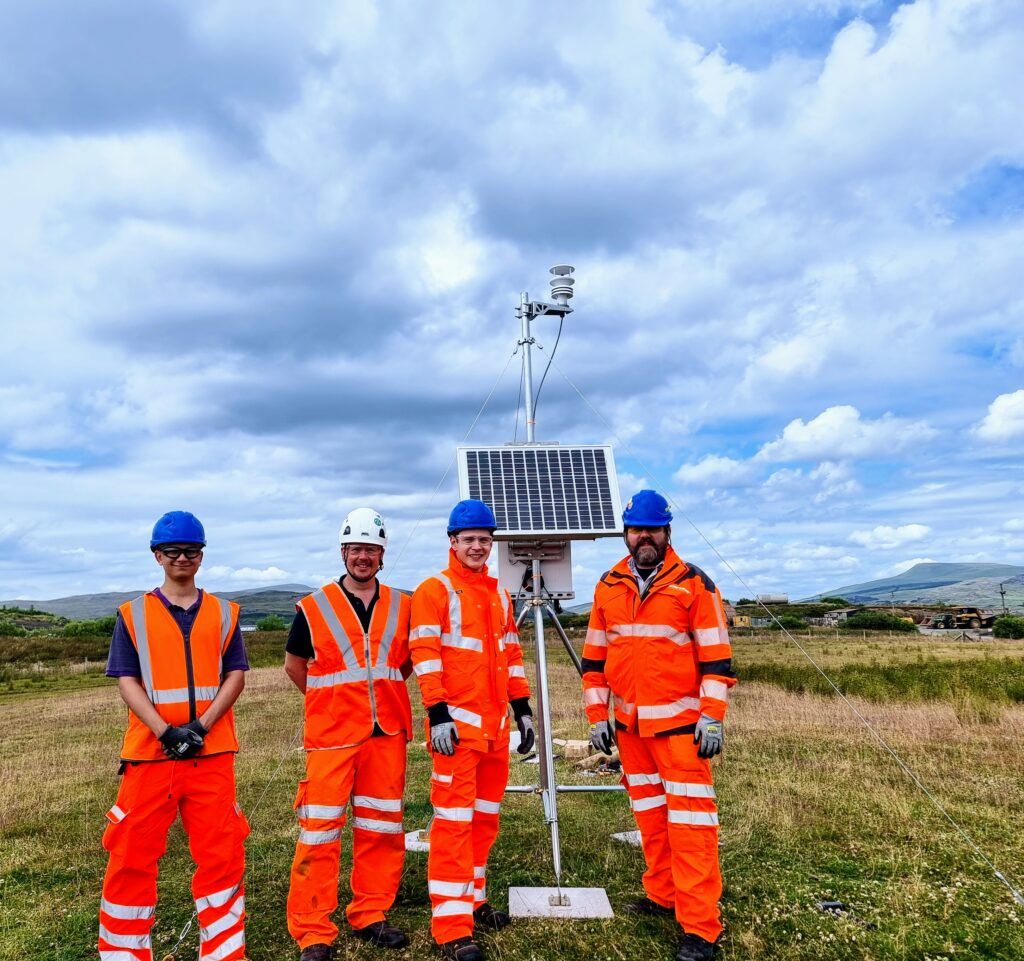
The company is testing these materials at the Global Centre of Rail Excellence test track in Wales, where the exposed mountaintop location provides a natural laboratory for extreme conditions.
Beyond overhead lines
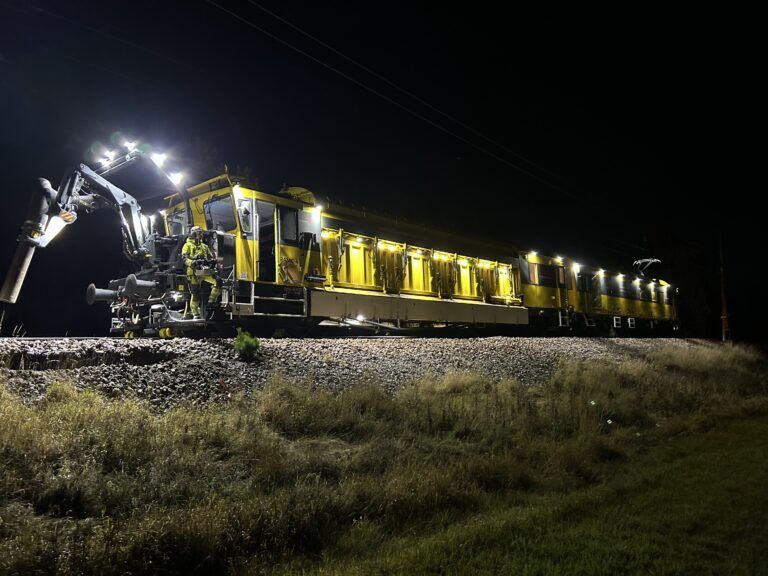
While overhead electrification equipment dominates the climate resilience conversation, other solutions are emerging. Railway maintenance contractor Railcare has developed high vacuum excavation technology that enables cables to be relocated below ground with minimal disruption to operations.
“As a railway maintenance contractor, innovator, and manufacturer of track bound high vacuum excavation machines, we see that there are several railway maintenance solutions that do not need to disrupt ongoing train traffic in order to make the railway more resilient to climate change,” explains Jonny Granlund, area business manager at Railcare.
Moving cables underground reduces weather-related damage while minimizing sabotage risks – an increasingly important consideration. The company’s method has accumulated over 250,000 documented operating hours, with tracks remaining fully operational immediately after installation.
The HS2 approach
As Britain’s first major new intercity line heading north from London in more than a century, HS2 offers a glimpse of what climate-resilient rail infrastructure looks like when designed from scratch.
HS2’s overhead power lines will be tensioned up to 10 kiloNewton meters tighter than on the conventional railway, with self-regulating counterweights positioned every 1,200 meters keeping wires at optimum tension. The system is designed to enable trains to maintain contact at speeds over 200mph, regardless of temperature.
Wind resilience, meanwhile, borrows from French engineering: HS2 will use an updated version of overhead power lines developed for the Lyon-Marseille high-speed line, designed to withstand prolonged wind speeds up to 87.5mph. On exposed sections such as viaducts, masts are placed closer together – between 45 and 72 meters apart – to distribute loads and enhance resilience.
Even cold weather considerations are built in. All HS2’s points will feature heating systems that activate automatically when temperatures drop, preventing the freezing that can bring conventional railways to a halt. Furthermore, sensors will be embedded throughout HS2’s infrastructure to continuously monitor performance and condition, enabling predictive maintenance rather than reactive repairs.
The road ahead
The consensus among experts is clear: railway infrastructure needs significant investment to cope with the climate of the future. “By the 2050s, we can expect heatwaves to reach 45°C in the UK, when only a few years ago, 40°C was unheard of,” warns Dolphin. “Currently, no one is planning for a 45°C summer, and the impact will be dreadful on UK infrastructure.”
The challenge is compounded by timing. Spring and autumn heatwaves can be particularly damaging when temperature ranges between day and night are greater. During the 2018 spring heatwave, temperatures were lower than summer peaks, yet there was still an 80% increase in asset failures on the UK rail network, Dolphin notes.
The industry is modernizing, introducing digital monitoring and predictive analytics. Furrer+Frey is working with Airbus and the UK Space Agency on projects using Earth observation satellite data for infrastructure monitoring, while Network Rail is testing similar systems to assess vegetation changes and embankment movement. However, as Dolphin notes, the UK is “still playing catch-up after decades of under-investment and fragmentation compared to more resilient countries.”
Arup’s Ridley sounds a note of optimism about longer-term alternatives. “As battery technology and rapid charging improve, there’s growing interest in alternatives to overhead electrification and conductor rails,” he says, suggesting that future-ready planning should remain flexible.
For network operators, Dolphin’s advice is straightforward: “Factor in future resilience; standards and specifications need to change now. Operators can also include monitoring when installing new equipment; doing this retrospectively is always expensive.”