

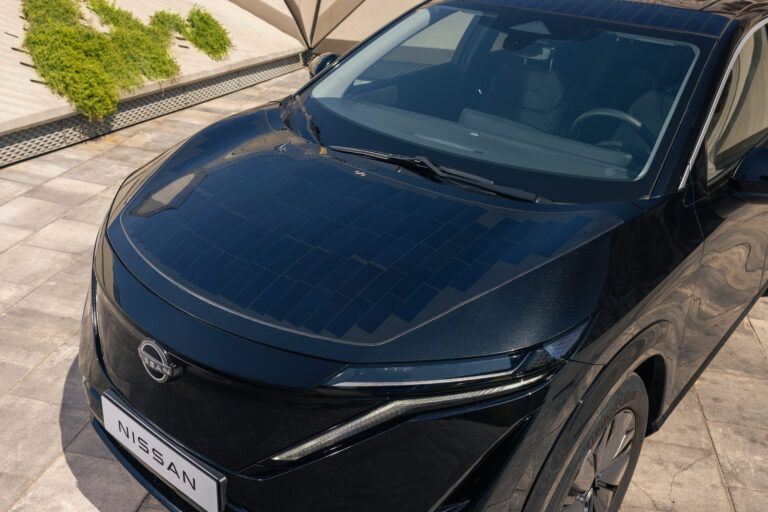
Nissan’s solar-powered Ariya concept integrates photovoltaic panels generating up to 14.3 miles daily range. Developed with Dutch firm Lightyear, the system could reduce charging frequency by 65 percent, supporting the automaker’s 2050 carbon neutrality goal through renewable energy integration.
Nissan has developed a solar-powered concept version of its Ariya EV that incorporates photovoltaic panels capable of generating additional driving range from sunlight. The prototype, revealed on Clean Energy Day, represents an engineering exploration into integrating renewable energy generation directly into EVs.
The concept vehicle features 3.8 square meters of high-efficiency photovoltaic panels embedded across the hood, roof, and tailgate. These polymer and glass-based solar panels convert sunlight into direct current power, which is managed through a controller system designed to optimize energy utilization and decrease dependence on conventional charging infrastructure.
Engineering teams from Nissan’s Advanced Product Planning division in Dubai and Powertrain Planning group in Barcelona collaborated on the development. The project also involved a partnership with Lightyear, a Dutch solar mobility technology company that provided the next-generation panel technology.
Real-world testing data indicates the system can generate up to 14.3 miles of additional range daily under optimal conditions. In Barcelona, a city with high solar exposure, the vehicle produces an average of 10.9 miles of solar-generated driving range per day. Year-round performance varies by location, with average daily solar range of 6.3 miles in London, 11.7 miles in New Delhi, and 13.2 kilometers in Dubai.
According to testing results, drivers could reduce charging frequency by up to 65 percent depending on usage patterns. During a two-hour, 50-mile journey, the system can produce 0.5 kilowatt-hours of energy, translating to approximately 1.8 miles of zero-emission range.
“The solar powered Ariya concept embodies Nissan’s belief that innovation and sustainability must move forward hand in hand,” said Shunsuke Shigemoto, Vice President ePowertrain and Internal Combustion Engine Powertrain, Technology Research and Advanced Engineering and Chief Powertrain Engineer at Nissan AMIEO. “By exploring how vehicles can generate their own renewable energy, we are opening the door to new opportunities for customers – greater freedom, reduced charging dependency, and a cleaner future. This concept is not just a technical milestone; it’s a vision of how Nissan intends to lead the next phase of electric mobility.”
The technology could prove particularly beneficial in regions with limited charging infrastructure, where extended intervals between charging sessions would increase vehicle practicality. The solar-powered Ariya concept aligns with Nissan’s stated goal of achieving carbon neutrality across its product life cycle and operations by 2050.